One Bedroom Apartment Rental Guide for Solo Working Professionals
Introduction
Renting a one-bedroom apartment can be an excellent fit for a solo working professional who wants more privacy, separation, and flexibility than a studio provides. The extra room can make everyday life feel more organized, especially when work, rest, exercise, cooking, and personal time all need their own space.
For professionals living in New York City, the decision usually comes down to more than square footage. Rent, commute time, neighborhood convenience, building quality, storage, and the apartment’s ability to support both workdays and weekends all matter.
A one-bedroom can create valuable separation between sleeping and living areas. That distinction may seem simple, but it can make a major difference for remote workers, hybrid professionals, and anyone who wants home to feel different from work.
The challenge is making sure the higher cost actually provides enough value. One-bedroom apartments usually require a larger housing budget than studios, so solo renters need to evaluate whether the extra privacy, storage, and flexibility justify the premium.
The strongest choice is not necessarily the newest apartment or the unit in the most prestigious neighborhood. It is the apartment that supports your routine without putting unnecessary pressure on your finances.
This guide explains how solo working professionals can evaluate one-bedroom apartments more carefully, starting with budget, location, layout, storage, comfort, and the features that matter most in everyday independent living.
Why One-Bedroom Apartments Appeal to Solo Working Professionals
The biggest advantage of a one-bedroom is separation.
Having a distinct bedroom allows the main living area to serve as a place for relaxing, working, eating, or entertaining without making the bed the visual center of the apartment.
This can improve the way the home feels at the beginning and end of the workday.
A professional who works from home may be able to set up a desk in the living room while keeping the bedroom reserved primarily for rest. That separation can make it easier to disconnect from work mentally.
Solo renters also gain privacy.
There is no need to share kitchens, bathrooms, or living areas with roommates, and daily routines can be managed entirely on your own schedule.
This independence can be particularly valuable for people with demanding or irregular working hours.
You can cook late, work early, host a guest, or keep the apartment arranged according to your own habits without needing to coordinate with another person.

Understanding the Difference Between a Studio and a One-Bedroom
The difference between a studio and a one-bedroom is not simply the presence of an extra wall.
The additional separation changes how the entire apartment functions.
In a studio, sleeping, working, and relaxing often happen in one main space. In a one-bedroom, the bedroom can remain private while the living room supports several other activities.
This becomes especially valuable for professionals who spend significant time at home.
The separate bedroom can also simplify entertaining.
Guests can remain in the living area without seeing the sleeping space or walking around personal belongings.
Storage may improve as well.
Some one-bedroom apartments provide additional closets, bedroom furniture space, or larger entry areas.
However, the extra room usually comes at a cost.
Renters should therefore compare the practical benefit against the monthly premium.
Calculating Whether the One-Bedroom Premium Is Worth It
Suppose a studio costs $2,700 per month and a comparable one-bedroom costs $3,100.
The difference is $400 each month.
Over twelve months, the one-bedroom costs $4,800 more before utilities or other expenses.
Ask what that $4,800 gives you.
If it provides enough space for a proper work area, more privacy, better storage, and a stronger separation between work and rest, the premium may make sense.
If the extra room remains mostly unused, the studio may provide better value.
The decision should reflect your actual routine.

Setting a Realistic Rental Budget Around Income and Career Goals
Solo renters carry the full housing cost themselves.
That makes budgeting especially important.
Start by identifying a monthly housing amount that fits comfortably alongside your other financial responsibilities.
Consider transportation, food, insurance, student loans, credit payments, savings goals, professional expenses, subscriptions, travel, and personal spending.
Do not let the apartment search define your maximum.
Listings can create budget creep quickly.
A slightly higher price may offer a better kitchen, then another increase adds laundry, and another adds a doorman.
Soon, the search may be hundreds of dollars above the amount you originally considered comfortable.
Set your limit before touring and increase it only if the broader financial picture still works.
Protecting Savings While Renting Alone
One-bedroom living should not eliminate your ability to save.
Financial breathing room is especially important for solo renters because there is no second household income to absorb unexpected costs.
Maintain an emergency reserve if possible.
Job changes, medical expenses, travel, technology replacement, moving costs, or other surprises can happen.
A beautiful apartment becomes stressful if every unexpected bill creates financial pressure.
The strongest rental budget supports both present comfort and long-term stability.

Balancing Housing Cost With Career Development
Working professionals often have goals beyond rent.
You may be saving for additional education, professional certifications, relocation, a future home purchase, travel, or retirement.
Housing should support those goals rather than consume all available income.
This does not mean choosing the cheapest apartment possible.
A good home can improve productivity, commute quality, sleep, and everyday comfort.
The goal is balance.
Spend enough to create a functional, comfortable living environment without allowing housing to limit every other financial priority.
Choosing the Right NYC Neighborhood for Work and Lifestyle
Neighborhood choice can influence both rent and quality of life.
A one-bedroom in a highly convenient area may cost more but save substantial time on commuting.
Another neighborhood may offer more space at a lower price while requiring a longer trip to work.
The right decision depends on how often you commute and where you spend your free time.
Walk through potential neighborhoods rather than evaluating them only on a map.
Look at transportation, grocery stores, cafés, restaurants, parks, gyms, pharmacies, and other destinations you use regularly.
Consider weekday mornings and evenings.
A neighborhood that feels ideal on a weekend afternoon may function differently during rush hour.
Choosing Neighborhood Convenience Over Prestige
Solo professionals sometimes feel pressure to live in a highly recognizable or fashionable area.
That can be worthwhile if the location genuinely supports your routine.
However, paying a substantial premium for reputation alone may provide limited everyday value.
A nearby neighborhood with strong transportation and useful services may offer a better apartment for the same budget.
Think about what you actually need from the area.
Convenient transit, groceries, quiet streets, nightlife, fitness options, or access to parks may matter more than the name of the neighborhood.
Location should improve your life rather than simply sound impressive.

Balancing Commute Time, Rent, and Apartment Quality
Commute time should be treated as a real cost.
A cheaper apartment may save money while requiring significantly more travel every workday.
A more expensive apartment may return several hours of personal time each week.
Neither option is automatically better.
The correct choice depends on the size of the rent difference and the amount of time saved.
A direct commute can be particularly valuable.
A slightly longer train ride with no transfers may feel easier than a shorter trip involving several connections.
Test the route when practical.
Door-to-door travel time matters more than distance alone.
Evaluating Hybrid Work Differently
Hybrid professionals should weigh commute value differently from daily office commuters.
If you travel to work only two or three times per week, saving a few minutes each way may not justify a large housing premium.
Interior comfort may become more important because you spend more working hours at home.
Space for a desk, natural light, quiet, and reliable internet can therefore compete directly with transportation convenience.
Your schedule should guide the tradeoff.
A professional commuting five days per week may prioritize location more heavily than someone working remotely most of the time.
Evaluating Bedroom Size, Living Room Function, and Overall Layout
A one-bedroom should provide more than a door between two spaces.
The bedroom should be large enough to support comfortable sleeping and reasonable storage.
A bed should fit without blocking closets or creating awkward pathways.
Think about nightstands, dressers, and other furniture you expect to use.
The living room should also support your normal routine.
Consider seating, a television, a desk, dining space, or any other activity that matters to you.
The most useful floor plans allow the living room to serve multiple purposes without becoming cluttered.
Avoid focusing only on total square footage.
A smaller unit with a good layout may function better than a larger apartment with wasted hallways or difficult room shapes.

Bedroom Privacy and Separation
Bedroom location can influence comfort.
A bedroom positioned away from the apartment entrance may feel more private.
Separation from the kitchen can reduce cooking noise and odors.
Distance from elevators, stairwells, trash rooms, or building mechanical areas may also matter.
Listen carefully during the tour.
The bedroom should feel like the quietest and most private part of the apartment whenever possible.
For a solo professional, this separation can make the home feel significantly more restorative after a demanding workday.

Living Room Flexibility
Living rooms often need to support several activities.
You may want a sofa, desk, dining table, bookshelf, entertainment setup, or exercise area.
Not every one-bedroom can accommodate all of these comfortably.
Before renting, decide which functions are essential.
A remote worker may prioritize a proper desk over a large dining table.
Someone who often hosts friends may prefer more seating.
A renter who exercises at home may need open floor space.
Design the room around your actual habits.
Storage, Closets, and Organization for Independent Living
Storage becomes more important when you live alone because you cannot divide household items between several bedrooms or roommates.
Inspect every closet.
Look at depth, width, shelves, hanging space, and overhead storage.
Entry closets can be especially useful.
Coats, shoes, luggage, cleaning equipment, and seasonal items all need somewhere to go.
Bedroom closets should accommodate clothing without requiring several additional wardrobes.
Kitchen storage matters too.
A solo renter who cooks regularly may still need substantial cabinet space for food, cookware, dishes, and small appliances.
Bathroom storage should not be ignored.
A vanity, medicine cabinet, or shelving can reduce countertop clutter.
Planning for Luggage and Seasonal Items
Working professionals often travel.
Suitcases can consume substantial storage space when not in use.
Look for under-bed storage, upper closet shelves, or larger utility closets.
Seasonal clothing creates a similar issue.
Winter coats, boots, bedding, and summer items rotate throughout the year.
A one-bedroom with strong built-in storage may provide more long-term value than a slightly larger apartment that requires bulky freestanding cabinets.
Built-in storage preserves usable floor area.

Kitchen and Bathroom Features Worth Inspecting Carefully
A solo professional may not need a huge kitchen, but functionality still matters.
Check counter space.
You need enough room to prepare meals comfortably without moving everything to the dining table.
Inspect cabinets.
Make sure storage matches the way you cook.
Look at refrigerator capacity, oven size, dishwasher availability, and ventilation.
A dishwasher can be particularly convenient for professionals who cook regularly but have limited time for household chores.
Bathrooms deserve equal attention.
Check storage, lighting, ventilation, water pressure, and overall condition.
A compact bathroom is fine when it works efficiently.
Poor storage or weak ventilation can become frustrating quickly.
Evaluating Kitchen Convenience for Busy Schedules
A functional kitchen can save both time and money.
Professionals who can prepare meals easily at home may rely less on frequent takeout.
Good counter space, practical storage, and a dishwasher can make cooking feel less burdensome after work.
Do not pay heavily for a designer kitchen if you rarely cook.
At the same time, do not underestimate the long-term value of basic functionality.
A simple, well-designed kitchen can provide more everyday benefit than expensive finishes.
Natural Light, Noise, and Workday Comfort
Natural light affects the atmosphere of both the living room and bedroom.
Bright apartments often feel more open and pleasant.
Remote and hybrid workers may value daylight especially highly because they spend more time inside during daytime hours.
Window orientation matters.
Some apartments receive strong morning light, while others become brighter later in the day.
Nearby buildings can block sunlight even when the apartment has large windows.
Visit during daylight when possible.
Noise should also be evaluated carefully.
Solo professionals need the apartment to support both concentration and rest.
Street Noise and Work Calls
Street activity can affect remote work.
Traffic, sirens, construction, nightlife, and commercial activity may be noticeable during calls or focused tasks.
Close the windows and listen.
Do not assume higher floors are always silent.
Sound can travel differently depending on building orientation and surrounding structures.
If you rely heavily on video calls, think about both audible noise and the location where your desk will sit.
A quiet work zone can add significant practical value.
Hallway and Neighbor Noise
Internal building noise may matter just as much as street noise.
Listen near the front door and bedroom walls.
Elevators, stair doors, trash rooms, and neighboring entrances can create repeated sound.
A one-bedroom provides some protection because the bedroom door adds separation from the main living area.
However, the location of the bedroom within the building still matters.
Quiet is one of the most valuable features for professionals who need reliable rest.
Climate Control and Everyday Comfort
Heating and cooling systems deserve attention before signing.
Ask how heating works.
Understand what cooling options are available and whether you control the temperature directly.
A professional schedule may mean arriving home late or working from home for extended periods.
Consistent indoor comfort matters.
Strong sunlight can also influence temperature.
A bright west-facing apartment may become warm during afternoon hours.
The ideal apartment should remain comfortable without requiring complicated workarounds.
Common Mistakes Solo Professionals Make When Renting Alone
One common mistake is stretching the budget because there is no roommate to negotiate with.
Solo renters can make quick emotional decisions because the apartment affects only them.
That freedom is useful, but it can also encourage unnecessary spending.
Another mistake is overpaying for amenities.
A gym, rooftop, lounge, doorman, and concierge may look appealing, but each feature should be evaluated according to actual usage.
Some professionals choose an apartment mainly for commute time and ignore how much time they spend at home.
Hybrid work can make this especially problematic.
Others prioritize interior space while ignoring transportation and neighborhood convenience.
The best decision balances both.
Avoiding Career-Based Lifestyle Inflation
Income growth can make higher rent feel easy to justify.
However, every salary increase does not need to become a housing upgrade.
Consider whether a more expensive apartment provides real value.
Additional privacy, a shorter commute, better storage, or a proper home office may be worthwhile.
Cosmetic upgrades may provide less benefit.
Protecting financial flexibility can be especially important during career growth because future opportunities may involve relocation or other changes.
Avoiding Over-Furnishing
One-bedroom apartments provide more space than studios, but they are still easy to overcrowd.
Do not buy furniture simply because a room appears empty.
Live in the apartment long enough to understand how you move through it.
A large dining table may be unnecessary.
An oversized sectional may reduce flexibility.
Choose pieces that support the way you actually live.
Open floor space can be just as valuable as furniture.
Comparing One-Bedroom Value With a Studio
Before signing, compare your preferred one-bedroom with realistic studio alternatives.
Calculate the annual rent difference.
Then ask what the separate bedroom changes.
Does it improve sleep?
Does it support remote work?
Does it provide essential storage?
Does it allow you to host guests comfortably?
If the answers are yes, the premium may provide strong value.
If the bedroom simply contains a bed while the rest of your routine remains identical, the studio may deserve another look.
Preparing for the Next Stage of the One-Bedroom Search
Choosing the right one-bedroom begins with budget, location, layout, storage, and comfort.
The apartment should support your workday without making every decision revolve around rent.
The bedroom should provide genuine separation.
The living area should support relaxing, working, and everyday household routines without becoming crowded.
The next stage is about making the apartment function even better.
Home-office planning, furniture choices, building amenities, laundry, package handling, privacy, security, utilities, cleaning routines, and guest management can all influence whether a one-bedroom feels genuinely worth the premium over a studio.
Those details determine whether the apartment simply gives you another room or becomes a more organized, comfortable, and sustainable home for independent professional life in New York City.
Creating a Functional Home Office in a One-Bedroom Apartment
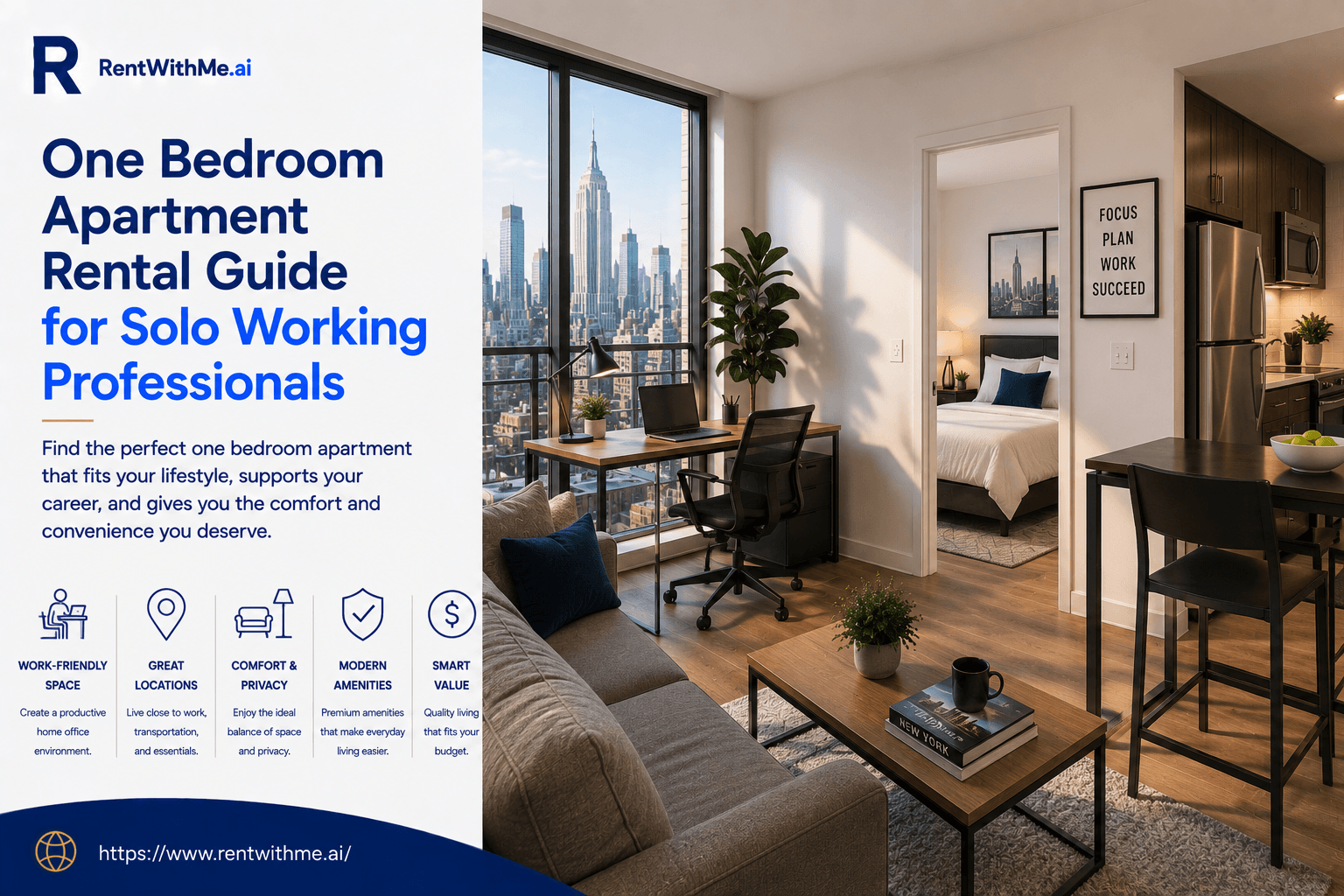
One of the biggest advantages of a one-bedroom apartment is the ability to create some separation between work and rest. For solo professionals, that separation can make the home feel more organized and reduce the sense that work is taking over every part of daily life.
The living room is usually the most practical location for a home office. A compact desk near a window, along an unused wall, or behind the sofa can create a functional work zone without sacrificing the rest of the room.
Think about lighting before choosing the desk location. Natural light is helpful, but direct glare on a screen can become uncomfortable during longer work sessions.
Electrical outlets matter too. A desk positioned far from power can lead to visible extension cords and an awkward setup.
Keep the work area proportional to how often you use it. A full-time remote professional may need a larger desk and better chair, while a hybrid worker may be comfortable with a smaller setup.
The goal is to create a workspace that supports productivity without making the apartment feel like an office.
Separating Work From Personal Time
Physical separation can improve mental separation.
If possible, avoid placing the desk in the bedroom. Keeping the bedroom focused primarily on sleep can make it easier to switch off after work.
At the end of the day, close the laptop and put away loose papers, chargers, and work materials.
A desk with drawers or nearby closed storage can help.
This small routine makes the living room feel less work-focused during the evening.
Remote professionals may also benefit from changing lighting after work. Turning off task lighting and using softer living-room lamps can create a clear shift between professional and personal time.
Choosing the Right Desk Size
A desk should support your equipment without overwhelming the room.
Measure your laptop, monitors, keyboard, and other essentials before choosing furniture.
If you use only a laptop, a narrow desk may be enough.
Professionals using several screens or specialized equipment need more surface area.
Consider depth as carefully as width.
A desk that is too deep can consume valuable walking space even when it fits along the wall.
Leave enough room for your chair to move comfortably without blocking the main pathway.
Furniture Planning Without Overcrowding the Living Area
A one-bedroom provides more flexibility than a studio, but the living room can still become crowded quickly.
Start with the largest pieces.
The sofa, desk, dining table, television setup, and storage furniture establish the room’s overall structure.
Avoid buying everything at once.
Live in the apartment long enough to understand the natural walking routes and which areas you actually use.
A smaller sofa may provide enough comfort while leaving more room for a desk.
A compact dining table may work better than a large table used only occasionally.
Choose furniture based on frequency of use rather than what traditionally belongs in a living room.
Creating a Flexible Living Room
The most useful living rooms support multiple activities.
A coffee table with storage can reduce clutter.
An extendable dining table can remain compact most of the time and expand when guests visit.
A lightweight side chair can move between the dining area and living room as needed.
Flexible furniture makes a one-bedroom easier to adapt without requiring constant rearrangement.
The goal is not to create a multipurpose showroom.
It is to make the room work naturally for your routine.
Dining Space for Solo Professionals
Solo renters often do not need a large formal dining area.
A small table that seats two or four may provide enough space for meals, occasional work, or hosting a friend.
Kitchen islands or breakfast bars can sometimes eliminate the need for a separate table.
Think realistically about how often you host meals.
If you eat at home frequently, a comfortable dining surface can encourage better routines.
If you rarely sit for formal meals, keeping more open floor space may be more valuable.
Choosing Amenities That Actually Support a Working Professional
Building amenities can add meaningful convenience when they match your schedule.
A gym may save travel time.
A resident lounge can provide a change of scenery for occasional work.
Package handling can make deliveries easier when you spend long days at the office.
Laundry access can reduce household chores.
The key is to evaluate amenities based on frequency.
A rooftop may be enjoyable, but a laundry room used every week probably affects daily life more.
A concierge may sound luxurious, but its value depends on whether you regularly use the service.
Prioritize practical amenities before decorative ones.
Evaluating Laundry Convenience
Laundry can become one of the most important apartment features for a busy professional.
In-unit laundry offers the greatest flexibility because you can wash clothes around your own schedule.
In-building laundry can still work well when the facility is clean, reliable, and easy to reach.
A laundromat may be practical if it is nearby and you wash infrequently.
Think about how often you need work clothes, gym clothing, bedding, and towels.
A professional with a demanding schedule may place more value on laundry convenience than someone with flexible hours.
Evaluating a Building Gym
A building gym can reduce both time and outside membership costs.
Before treating it as a major benefit, inspect the equipment.
Make sure the gym supports the workouts you actually do.
Check operating hours and peak-time crowding.
A beautiful gym provides little value if you can rarely access the equipment you need.
Also compare the building gym with nearby alternatives.
A commercial gym within a short walk may offer much better equipment for a reasonable price.
Package Handling for Busy Schedules
Package management can be surprisingly important for working professionals.
If you are away from home most of the day, reliable delivery handling reduces missed packages and repeated pickup trips.
Ask how the building receives and stores deliveries.
Some properties use lockers, staffed package rooms, or digital notifications.
Understand what happens with oversized boxes or refrigerated deliveries.
A good package system can save small amounts of time repeatedly throughout the year.
Doorman and Concierge Convenience
A doorman or concierge can provide additional convenience with visitors, deliveries, and building access.
This may be especially valuable for professionals who travel or have unpredictable schedules.
However, staffed service can contribute to higher rent.
Decide whether the convenience justifies the premium.
A well-managed non-doorman building may provide excellent value for someone who does not need frequent assistance.
Luxury-style service should be treated as an optional benefit rather than a universal requirement.
Privacy, Security, and Building Access for Solo Renters
Living alone makes building access particularly important.
Check how residents enter the property.
Key fobs, intercoms, staffed entrances, controlled elevators, and other systems can contribute to a more organized access process.
Look at lighting around the entrance and common areas.
Hallways, elevators, stairways, and mail areas should feel well maintained.
Ask how visitors enter.
A good system should allow normal guest access without compromising resident privacy.
Security features cannot eliminate all risk, but thoughtful building management can improve everyday comfort.
Evaluating Apartment Door and Lock Quality
The apartment entrance deserves attention during the tour.
Open and close the door.
Make sure it latches properly.
Check the lock and any additional security hardware.
If anything appears damaged or difficult to operate, ask whether it will be addressed before move-in.
A professionally maintained entrance is a basic part of apartment quality.
Understanding Utilities, Fees, and Total Monthly Housing Costs
Base rent should never be the only number in your budget.
Utilities, internet, laundry, parking, storage, amenity charges, and other recurring costs can materially change what the apartment actually costs.
Ask which utilities are included.
Heating, water, gas, electricity, and other services may be structured differently between properties.
Internet costs should be included as well, especially for professionals who work from home.
If the building charges mandatory amenity fees, include them in your monthly total.
A one-bedroom that appears affordable may become much more expensive after recurring charges are added.
Creating a Complete Monthly Housing Budget
A simple cost comparison can prevent surprises.
| Cost Category | Estimated Monthly Amount |
|---|---|
| Rent | |
| Electricity | |
| Internet | |
| Laundry | |
| Transportation | |
| Parking or storage | |
| Required amenity fees | |
| Other recurring housing costs | |
| Total estimate |
The goal is not perfect forecasting.
Reasonable estimates are enough to compare apartments more accurately.
Evaluating Rent Premiums Annually
A small monthly difference can become significant over a year.
A $150 premium becomes $1,800 annually.
A $300 difference becomes $3,600.
When one apartment costs more, ask what the annual premium provides.
Perhaps it gives you a much shorter commute.
Maybe it includes in-unit laundry and eliminates another expense.
If the difference buys only cosmetic upgrades, the higher price may be harder to justify.
Annual thinking makes tradeoffs clearer.
Managing Cleaning, Groceries, and Household Routines Efficiently
Living alone means every household task belongs to you.
A one-bedroom is still relatively easy to maintain, but routines help prevent chores from accumulating.
Cleaning a little throughout the week can be more manageable than spending an entire weekend catching up.
Keep cleaning supplies organized.
A small utility closet or designated storage area can make household maintenance easier.
Groceries deserve planning too.
A convenient supermarket near the apartment can reduce travel time and make meal preparation easier.
Neighborhood convenience therefore affects household efficiency as much as the apartment itself.
Creating a Simple Weekly Cleaning Routine
A basic routine can keep the apartment comfortable without consuming too much time.
You might handle kitchen surfaces and trash regularly, clean the bathroom once per week, and vacuum or sweep based on usage.
Laundry can be scheduled around work rather than allowed to accumulate.
The specific routine matters less than consistency.
Small regular tasks are easier to manage than major cleaning sessions.
Grocery Access and Meal Planning
Working professionals often spend more on food when grocery shopping is inconvenient.
If the apartment is close to a reasonably priced supermarket, preparing meals at home becomes easier.
Look at the route between work, transportation, and the grocery store.
A store located along your commute may provide more practical value than one located in the opposite direction.
Meal planning can also reduce expensive last-minute takeout.
A functional kitchen and convenient grocery access can therefore support both time and financial goals.
Hosting Guests Without Sacrificing Everyday Comfort
A one-bedroom gives solo renters more flexibility when friends or family visit.
The bedroom can remain private while the living room serves as the main social space.
You do not need to design the apartment around occasional visitors.
A sofa, small dining table, and a few flexible seating options may be enough.
If overnight guests are common, consider whether a sleeper sofa or other temporary sleeping solution makes sense.
Avoid purchasing oversized guest furniture that reduces your everyday comfort.
Your normal routine should remain the priority.
Creating Privacy When Guests Stay Overnight
A separate bedroom provides a clear advantage over a studio.
You can maintain personal privacy while a guest uses the living room.
Make sure bathroom access is practical.
Guests should not need to walk through your bedroom to reach it.
This layout consideration can matter more for renters who host family or friends regularly.
Evaluating Noise From Building Amenities
Amenities can create noise as well as convenience.
An apartment next to a gym may experience early-morning activity.
A unit near a lounge can receive more hallway traffic.
Rooftop access may generate noise on upper floors.
Ask where major shared spaces are located relative to the specific apartment.
Do not assume that a premium building is automatically quiet.
Unit position matters.
Evaluating Elevator and Hallway Traffic
Solo professionals often keep predictable schedules, which can make building congestion noticeable.
A large building may have busy elevators during commuting hours.
Ask how many elevators serve the property.
Observe wait times if possible.
Hallway location also matters.
A unit beside the elevator may be convenient but experience more foot traffic.
An apartment farther down the corridor may feel quieter.
Balance convenience with privacy.
Questions to Ask During a One-Bedroom Apartment Tour
A detailed tour helps reveal whether a one-bedroom will support both professional and personal life.
Useful questions include:
- Which utilities are included?
- What is the total monthly rent?
- Are there required amenity fees?
- What internet providers serve the building?
- How is heating controlled?
- What cooling options are available?
- Is laundry in-unit or shared?
- How are maintenance requests submitted?
- How are packages handled?
- Is there a doorman or concierge?
- What are the building’s guest policies?
- Are there building quiet hours?
- Where are elevators and stairwells located?
- Is the apartment near a gym, lounge, trash room, or mechanical area?
- Is storage available?
- What parking options exist if needed?
- Are pets permitted?
- Are wall-mounted shelves or televisions allowed?
- Are there move-in scheduling requirements?
- What lease terms should I review carefully?
These questions help turn the tour into a realistic evaluation rather than a quick visual impression.
Testing the Home Office During the Tour
Stand where you think the desk would go.
Look at the nearest electrical outlets.
Check natural light.
Listen for street and hallway noise.
Imagine video calls.
Consider what would appear behind you on camera if that matters for work.
Check whether a chair would block the walking path.
A small test can reveal whether the workspace is practical.
Testing the Bedroom for Rest
The bedroom should feel separated from work and activity.
Close the door during the tour.
Listen.
Check light levels.
Look at closet access.
Imagine the bed in place.
Make sure the room does not become too tight once basic furniture is added.
A comfortable bedroom is one of the strongest reasons to pay more for a one-bedroom rather than a studio.
Testing the Evening Routine
Imagine returning home after a long day.
Where will you put your bag and coat?
Is the kitchen convenient for preparing dinner?
Can you relax in the living room without seeing work clutter everywhere?
Is the bedroom quiet enough for rest?
These ordinary scenarios reveal more than staged apartment photos.
The strongest rental is one that makes routine life easier.
Evaluating a One-Bedroom for Hybrid Work
Hybrid professionals need an apartment that supports two different lifestyles.
On office days, commute convenience may matter most.
On remote days, quiet and workspace quality become more important.
A balanced one-bedroom can support both.
You may accept a slightly longer commute if the apartment provides an excellent home-office setup.
Alternatively, a central location may justify a smaller living room when office attendance is frequent.
The correct balance depends on how many days you spend in each environment.
Evaluating a One-Bedroom for Full-Time Office Workers
Professionals who leave home every weekday may place more emphasis on location.
A shorter commute can return significant personal time.
The apartment still needs to be comfortable, but a large home-office area may be unnecessary.
Instead, prioritize bedroom comfort, kitchen function, storage, laundry, and evening convenience.
Amenities that support mornings and evenings may provide more value than coworking spaces.
Evaluating a One-Bedroom for Full-Time Remote Professionals
Full-time remote workers should treat the apartment as both housing and workspace.
Interior quality becomes extremely important.
Noise, natural light, temperature, internet reliability, and desk placement deserve substantial weight.
A slightly larger living room may be worth paying more for.
Building lounges or coworking spaces can add flexibility, but they should not be necessary for basic productivity.
Your apartment should remain a functional workplace even when shared amenities are unavailable.
Managing Work Equipment Without Creating Clutter
Professional equipment can accumulate.
Monitors, chargers, notebooks, headphones, printers, and other items need storage.
Keep cables organized.
Use drawers or cabinets where possible.
Avoid spreading work items across the dining table and sofa.
A contained work zone helps preserve the apartment’s residential atmosphere.
This becomes especially important when you live alone because there is no separate household area to absorb the clutter.
Choosing Building Amenities Based on Career Lifestyle
Different professionals value different features.
A consultant who travels frequently may prioritize package handling and security.
A remote worker may value a lounge and fitness center.
A professional with long office hours may care most about laundry and a doorman.
A driver may prioritize parking.
Choose buildings whose amenities solve recurring problems in your actual routine.
Avoid paying extra for a long amenity list that does not fit your lifestyle.
Avoiding the Trap of Paying for Prestige
Some solo professionals feel pressure to choose a building or neighborhood that reflects career success.
That can lead to unnecessary housing costs.
Your apartment should support your goals rather than become proof of them.
A well-located, comfortable one-bedroom in a simpler building may provide more value than a highly branded luxury property.
Financial flexibility can create its own form of independence.
Comparing a Simpler Apartment With a Full-Service Building
A simpler building may provide lower rent and a larger apartment.
A full-service property may offer convenience through staff, amenities, package systems, and newer finishes.
Compare the value of those services with the price difference.
If you use them frequently, the premium may be reasonable.
If not, keep the savings.
There is no universal definition of the right professional apartment.
Planning for Career Changes
A one-bedroom lease may overlap with changes in your professional life.
You might change jobs, begin working remotely, commute to a different neighborhood, or travel more frequently.
A flexible apartment can adapt better.
Strong transportation access may protect against job-location changes.
A usable desk area can support future remote work.
Good storage can accommodate changing routines.
You do not need to predict the future perfectly, but some flexibility creates long-term value.
Planning for Personal Changes
Professional life is not the only thing that may change.
A partner may spend more time at the apartment.
You may adopt a pet.
You may begin hosting family more often.
You could develop a hobby that needs space.
Do not rent extra square footage for every hypothetical possibility.
Instead, look for a layout that can adapt without becoming unusable.
Flexible rooms and good storage are particularly valuable.
Comparing Total Value Before Signing
Before choosing a one-bedroom, compare the complete package.
Look at rent, commute, apartment layout, storage, work setup, building services, neighborhood convenience, and recurring expenses.
Then rank the features according to how often you will use them.
A shorter commute used ten times each week may deserve more weight than a rooftop used once per month.
In-unit laundry may save more time than premium finishes.
A quiet bedroom may matter more than a larger lobby.
Total value becomes clearer when you focus on recurring benefits.
Preparing for the Final One-Bedroom Apartment Decision
By this stage, the one-bedroom should be evaluated as a complete independent-living system.
The bedroom should provide real privacy and rest.
The living room should support relaxing, working, dining, and occasional guests without becoming overcrowded.
Building amenities should improve your routine rather than simply raise the rent.
Utilities and fees should fit comfortably within your monthly budget.
Security, package handling, laundry, and maintenance should support the reality of living alone.
The final step is to apply these ideas to realistic professional lifestyles, answer common renter questions, build a complete one-bedroom checklist, identify mistakes that can make solo renting unnecessarily expensive, and determine whether the apartment provides enough long-term value to support both your career and your personal life.
Real-Life One-Bedroom Apartment Examples for Different Working Professionals
A one-bedroom apartment can provide very different kinds of value depending on a professional’s schedule, commute, income priorities, and time spent at home. Looking at realistic renter situations can make it easier to understand why the best apartment is not necessarily the largest, newest, or most expensive option.
The key is matching housing decisions to everyday routines. A feature that dramatically improves life for a remote worker may offer limited value to someone who spends five days each week in an office.
The Office Professional Who Prioritizes a Shorter Commute
Marcus works in Manhattan five days a week and usually leaves home early in the morning. When comparing apartments, he found a spacious one-bedroom with attractive finishes at a lower monthly rent, but the commute required multiple transfers.
Another apartment was smaller and cost slightly more. However, it offered a much more direct route to work and was within walking distance of groceries, a gym, and several places Marcus regularly visited after work.
Marcus calculated how frequently he would make the commute throughout the year. The convenience suddenly seemed much more valuable than the additional square footage available in the cheaper apartment.
He chose the smaller one-bedroom.
For Marcus, the apartment’s greatest advantage was not what happened inside the unit. It was the amount of time the location returned to him every week.
The Hybrid Professional Who Prioritizes Balance
Priya works from home three days each week and commutes to an office on the other two. She originally focused heavily on finding an apartment close to work.
As she compared options, she realized that she would spend far more waking hours inside her apartment than commuting. A slightly longer trip to the office became reasonable if it provided a significantly better home environment.
She chose a one-bedroom with a living room large enough for a dedicated desk near a window.
The apartment was also relatively quiet during the daytime.
Her bedroom remained completely separate from the workspace, allowing her to close the laptop at the end of the day and leave work behind in another room.
The arrangement provided the balance she needed between professional productivity and personal comfort.
The Remote Professional Who Pays More for Interior Quality
James works remotely full time.
During his search, he found several inexpensive one-bedroom apartments in convenient neighborhoods. Unfortunately, some had dark living rooms, limited electrical outlets, substantial street noise, or layouts that made desk placement difficult.
James eventually selected a slightly more expensive apartment with excellent natural light and a quiet living room.
The higher rent initially seemed difficult to justify.
Then he considered that the apartment would serve as his workplace roughly eight hours per weekday.
The better environment was not simply a housing upgrade. It directly affected a place where he would spend a significant percentage of his working life.
For a full-time remote professional, that additional value made the premium reasonable.
The Frequent Traveler Who Prioritizes Building Convenience
Elena travels regularly for work and may be away from New York for several days at a time.
A large apartment was not particularly important to her.
Instead, she prioritized reliable package handling, controlled building access, convenient transportation, and a manageable apartment that did not require extensive maintenance.
She chose a moderately sized one-bedroom in a building with organized delivery procedures.
The apartment gave her enough storage for luggage and professional clothing without requiring her to pay for space she rarely used.
Her example demonstrates why building operations can sometimes matter as much as apartment size.
The Professional Focused on Financial Flexibility
David qualified for several luxury apartments but wanted to maintain a high savings rate.
Instead of selecting the most expensive apartment available within his income range, he established a housing budget based on his broader financial goals.
He chose a comfortable one-bedroom in a simpler building.
It did not have a rooftop, resident lounge, or elaborate fitness center.
However, it offered a practical layout, convenient transportation, useful storage, and a comfortable bedroom.
The lower monthly cost allowed David to continue saving toward longer-term goals without sacrificing the independence of living alone.
His decision reflects an important principle for solo professionals. The amount you qualify to spend and the amount that supports your goals are not necessarily the same.
Frequently Asked Questions About Renting a One-Bedroom Alone
Solo renters often face questions that differ from those of couples, families, or roommates. The full financial responsibility belongs to one person, but so does the freedom to prioritize exactly what matters most.
Understanding the most common considerations can make the search more deliberate.
Is a one-bedroom apartment worth it for one person?
It can be.
A separate bedroom provides privacy, better separation between activities, and greater flexibility than a studio.
The additional cost makes the most sense when you regularly benefit from the extra room.
Remote workers, frequent hosts, people with substantial belongings, and renters who strongly value separation between sleep and living areas may find a one-bedroom particularly worthwhile.
Should a solo renter choose a studio instead?
A studio can provide better value when reducing housing costs is a major priority.
It may also make sense for professionals who spend little time at home or prefer putting more of their budget toward location.
Compare actual apartments rather than apartment categories.
An excellent studio may be preferable to a poorly designed one-bedroom.
How important is a separate bedroom for remote work?
A separate bedroom can be extremely useful because it allows work to remain outside the sleeping area.
The living room can support a desk while the bedroom remains focused on rest.
This arrangement does not guarantee work-life balance, but it creates helpful physical separation.
For someone working from home five days each week, that distinction may justify a meaningful portion of the one-bedroom premium.
Should I put my home office in the bedroom?
Usually, another area is preferable when the layout allows it.
Keeping work equipment in the living room can preserve the bedroom as a quieter personal space.
However, every apartment is different.
If the bedroom has substantially better light, enough extra space, and a layout that allows some separation between the desk and bed, it may still function well.
Prioritize comfort and productivity over rigid design rules.
How much storage does one person need?
Storage needs depend more on lifestyle than household size.
A professional with extensive work clothing, sports equipment, luggage, seasonal belongings, or hobbies may require more storage than a couple with a minimalist lifestyle.
Inspect closets carefully before renting.
Built-in storage is particularly valuable because it reduces the need for freestanding wardrobes and cabinets.
Is in-unit laundry worth paying more for?
For some professionals, yes.
In-unit laundry can save time and make it easier to handle clothing around unpredictable work schedules.
The value depends on the premium.
If an otherwise comparable apartment costs significantly more solely because of laundry, calculate the annual difference before deciding.
Convenience has value, but that value should remain proportional to the cost.
Is a doorman necessary when living alone?
No.
Many solo renters live comfortably in buildings without staffed entrances.
A doorman can provide convenience for visitors, deliveries, and certain building operations, but good access systems and responsive management can also support a well-run property.
Evaluate the complete building rather than treating one feature as essential.
Should I choose a larger apartment farther from work?
That depends on how often you commute and how much you value interior space.
Daily office commuters may benefit significantly from a shorter journey.
Remote and hybrid workers may gain more from additional interior comfort.
Calculate the time difference over an entire week rather than focusing on a single trip.
Then compare that time with the rent and space differences.
How much should I care about building amenities?
Care about the amenities you will actually use.
A gym used four times per week can provide meaningful value.
A rooftop visited twice during the entire lease provides much less.
Evaluate amenities according to frequency, convenience, and whether they replace expenses you would otherwise pay elsewhere.
Is a luxury one-bedroom a good career investment?
Housing is primarily a lifestyle and financial decision rather than a professional status requirement.
A comfortable apartment may improve rest, productivity, and everyday satisfaction.
However, paying substantially more for prestige alone does not necessarily improve your career.
Choose housing that supports professional life without allowing appearances to determine the budget.
Complete One-Bedroom Apartment Evaluation Checklist
A consistent checklist helps solo professionals compare apartments objectively. It can prevent attractive finishes or an impressive building lobby from distracting from practical issues that will affect everyday life.
Use the following points during your search:
- Confirm the monthly rent and lease term.
- Identify all mandatory recurring fees.
- Estimate electricity, internet, laundry, and other housing costs.
- Compare the total cost with your comfortable monthly budget.
- Calculate major rent differences annually.
- Test the commute during realistic travel hours when possible.
- Check access to subway, bus, or other transportation options you use.
- Evaluate grocery stores and everyday services nearby.
- Consider how the neighborhood fits your weekend routine.
- Review the overall floor plan rather than square footage alone.
- Confirm that the bedroom comfortably fits your essential furniture.
- Check bedroom closet capacity.
- Identify practical living-room furniture locations.
- Determine where a home-office desk could go.
- Inspect electrical outlet locations near the proposed workspace.
- Consider natural light for both work and relaxation.
- Listen for street, hallway, elevator, and neighboring-unit noise.
- Inspect kitchen counter and cabinet space.
- Check the size and condition of major appliances.
- Evaluate bathroom storage and ventilation.
- Understand heating and cooling arrangements.
- Check internet provider availability.
- Review laundry options and costs.
- Understand package delivery procedures.
- Inspect building access systems.
- Note the location of elevators, stairways, trash rooms, and amenities.
- Review guest policies when relevant.
- Ask about maintenance request procedures.
- Confirm pet policies if you have or plan to have a pet.
- Ask about available storage if needed.
- Review move-in requirements and applicable charges.
- Determine which amenities are included and which require additional payment.
- Read the lease carefully before committing.
- Compare the apartment with realistic studio and one-bedroom alternatives.
- Decide whether the property supports your normal weekday routine.
- Consider whether the apartment leaves enough room for savings and other financial goals.
A checklist should support judgment rather than replace it. Once the essential facts are collected, consider how each apartment would actually feel during an ordinary week.
Expert Tips for Balancing Comfort, Career, and Housing Costs
Working professionals sometimes approach apartment hunting as though they must choose between a comfortable lifestyle and responsible finances.
The better goal is to find the point where the two support each other.
A strategically chosen apartment can save time, support better routines, provide privacy, and create an environment where you can recover from demanding workdays.
At the same time, excessive housing costs can create financial pressure that undermines those benefits.
Spend More on Features You Use Frequently
Frequency is one of the easiest ways to evaluate apartment value.
A quiet bedroom affects you every night.
A good commute affects every office day.
A functional home office affects every remote workday.
Convenient laundry affects you regularly.
These features often deserve more weight than amenities used occasionally.
When comparing two apartments, ask which differences will affect the greatest number of days during the lease.
That question can simplify complicated decisions.
Value Time Alongside Money
Rent is measurable, but time is easy to overlook.
Suppose one apartment saves 30 minutes of commuting each workday.
For someone commuting five days per week, that difference becomes several hours every month.
A higher rent may be reasonable when the time savings are substantial and the budget remains comfortable.
However, avoid assigning unlimited financial value to convenience.
The goal is to recognize time as part of the calculation, not use it to justify any price.
Protect Your Ability to Handle Change
Careers can change quickly.
A new employer may be located elsewhere.
Remote-work policies may change.
You may decide to pursue additional education, travel more, or relocate.
Avoid housing costs that leave no room for flexibility.
A sustainable apartment provides comfort today without making future decisions unnecessarily difficult.
Pay for Function Before Finishes
Renovated finishes can make an apartment attractive during a tour.
However, functional improvements usually matter more over an entire lease.
Good storage can be more valuable than fashionable cabinets.
Quiet can matter more than decorative lighting.
A practical floor plan may outperform expensive flooring.
A short commute can matter more than an impressive lobby.
Prioritize the features that continue providing value after the excitement of moving fades.
Common One-Bedroom Rental Mistakes to Avoid
Solo professionals often have considerable control over their housing decisions. Without roommates or partners involved, choices can happen quickly.
That independence makes it particularly important to maintain a disciplined evaluation process.
Stretching the Budget for Lifestyle Image
A promotion or salary increase can make a luxury apartment feel like the natural next step.
There is nothing wrong with spending more on housing when the benefits matter to you.
Problems begin when rent increases primarily because the apartment seems appropriate for a certain professional image.
Your home should support your life rather than demonstrate your income.
An apartment that preserves savings and flexibility can be a stronger long-term choice than one selected for appearance.
Ignoring Total Monthly Costs
Rent is only part of the housing budget.
Electricity, internet, laundry, transportation, amenity fees, storage, parking, and other recurring expenses can change the comparison substantially.
Estimate the complete monthly amount.
A lower-rent apartment with an expensive commute may not be as affordable as it appears.
A higher-rent apartment with included services may be more competitive than the advertised price suggests.
Choosing an Apartment for Occasional Guests
A solo renter may use the apartment alone almost every day.
Do not sacrifice everyday functionality to accommodate visitors who stay only a few times per year.
Flexible guest solutions are usually enough.
A sleeper sofa, temporary mattress, or nearby accommodation may be more practical than paying continuously for unnecessary space.
Design your home around your normal routine first.
Underestimating Work-From-Home Needs
A small desk may seem sufficient during the tour.
After several months of remote work, poor lighting, an uncomfortable chair, or constant background noise can become significant problems.
If remote work is a regular part of your career, treat workspace quality as an essential housing feature.
Test it during the apartment tour.
Do not assume you will solve every problem after moving.
Buying Too Much Furniture Immediately
Empty rooms can create pressure to furnish quickly.
Resist it.
Move in with essential pieces and learn how you actually use the apartment.
You may discover that a planned dining table is unnecessary or that additional storage would be more useful than another chair.
Gradual furnishing can reduce costs and improve the final layout.
Additional Ways to Improve Daily Function and Reduce Living Costs
A one-bedroom gives solo renters enough space to live comfortably without requiring the maintenance of a much larger home. Thoughtful routines can make that space even more efficient.
Start with purchases.
Avoid duplicating household products simply because storage exists.
A larger apartment can gradually fill with belongings that provide little practical value.
Keep frequently used items accessible and periodically review possessions that occupy closets without being used.
This maintains flexibility if your lifestyle changes.
Use the Bedroom Primarily for Rest
A separate bedroom is one of the features you are paying for.
Use that separation intentionally.
When possible, keep major work equipment outside the bedroom.
Avoid allowing unopened packages, laundry, and general storage to accumulate around the bed.
A calmer bedroom can improve the sense that the apartment contains distinct areas for different parts of life.
Build an Efficient Morning Routine
Apartment layout can influence how smoothly mornings unfold.
Keep work essentials near the entry area.
Organize clothing so frequently used professional items are easy to reach.
Store breakfast and coffee supplies conveniently.
These small choices reduce unnecessary movement and decision-making before work.
A functional apartment supports routines rather than creating friction.
Make Evening Resetting a Habit
Spend a few minutes returning the apartment to order at the end of the day.
Put work equipment away.
Clear the kitchen.
Return clothing and bags to their designated locations.
This prevents small amounts of clutter from building into weekend chores.
For a solo renter, the advantage is that your organizational system never needs to accommodate someone else’s habits.
Use Your Kitchen to Control Food Spending
Takeout can become one of the easiest expenses to increase during demanding work periods.
A functional kitchen makes alternatives easier.
Keep simple ingredients available for quick meals.
Use the refrigerator and freezer strategically rather than buying food without a plan.
The objective is not to cook every meal.
Even replacing some convenience purchases with easy home meals can create meaningful savings across a year.
Evaluate Subscriptions Connected to the Apartment
Housing can indirectly encourage duplicate spending.
A building may include a gym while you continue paying for another membership.
A coworking lounge may reduce the need for occasional external workspace.
Included internet or other services may replace separate subscriptions.
Review these expenses after moving.
If the building provides something useful, take advantage of the value you are already paying for through rent or fees.
Maintaining a One-Bedroom With a Demanding Work Schedule
A one-bedroom is relatively manageable, but chores can still accumulate during busy periods.
Create routines that require minimal planning.
Handle small cleaning tasks throughout the week.
Keep supplies near where they are used.
Avoid owning more cleaning products than necessary.
If you decide to pay for professional cleaning occasionally, include that expense in your broader housing budget.
Time-saving services can have legitimate value, but they should be evaluated like any other recurring expense.
Planning for Professional Travel
Frequent travelers should think about the apartment differently.
Package handling becomes more important.
So does the ability to secure windows and doors confidently before leaving.
Keep travel essentials organized so packing does not disrupt the entire apartment.
A dedicated luggage location is useful.
If you are away frequently, reconsider how much apartment space you actually need.
Paying for a large home that remains empty much of the month may provide limited value.
Creating Space for Exercise at Home
Not every professional wants a building gym.
Some prefer short workouts inside the apartment.
A living room with enough open floor area for a yoga mat or basic exercise routine can be useful.
Avoid purchasing large fitness equipment unless you know you will use it consistently.
A treadmill or exercise bike can dominate a smaller living room.
Compare the cost and space requirements with nearby gym options before committing.
Planning for Career Growth Without Automatic Housing Inflation
Career advancement can improve your housing choices, but it does not require immediate lifestyle expansion.
If income rises, you may choose to direct part of that increase toward savings or investments rather than rent.
Upgrade housing when the new apartment solves a meaningful problem.
Perhaps you need a better workspace.
Maybe a shorter commute has become more valuable.
You may need additional storage or prefer a building with better services.
Purposeful upgrades generally provide more satisfaction than increasing housing costs simply because you can.
Knowing When a One-Bedroom Is No Longer Enough
A one-bedroom can support a solo professional for many years.
However, circumstances change.
A partner may move in.
You may need a permanent dedicated office.
A growing hobby may require more room.
Long-term guests or changing family responsibilities can alter your space requirements.
Evaluate these needs when they become real rather than renting excessive space years in advance.
The right apartment should match your current life while providing reasonable flexibility.
Knowing When a One-Bedroom Is More Than You Need
The opposite can happen too.
A professional who travels constantly or spends very little time at home may realize that the separate bedroom provides less value than expected.
A well-designed studio could potentially reduce expenses without meaningfully reducing quality of life.
There is no rule that housing must become larger over time.
Downsizing can be a strategic decision.
The objective is to pay for the amount and type of space that supports your lifestyle.
Evaluating Your Apartment Before Lease Renewal
Lease renewal provides an opportunity to reassess the decision with real experience.
Ask how well the apartment supported your previous year.
Did the commute work?
Was the bedroom quiet?
Did you have enough storage?
Was the home office comfortable?
Did you actually use the amenities?
Were maintenance requests handled effectively?
Then evaluate the proposed rent.
An apartment that represented excellent value at the original price may become less competitive after a significant increase.
Compare alternatives before automatically renewing.
Moving has costs too, so include those when evaluating whether another apartment truly offers better value.
Comparing Final One-Bedroom Options
When you reach the final stage of the search, create a simple comparison based on your highest priorities.
| Factor | Apartment A | Apartment B | Apartment C |
|---|---|---|---|
| Total monthly housing cost | |||
| Commute | |||
| Bedroom comfort | |||
| Home-office potential | |||
| Storage | |||
| Natural light | |||
| Noise | |||
| Laundry convenience | |||
| Building services | |||
| Neighborhood convenience | |||
| Overall value |
Do not automatically select the apartment that wins the most categories. Some factors deserve much more weight than others based on your routine.
For example, a full-time remote worker may place exceptional importance on quiet and workspace quality. A daily commuter may give much more weight to transportation.
Final Advice Before Renting a One-Bedroom Apartment in NYC
Start with a comfortable budget rather than the maximum amount you could theoretically spend.
Living alone means you carry the complete housing cost, so financial flexibility deserves serious consideration.
Next, evaluate location based on your real schedule.
Count office days.
Test transportation.
Consider grocery shopping, exercise, social activities, and other regular destinations.
Then focus on the apartment itself.
A one-bedroom should provide meaningful separation between sleeping and living areas.
The bedroom should be comfortable enough to function as a genuine retreat.
The living room should support the activities that matter most, whether that means remote work, relaxing, dining, exercise, or entertaining.
Storage should accommodate your real belongings without requiring the apartment to become filled with additional cabinets.
The kitchen and bathroom should work well even if they are not luxurious.
Natural light, noise, heating, cooling, and internet access deserve careful evaluation because these features affect ordinary days repeatedly.
Treat amenities as practical tools rather than symbols of apartment quality.
A gym you use frequently has value.
Reliable package handling can make long office days easier.
Convenient laundry can save time every week.
A beautiful amenity that rarely enters your routine should receive less weight.
Finally, compare the one-bedroom with realistic alternatives.
A studio may allow you to save substantially.
Another neighborhood may provide better value.
A simpler building may offer a better apartment.
The right choice becomes clearer when you stop asking which property looks most impressive and start asking which one best supports your life.
Conclusion
A one-bedroom apartment can provide an excellent balance of independence, privacy, functionality, and comfort for a solo working professional. The separate bedroom creates something especially valuable in a busy city: the ability to divide different parts of life within your own home.
That separation can improve everyday routines.
Work can remain in the living area while sleep stays in the bedroom.
Guests can visit without entering your most private space.
Storage can be distributed more naturally.
The apartment can feel like a complete home rather than a single room performing every function at once.
However, that additional comfort usually comes with a higher housing cost.
The central question is therefore not whether a one-bedroom is better than a studio in general. It is whether the specific one-bedroom provides enough recurring value to justify its cost for your lifestyle.
Solo professionals should begin that decision with financial sustainability.
Rent should leave room for utilities, transportation, food, savings, emergencies, career development, travel, and the other priorities that make up a complete financial life.
Qualifying for an apartment does not automatically mean it represents a comfortable long-term expense.
Location deserves equally careful consideration.
A shorter commute can return meaningful personal time, particularly for professionals traveling to an office several days each week. Hybrid and remote workers may reasonably trade some transportation convenience for better interior space, quiet, natural light, or a stronger home-office setup.
There is no single neighborhood or apartment type that works for every professional.
Your schedule determines what deserves the greatest weight.
Inside the apartment, functionality should come before appearance.
A well-proportioned bedroom, flexible living room, practical kitchen, useful closets, comfortable workspace, and manageable noise levels can provide value every day.
Premium countertops or dramatic building amenities may be enjoyable, but they should not distract from features that directly influence how comfortably you live and work.
The same principle applies to building services.
In-unit laundry can be valuable for a professional with limited free time.
Reliable package handling may help someone who spends long hours at the office.
A gym can replace another membership when it supports your actual fitness routine.
A doorman may add useful convenience for certain renters.
None of these features is universally necessary.
Their value comes from how frequently they solve a real problem.
A successful apartment search therefore requires more than scrolling through photographs and comparing monthly rents.
Tour carefully.
Measure rooms.
Open closets.
Test the commute.
Listen for noise.
Inspect the kitchen and bathroom.
Understand the building’s access and maintenance systems.
Ask about utilities and recurring charges.
Imagine where your desk, sofa, bed, clothing, luggage, and household supplies will actually go.
Most importantly, imagine an ordinary week.
Picture Monday morning before work.
Think about a remote Wednesday filled with calls.
Imagine returning home tired on Friday evening.
Consider grocery shopping, laundry, cooking, cleaning, exercise, and occasional guests.
An apartment that makes those routine moments easier is likely to provide more lasting value than one that simply creates the strongest first impression.
One-bedroom living also offers flexibility as a professional life evolves.
The living room can become a more substantial workspace if remote responsibilities increase.
The separate bedroom can protect rest during demanding periods.
Additional storage can support changing wardrobes, hobbies, travel, and other needs without immediately requiring a move.
At the same time, renters should remain willing to reassess.
A one-bedroom may eventually become too small for a changing household or more space-intensive career.
It may also become more apartment than a frequent traveler or highly active city resident needs.
Housing decisions do not need to follow a permanent progression toward larger and more expensive homes.
The best apartment is the one that fits the life you are actually living.
For a solo working professional in New York City, that may very well be a thoughtfully chosen one-bedroom.
When the rent remains sustainable, the commute fits your schedule, the bedroom provides genuine privacy, the living area supports your work and personal routines, and the neighborhood connects you efficiently with the city, the apartment can offer far more than additional square footage.
It can provide a private, organized home where professional responsibilities and personal life have enough room to coexist without constantly competing for the same space.
That balance is ultimately what makes a one-bedroom apartment valuable for a solo professional. It gives you independence without requiring excessive space, separation without sacrificing flexibility, and a home environment that can support both career ambitions and life beyond work.