Fake Apartment Listings And How to Verify Every Rental
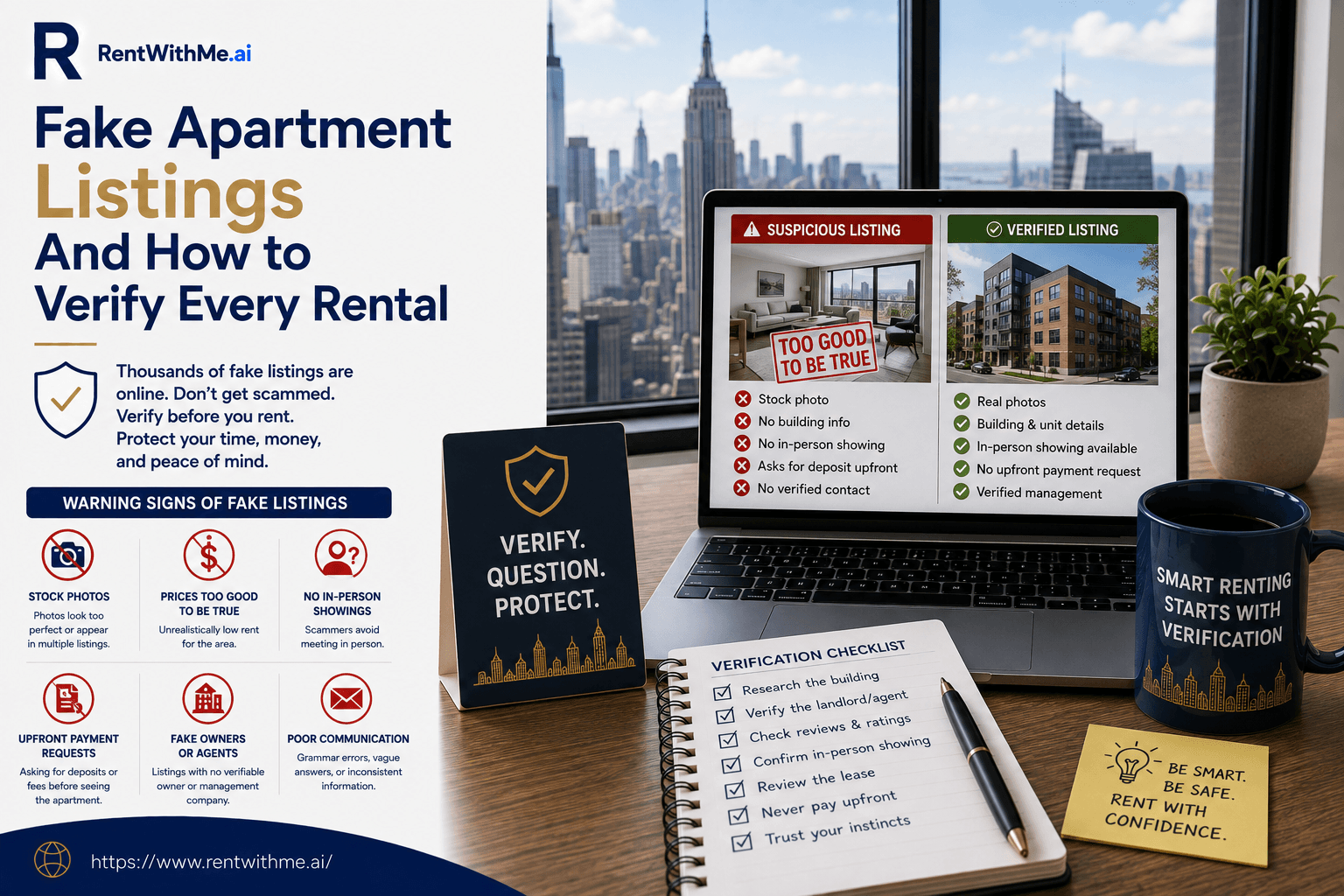
Introduction
Finding an apartment online has made rental searching faster, easier, and far more convenient than it was a generation ago. Renters can compare neighborhoods, prices, floor plans, amenities, and photographs without visiting dozens of properties in person.
That convenience has also created opportunities for rental scammers. A fraudulent advertiser can copy photographs from a legitimate property, reuse a real address, create a convincing description, and publish what appears to be a genuine apartment listing within minutes.
The most dangerous fake apartment listings are rarely the ones that look obviously fraudulent. Many use professional photography, accurate neighborhood information, realistic property descriptions, recognizable building names, and even the identities of real estate professionals.
For prospective renters, particularly those searching in competitive markets such as New York City, the challenge is no longer simply finding an attractive apartment. It is determining whether the opportunity actually exists and whether the person advertising it has legitimate authority to rent it.
Verification should therefore begin before an application is submitted or money changes hands. A renter who knows how to examine the listing itself can often identify inconsistencies long before reaching the most financially risky stages of the transaction.

Why Fake Apartment Listings Are So Convincing
Rental scammers do not necessarily need to invent apartments.
Thousands of legitimate property listings already contain almost everything a fraudster needs. Public advertisements may provide interior photographs, floor plans, building descriptions, amenity lists, neighborhood information, rent history, and sometimes virtual tours.
A scammer can copy this material and create another advertisement that appears authentic.
The address may be real.
The apartment may be real.
The photographs may accurately represent the property.
The fraud lies in the advertiser’s relationship with that property.
This distinction is one of the most important concepts renters should understand. Verifying that an apartment exists does not prove that the person communicating with you has authority to rent it.
Familiar Details Create False Confidence
Suppose you recognize the building from walking through the neighborhood.
You search the address and confirm that it exists.
The lobby shown in the advertisement matches photographs online, and the interior appears consistent with other units in the building.
Those details make the listing feel legitimate.
Yet all of them could have been copied from publicly available information.
The strongest verification therefore looks beyond whether individual facts are accurate. It asks whether the advertiser, property, availability, and proposed transaction can be connected independently.

Professional Presentation Is Easy to Reproduce
Renters sometimes expect fraudulent listings to contain obvious spelling mistakes, blurry photographs, strange formatting, or unrealistic promises.
Some do.
Others look excellent.
A scammer can copy a professionally written description word for word from a legitimate listing. High-resolution property photography can be downloaded and reused, while logos and company names can be copied from legitimate businesses.
A polished listing should influence how you evaluate the apartment’s presentation. It should not determine whether you trust the advertiser.
How Rental Scammers Copy Real Properties and Create Fake Listings
One common rental scam begins with a genuine property advertisement.
The fraudster copies its photographs and description, then publishes another version using different contact information. The rent may be reduced enough to generate significantly more inquiries.
The Federal Trade Commission warns that rental scammers may hijack legitimate listings by changing the email address or other contact information. Others copy information from legitimate rental or real estate advertisements and create their own versions.
This approach gives scammers an important advantage.
When a prospective renter researches the address, they find evidence confirming that the property exists.
Unfortunately, that evidence may belong to the legitimate listing rather than the fraudulent one.

The Fake Listing May Be Almost Identical
Imagine a legitimate apartment advertised for $3,800 per month.
A scammer copies everything but changes the rent to $2,850.
The photographs remain identical.
The bedroom count remains identical.
The building description remains identical.
Only the contact information and price have changed.
A renter searching the address might discover the original $3,800 advertisement. Instead of immediately recognizing the cheaper version as suspicious, they may believe they discovered an unusually good deal from a different landlord.
That discrepancy should be investigated before proceeding.
Some Fraudsters Advertise Properties That Are for Sale
A property does not even need to be available for rent.
A scammer can take photographs from a home or condominium listed for sale and advertise it as a rental.
The FTC specifically recommends searching the rental address together with the property owner’s or rental company’s name and notes that finding the property listed for sale rather than rent can be a warning sign.
If you discover conflicting information, determine which advertisement comes from a verifiable source.
Do not assume the rental version is legitimate simply because it offers the arrangement you prefer.

Recognizing Prices That Are Suspiciously Below Similar Rentals
Price is one of the most effective tools scammers can use to generate attention.
Renters naturally prioritize listings that provide better value.
A spacious apartment with attractive finishes at a surprisingly low monthly rent may receive far more inquiries than an ordinary market-rate listing.
That creates a large pool of potential victims.
Compare Similar Properties, Not Just Your Budget
A rental can be affordable for you while still being suspiciously inexpensive relative to its market.
Compare the apartment with similar properties based on location, bedroom count, building type, condition, amenities, and approximate size.
If comparable apartments cluster around $4,000 but one nearly identical property is advertised for $2,400, investigate why.
There may be a legitimate explanation.
The unit could have fewer amenities, an unusual layout, significant drawbacks, or another characteristic that affects pricing.
What matters is whether the difference can be reasonably explained.

Beware of the “Owner Doesn’t Care About Money” Story
A scammer may explain the discount before you even question it.
Perhaps the owner moved overseas and only wants someone responsible to care for the apartment.
Maybe they inherited the property and have no mortgage.
They might claim that finding a trustworthy renter matters more than collecting market rent.
Any of these circumstances could theoretically occur.
A compelling personal story is still not evidence of ownership or rental authority.
Verify the property and advertiser rather than deciding whether the explanation sounds emotionally believable.
Spotting Stolen Photos and Reused Property Descriptions
Photographs are among the most persuasive elements of any apartment advertisement.
They are also easy to copy.
A renter may spend several minutes studying the kitchen, bathroom, bedrooms, views, and finishes without asking where the images originated.
That question matters.

Search for Other Versions of the Property
Start with the address when available.
Look for previous or current advertisements containing the same photographs.
Compare the listing details.
If identical images appear unde

 r different addresses, different unit numbers, or conflicting rental prices, investigate further.
A photograph appearing elsewhere does not automatically indicate fraud. Property managers and brokers may legitimately distribute the same listing across multiple platforms.
The concern increases when important information conflicts.
Look for Inconsistent Interior Details
Sometimes the images themselves reveal that they do not belong together.
One photograph may show dark hardwood floors while another shows light flooring in what appears to be the same room.
Kitchen cabinetry may change between photographs.
Window shapes, ceiling heights, heating systems, or views may be inconsistent.
These differences could result from photographs of multiple units in the same building.
If the advertisement represents all of them as one specific apartment, ask which images actually show the unit being offered.
Pay Attention to Watermarks
A photograph may contain a brokerage, photographer, property portal, or management-company watermark.
Search that name independently.
If the advertiser claims to be the owner while every photograph carries the branding of an unrelated brokerage, find out why.
The explanation may be legitimate.
The inconsistency should still be resolved.
Identifying Duplicate Listings With Conflicting Prices or Contacts
Seeing the same apartment on several websites is not inherently suspicious.
Legitimate rental properties can appear across multiple platforms.
The important issue is whether the versions tell the same story.
Compare rent, availability, unit number, contact information, broker or management details, deposit terms, and apartment features.
Small formatting differences are normal.
Major factual differences deserve attention.
Conflicting Prices Require Investigation
Suppose one version lists the apartment for $3,700 while another advertises it for $2,500.
Do not automatically contact the cheaper advertiser because the price is more attractive.
Determine who published each version.
If the higher-priced advertisement comes directly from a verified building management company while the cheaper one comes from an anonymous social profile, the source difference is meaningful.
The cheapest listing is not necessarily the opportunity.
It may be the bait.
Different Contact Information Can Be Legitimate
Several brokers may sometimes market properties, and listings may appear through different channels.
Different phone numbers therefore do not automatically indicate fraud.
Look at the complete relationship.
Can each professional be independently verified?
Does the brokerage affiliation make sense?
Are the terms consistent?
Does the property manager recognize the listing?
The goal is not to reject every duplicate. It is to understand why duplicates exist.
Checking Whether the Address, Unit Number, and Building Details Match
A fake listing can use a real address while getting important details wrong.
Always examine the relationship between the advertised apartment and the actual building.
If a listing claims to offer a luxury high-rise residence with a doorman and rooftop amenities, verify that the address corresponds with that type of property.
Basic inconsistencies can sometimes expose a copied advertisement quickly.
Check the Building Configuration
Look at reliable information about the property.
Does the building have the number of floors implied by the unit?
If the advertisement offers an apartment on the 18th floor but the building has six stories, something is wrong.
Similarly, verify major advertised amenities where practical.
An elevator, doorman, parking garage, rooftop deck, laundry facility, or fitness center may be important enough to confirm independently.
Unit Numbers Can Reveal Problems
The apartment number deserves attention.
Search it together with the building address.
You may discover historical listings that help confirm the property’s configuration and previous rental information.
If the same photographs are associated with another unit, ask why.
Sometimes management companies reuse representative photographs, particularly in larger developments.
That practice can be legitimate if the listing clearly communicates it.
The problem occurs when a renter is led to believe generic or unrelated photographs show the exact apartment being offered.
Warning Signs in Listing Language, Photos, and Property Features
No single writing style proves that an advertisement is fraudulent.
Instead, look for inconsistencies between what the listing promises and what can be independently confirmed.
An advertisement may claim that all utilities are included when other reliable building information says otherwise.
It may advertise parking in a building where no parking appears to exist.
It might describe a private outdoor space that cannot be found in floor plans or photographs.
One discrepancy may result from an ordinary listing error.
Several discrepancies deserve deeper investigation.
Extremely Vague Descriptions Can Be Useful to Scammers
Some fake advertisements avoid specific details.
The listing promises a “beautiful apartment in an amazing location” but says little about the building, lease, utilities, or actual features.
When you ask questions, the advertiser pushes you toward payment rather than providing answers.
A legitimate advertisement does not need to be lengthy.
However, the person offering the property should be able to answer reasonable factual questions.
Too Many Unrelated Amenities Can Be Suspicious
Copied advertisements occasionally combine details from different properties.
The listing may promise a balcony, rooftop access, private yard, gym, parking, concierge service, and in-unit laundry while the photographs support only some of those claims.
Verify important features before treating them as part of the rental.
This matters even when fraud is not involved.
A misleading but legitimate listing can still waste your time and affect your rental decision.
Why Professional-Looking Listings Can Still Be Fraudulent
A professional appearance is one of the weakest forms of verification because it is easy to reproduce.
Logos can be copied.
Property photographs can be downloaded.
Legal language can be reused.
Company names can be imitated.
Even virtual tours can originate from legitimate advertisements.
A scammer does not need to create professional content if someone else has already created it.
Do Not Confuse Production Quality With Authority
When evaluating a rental, separate presentation from authorization.
The listing tells you what someone claims is available.
Verification tells you whether that person can actually provide it.
This distinction becomes increasingly important as the transaction progresses.
A polished advertisement may lead to a polished application, which may lead to a polished lease and payment page.
If the underlying advertiser was never verified, each new layer simply reinforces an assumption that may have been wrong from the beginning.
How Scammers Use Urgency to Push Renters Into Fast Decisions
Competitive rental markets naturally move quickly.
That makes urgency particularly difficult to evaluate.
A legitimate agent might accurately tell you that other people are interested.
The difference appears when urgency is used to prevent reasonable verification.
“You need to decide today” is different from “Send the deposit in ten minutes or I won’t answer any more questions.”
The FTC advises renters to be cautious when someone pressures them to make a quick rental decision.
Artificial Competition Changes How Renters Think
Imagine spending weeks looking for an apartment.
You finally find one that fits your budget and preferred location.
The advertiser says three other applicants are ready to pay.
Suddenly, your primary concern is no longer whether the listing is legitimate.
It is whether someone else will get it first.
That emotional shift benefits scammers.
Maintain the same verification standards whether you believe you are the only applicant or one of twenty.
A Deadline Does Not Validate a Payment
Scammers may attach exact countdowns to requests.
“The owner needs the deposit within thirty minutes.”
“The payment link expires at 6 p.m.”
“The next applicant gets the apartment if you don’t send money now.”
A deadline may be real or fabricated.
It does not answer the fundamental questions about the apartment and recipient.
Verify first.
Advertisers Who Refuse In-Person or Live Virtual Tours
Being unable to view an apartment deserves careful attention, particularly when the advertiser simultaneously requests money.
FTC guidance warns against paying for a property you have never seen and recommends seeing the rental in person or having someone you trust view it when you cannot.
There are legitimate situations where immediate physical access is difficult.
A current tenant may still occupy the property.
Repairs may be underway.
The prospective renter may live in another state.
Those circumstances call for alternative verification, not blind trust.
A Live Virtual Tour Is Stronger Than a Recording
Prerecorded videos can be copied just like photographs.
A live interactive tour provides more useful evidence of current access.
Ask the person conducting the tour to respond to requests in real time.
They might show the inside of a particular closet, walk into the hallway, display the view from a window, or move from the kitchen directly into another room.
This makes prerecorded deception more difficult.
However, a live tour establishes access more strongly than authority.
You still need to verify who is offering the property.
Landlords or Agents Who Claim They Cannot Meet
One familiar rental-scam story involves a landlord who has moved away.
They may say they relocated because of employment, family responsibilities, military service, charity work, or another personal reason.
The keys will supposedly be mailed after payment.
The story can be detailed enough to feel authentic.
Do not evaluate it primarily through emotion.
Ask whether the rental can be independently verified.
Distance Should Increase Verification
A remote landlord can be completely legitimate.
Property owners do not need to live near every property they rent.
What matters is whether their ownership or authority can be established.
If the person cannot meet, cannot arrange a legitimate representative, cannot provide a live tour, cannot explain their connection to the property, and still demands money, the combined pattern deserves serious concern.
The more normal verification methods become unavailable, the stronger alternative verification should become.
Suspicious Email Addresses, Phone Numbers, and Messaging Profiles
Contact information can reveal inconsistencies that property photographs cannot.
Suppose an advertiser claims to represent a major property-management company but communicates exclusively from an unrelated personal email address.
That does not automatically prove fraud.
It should encourage verification.
Search the company independently.
Compare its published contact information.
Determine whether the individual actually works there.
Look Carefully at Domain Names
Impersonators may create email addresses that resemble legitimate company domains.
A single added letter or word can be easy to miss.
For example, a fake address might add terms such as “leasing,” “NY,” “rentals,” or “management” to a familiar company name.
Do not rely on visual familiarity.
Navigate to the company’s official website independently and compare the actual domain.
Phone Numbers Are Not Proof of Identity
A local area code can create false reassurance.
Phone numbers can be obtained remotely, and caller identification can be manipulated.
Treat the number as one piece of information rather than proof that the person is physically located in New York or connected with the property.
When necessary, contact the claimed company through a separately verified number.
Verifying Whether a Broker, Agent, or Property Manager Is Real
A person claiming to be a real estate professional provides an opportunity for additional verification.
New York maintains official licensing information for real estate brokers and salespeople through the Department of State. Renters can use official records to check whether a claimed professional is licensed.
Finding the person’s name is only the beginning.
You must still determine whether the person communicating with you is actually that professional.
Compare the Professional Relationship
Look at the brokerage affiliation.
Does it match what the advertiser told you?
Can the brokerage confirm the relationship?
Does the professional’s independently located contact information correspond with the communication you received?
A scammer may deliberately impersonate a real licensed professional because renters who perform a basic name search will find reassuring results.
Identity verification must therefore connect the name to the communication channel.
Verify the Management Company Separately
Property managers may not be functioning as brokers in every situation, so the verification process can differ.
Search the company independently.
Look for credible information connecting it with the building.
If the property has an established leasing office, contact that office through independently obtained information.
Ask whether the apartment is available and whether the person communicating with you is authorized to handle it.
A short independent call can resolve questions that dozens of messages with an unverified advertiser cannot.
Common Mistakes Renters Make Before Verifying a Listing
Many renters do not intentionally ignore safety.
They simply verify the wrong things.
They confirm the address exists and assume the advertisement must therefore be real.
They find the broker’s name online and assume they are speaking with that person.
They see professional photographs and interpret them as evidence of legitimacy.
Each of these checks can be useful.
None is sufficient alone.
Falling in Love With the Apartment Too Early
Emotional commitment makes objective verification harder.
Once renters begin imagining their furniture in the living room, commute from the neighborhood, or weekends on the advertised rooftop, contradictory information becomes easier to excuse.
Keep the apartment provisional until the essential facts are verified.
An attractive property should motivate research, not reduce it.
Assuming Expensive Rentals Cannot Be Fake
Rental scams are not limited to suspiciously cheap apartments.
Fraudsters can advertise properties at realistic prices.
In some cases, a normal price may make the listing more convincing precisely because renters have learned to distrust extreme bargains.
Price is one verification signal.
It is not a fraud detector.
Assuming a Familiar Website Guarantees Every Listing
Reputable rental marketplaces can implement fraud-prevention systems, but no user-generated marketplace should replace individual verification.
A scammer may operate briefly before an advertisement is detected.
Treat the platform as the place where you discovered the opportunity, not as proof that every person behind every listing has been fully authenticated for your particular transaction.
Sending Personal Information Too Early
Some renters focus entirely on avoiding financial loss and forget that identity information also has value.
A fake landlord may ask for identification, employment records, bank statements, Social Security information, or other sensitive data through a fraudulent application.
Do not provide highly sensitive information merely because the advertiser says it is required to schedule a viewing.
Verify the rental process first.
Building a Verification Mindset Before You Apply
The safest rental search separates discovery from verification.
During discovery, you identify apartments that might fit your needs.
During verification, you determine whether those opportunities are genuine.
The first stage is about bedrooms, rent, location, commute, amenities, and lifestyle.
The second is about evidence.
Is the address accurate?
Does the apartment exist?
Does the unit information make sense?
Are the photographs connected with the property?
Is the advertised price plausible?
Who is offering the rental?
Can that person’s role be independently verified?
The more confidently you can answer those questions, the safer it becomes to move toward an application.
Verification Should Become Stronger as the Stakes Increase
You do not need to conduct exhaustive research before sending a basic inquiry.
The level of verification should increase as the consequences increase.
Before sharing sensitive information, verify more.
Before signing a lease, verify more.
Before sending thousands of dollars, verification should be strongest.
This approach allows renters to move efficiently without treating every advertisement as a criminal investigation.
The Next Stage Goes Beyond the Listing
A fake rental advertisement is only the first layer of many scams.
Once contact has been established, fraudsters may create application forms, credit-check websites, property-management identities, leases, payment portals, and deposit instructions designed to reinforce the original deception.
That means verifying the listing is necessary, but it is not the end of the process.
How to Verify Who Owns or Controls the Rental Property
Once a listing passes the initial credibility check, the next question is authority. You are not simply trying to prove that the apartment exists. You need to determine whether the person offering it has a legitimate connection to the property.
This distinction matters because a scammer can advertise a completely real apartment. They may know the building address, use accurate photographs, understand the neighborhood, and even possess information about previous rents without having any right to offer the unit.
Ownership information can provide an important starting point. In New York City, public property resources can help renters research buildings, owners, property records, and other relevant information.
Understand That the Owner’s Name May Not Be Obvious
Do not expect every property record to display the individual landlord’s personal name.
Many NYC properties are owned through LLCs, corporations, partnerships, or other entities. A building may also be managed by a company that is different from its legal owner.
That difference is normal.
The important question is whether the relationship can be explained.
Suppose property information identifies “Example Property LLC” as the owner while your contact works for “Example Residential Management.” The names do not match exactly, but the management company may legitimately represent the ownership entity.
Ask how the parties are connected when the relationship is unclear.
Ownership Alone Does Not Confirm Availability
Finding the correct owner does not prove that the advertised apartment is currently available.
A scammer may copy information from public records precisely because it makes their story more credible.
Continue verifying the specific unit and availability.
Property verification works best when several independent pieces of evidence point toward the same conclusion.
Checking the Landlord or Management Company’s Connection to the Building
Property-management companies can make verification easier because they often maintain established business information.
Search for the company independently rather than relying exclusively on a website supplied by the advertiser.
Look for information connecting the company to the building.
If you find a verified office number, consider contacting the company directly when necessary.
Ask whether it manages the property and whether the person communicating with you is authorized to handle the apartment.
Do Not Let the Advertiser Control the Verification Process
Imagine asking a suspicious advertiser whether they really work for a particular management company.
They respond by sending a link to a website.
You visit the website and see the advertiser’s name.
That appears reassuring.
However, if the advertiser created or controls the website, the “verification” proves nothing.
Independent verification means finding information through a source that does not originate solely from the person making the claim.
This principle becomes increasingly important as applications and payments enter the process.
Verifying Real Estate Licenses and Brokerage Affiliations
When someone claims to be a licensed New York real estate broker or salesperson, verify that information through official state resources.
Finding a matching professional name is useful.
It is not the final step.
Scammers can impersonate legitimate professionals whose licensing information is publicly available.
Compare the brokerage affiliation and other available details with what you have been told.
If uncertainty remains, contact the brokerage through independently obtained contact information.
Verify the Person Behind the Communication
Suppose “John Smith” is a genuine licensed real estate salesperson.
The person emailing you also calls himself John Smith.
Searching licensing records confirms that a professional with that name exists.
You still have not established that the person sending the emails is the licensed John Smith.
Look at the email domain.
Check the phone number.
Confirm the brokerage relationship.
When a substantial payment or sensitive application is involved, contact the brokerage independently if needed.
Identity impersonation works precisely because renters stop after confirming that the stolen identity belongs to a real person.
Confirming That the Apartment Is Actually Available
A real apartment can still produce a fake listing when it is no longer available.
Scammers may copy old advertisements for units that were rented months or years earlier.
Historical listings are especially useful to fraudsters because they provide professional photographs, descriptions, floor plans, and sometimes virtual tours.
Search the exact address and unit.
Look for current information.
If you find evidence that the apartment recently rented, ask why it has returned to the market.
There may be a legitimate explanation, such as an early lease termination or a new rental cycle.
The explanation should be consistent with other evidence.
Contact the Building When Appropriate
If a larger rental building has an established leasing office, that office can be an important verification resource.
Contact it through independently obtained information.
Ask whether the advertised unit is available.
If the supposed listing agent claims to represent the building, you can also ask whether that relationship is legitimate.
This simple check can quickly expose a copied listing.
Do Not Accept “It Was Just Taken Offline” Without Question
A scammer may explain the absence of a current listing by saying the apartment was removed because you have been selected.
That creates a circular verification problem.
You cannot confirm the listing because the advertiser supposedly removed it for you, and the only evidence that it was removed for you comes from the advertiser.
Look for independent confirmation.
Using Live Tours to Verify Remote Rental Listings
Remote renters cannot always visit an apartment before applying.
A live video tour can help bridge that gap.
The key word is live.
Prerecorded video can be copied from legitimate advertisements just like photographs.
During a live tour, ask the person showing the apartment to respond naturally to requests.
Have them move between rooms, show a specific appliance, open a closet, display the hallway, or show the view from a particular window.
These interactions help establish that the person currently has access.
Access Still Does Not Equal Authority
A live tour is useful but limited.
A current tenant, short-term occupant, contractor, employee, or unauthorized individual might have physical access.
Continue verifying who the person is and why they have authority to offer the apartment.
Think of a live tour as one layer.
It verifies the physical property more strongly.
Other checks establish the legal or professional relationship.
Fake Rental Application and Credit Check Scams
After a renter becomes interested in an apartment, the application stage creates a new opportunity for fraud.
The advertiser sends a professional-looking application and asks for information typically associated with tenant screening.
Because renters expect applications, the request may seem completely ordinary.
The danger lies in where the information goes.
A fraudulent rental application can collect enough information to support identity theft or other financial fraud.
Verify Before You Submit Sensitive Information
The more sensitive the requested information, the stronger your verification should be.
Before providing Social Security information, identification documents, detailed financial records, or similar data, establish who is receiving them.
A renter should not need to hand over an identity profile simply to discover whether an advertiser is legitimate.
The property and rental professional should already have passed reasonable verification.
Watch for Applications Sent Too Early
Be cautious if someone demands a complete application before answering basic questions or allowing any meaningful property verification.
Some legitimate rental processes move quickly and may involve early applications.
The issue is the combination of circumstances.
An unverified stranger demanding sensitive information for an apartment you cannot see creates substantially more risk than a verified management company processing an application for a property you toured.
Protecting Social Security Numbers, IDs, and Financial Documents
Rental applications can require sensitive information because landlords may evaluate income, identity, creditworthiness, and rental history.
That legitimate need makes rental scams particularly dangerous.
A fraudster does not have to invent an unusual reason for requesting valuable data.
They can imitate the same process a legitimate landlord uses.
Limit Unnecessary Exposure
Understand what each requested document contains.
A bank statement may reveal account numbers, balances, transaction history, addresses, and other information.
Identification documents contain valuable personal data.
Employment records can reveal additional details about your identity and finances.
Do not distribute these documents casually to every apartment advertiser.
Verify the recipient first.
Use Secure Submission Methods
A legitimate organization may provide a secure application or document-upload system.
Confirm that the system genuinely belongs to the company before using it.
Do not assume a website is safe because it uses professional branding or a padlock icon.
The connection can be encrypted while the website itself belongs to a scammer.
Security technology protects the transmission.
It does not verify the recipient’s honesty.
Recognizing Fake Background Check and Application Websites
Some fake apartment listings lead renters to external websites for a supposed credit or background check.
The advertiser may say every applicant must use a specific service.
The website requests personal information and payment.
There may be no legitimate screening process at all.
The site may exist to collect application fees, payment-card information, identity data, or account credentials.
Check the Website Independently
Do not judge an application site entirely from the page you were sent.
Research the service separately.
Examine the domain carefully.
Look for an established company presence and determine whether the rental professional can explain why that service is being used.
A familiar-looking logo is not sufficient evidence.
Never Provide Banking Login Credentials Directly
Be extremely cautious if an application asks for the username and password you use to access online banking.
Some legitimate financial verification services use secure authorization systems, but you should understand exactly which established service is handling the connection.
Never send your banking password to a landlord, broker, roommate, or advertiser through text, email, or messaging apps.
Likewise, do not provide one-time authentication codes to someone who claims they need the code to process your application.
Suspicious Application, Administrative, and Processing Fees
Fraudsters frequently use small fees because renters may consider them too minor to investigate.
A $30 or $50 payment feels less risky than a $3,000 deposit.
Once the renter pays, however, the scammer knows that the victim is willing to transfer money.
Additional requests may follow.
In New York, application-related charges are regulated, so renters should understand current rules rather than assuming any fee described as “standard” must be legitimate.
Ask What Every Fee Covers
Do not focus only on the amount.
Ask what the fee pays for.
Who receives it?
Is it refundable?
Is it required by the landlord, broker, management company, or screening provider?
Where is the requirement documented?
Clear answers make legitimate charges easier to evaluate.
Vague explanations combined with payment pressure should increase caution.
Small Payments Can Build Trust
A scammer may intentionally begin with a modest application fee.
After you pay it and receive a professional confirmation, the transaction feels more real.
Then comes the larger security deposit.
Treat every payment as part of the same verification process.
A successful $25 transaction does not prove that the person is authorized to collect $3,000 next.
Fake Security Deposit and First-Month Rent Requests
The highest financial risk often appears after the supposed application is approved.
The advertiser congratulates you.
You are told that the apartment will be removed from the market as soon as the security deposit arrives.
Everything feels like it is progressing normally.
That feeling is exactly why the stage is dangerous.
Verify Before Approval Becomes Payment
Approval is only meaningful when it comes from a legitimate party.
A scammer can approve every applicant.
Before sending a security deposit or first month’s rent, verify the apartment, landlord or authorized representative, agreement, and payment recipient.
Do not allow an approval message to reset your caution.
Understand New York’s Security Deposit Limit
For most residential rentals in New York, the security deposit is limited to one month’s rent.
That rule provides a useful reference when evaluating unusually large demands.
However, compliance with the amount does not prove legitimacy.
A scammer offering a $3,000 apartment can request a $3,000 security deposit and still disappear with the money.
Legal-looking numbers are easy to imitate.
Dangerous Payment Methods and Last-Minute Banking Changes
Payment instructions deserve their own verification.
A legitimate-looking rental can become fraudulent at the final stage if money is redirected to the wrong recipient.
Be particularly careful when instructions change unexpectedly.
Perhaps you were told to pay the management company.
An hour before the deadline, the agent says the company’s payment system is down and asks you to transfer the money to a personal account instead.
Do not treat this as a routine inconvenience.
Verify the change independently.
Gift Cards Should Stop the Transaction
A request to pay an apartment deposit with retail gift cards is a major fraud warning.
Gift-card codes can be transferred quickly and are difficult to recover once redeemed.
Do not purchase gift cards for someone claiming they are needed to reserve an apartment, verify funds, pay rent, or unlock a refund.
Cryptocurrency Demands Require Serious Caution
Cryptocurrency transfers can also be difficult to reverse.
A scammer may present crypto as faster, international, or more convenient.
Convenience is irrelevant if you cannot establish who controls the receiving wallet.
Verify the rental before considering any payment method.
Peer-to-Peer Payment Apps Need Verification Too
A familiar payment application can create false comfort.
The service itself may be legitimate while the recipient is fraudulent.
Do not rely on a display name or profile photograph.
Confirm the recipient through the verified rental relationship.
Fake Lease Agreements and Altered Rental Documents
A professionally formatted lease can be one of the strongest psychological tools in a rental scam.
The renter sees several pages of legal terms and assumes the transaction has passed into an official stage.
A scammer can obtain a legitimate lease template and modify the names, dates, rent, and property address.
The sophistication of the document says nothing about the authority of the person issuing it.
Compare the Lease With the Listing
Read the lease closely.
Check the exact property address and apartment number.
Confirm the monthly rent.
Review the security deposit.
Look at the lease dates.
Identify the landlord.
Compare those details with the listing and previous communications.
Unexpected differences should be resolved before signing.
Look for Unexplained Entities
The lease may introduce a company you have never encountered.
That is not automatically suspicious because ownership entities and management companies often differ.
Research the entity.
Ask how it relates to the property.
If nobody can explain why a previously unknown company suddenly appears as the landlord or payment recipient, do not ignore the inconsistency.
Verifying Rent, Lease Dates, Fees, Utilities, and Payment Recipients
A legitimate rental transaction should become increasingly consistent as you move toward signing.
The final agreement should reflect the important terms you were told earlier.
Check whether utilities are included or separately billed.
Review move-in charges.
Confirm the rent due date and lease duration.
Understand renewal or termination provisions relevant to your decision.
Most importantly for fraud prevention, determine where money goes.
Create a Transaction Map
Before paying, mentally connect the major parties.
There is a property.
There is an owner.
There may be a management company.
There may be a broker.
There is a tenant.
There is a payment recipient.
You should understand how those pieces relate.
If the lease names one landlord, management emails come from another company, and the deposit goes to an unrelated individual, investigate until the relationship becomes clear.
Complexity is not necessarily fraud.
Unexplained complexity is risk.
Fraudulent Sublet Listings
Sublets create additional verification challenges because the advertiser may not own the property.
A legitimate current tenant can sometimes offer a sublet subject to the applicable lease and legal requirements.
A scammer may copy that structure while lacking the necessary authority.
The apartment can be real, and the person offering it may even live there.
That does not automatically make the proposed arrangement valid.
Verify the Primary Tenancy
Ask who holds the original lease.
Understand the remaining lease period.
Determine whether the proposed sublet fits those dates.
Ask what approvals are required.
If management or the landlord needs to approve the arrangement, confirm that process appropriately.
A person who refuses to discuss the underlying lease but demands a deposit should receive additional scrutiny.
Beware of the “Landlord Doesn’t Need to Know” Explanation
Some renters are told that formal approval is unnecessary.
The advertiser may say the landlord never checks or that everyone in the building sublets informally.
That creates risk even when the advertiser is not deliberately committing fraud.
You could pay for an arrangement that cannot legally or contractually provide the occupancy promised.
Verify rather than relying on assurances.
Fake Roommate Listings
Roommate advertisements can feel safer because they involve a bedroom rather than an entire apartment.
They can also feel more personal.
You meet someone who seems friendly, tour the apartment, discuss work schedules, and imagine living together.
That social connection can reduce financial caution.
Do not let it.
Confirm the Person’s Relationship With the Apartment
Ask who is on the lease.
If other roommates live there, meet or communicate with them when practical.
Understand how rent and deposits are handled.
Determine whether the advertiser has authority to offer the room.
Someone may have temporary access to an apartment without having any legitimate right to collect a deposit for future occupancy.
Put Important Terms in Writing
Informality can create problems even when no scam is intended.
Clarify rent, deposit, move-in date, utilities, shared expenses, duration, and deposit-return expectations.
Written terms help distinguish a genuine housing arrangement from a vague promise.
They also reduce later disputes.
How Fake Listings Evolve Into Complete Rental Scams
The most sophisticated fake apartment listings are not isolated advertisements.
They are funnels.
The listing creates interest.
The conversation builds trust.
The application creates legitimacy.
The approval creates excitement.
The lease creates formality.
The payment request converts all of that trust into money.
At each stage, the renter receives another reason to believe the previous stage must have been genuine.
That is why verification needs to remain active throughout the process.
Do Not Let Previous Effort Become Evidence
Suppose you have spent four days communicating with an advertiser.
You completed an application.
You participated in a video tour.
You reviewed a lease.
You may feel that the transaction must be legitimate because otherwise all that effort was wasted.
The amount of time invested is not evidence.
If something becomes suspicious on day five, investigate it just as seriously as you would have on day one.
Building a Full Rental Verification Process
A reliable process does not depend on instinct alone.
Before a major commitment, several independent facts should support the transaction.
The property exists and matches the advertisement.
The specific apartment appears genuinely available.
The advertiser has a verifiable identity.
Their relationship with the owner, management company, brokerage, or lawful sublet arrangement makes sense.
The lease corresponds with the property and terms discussed.
The payment recipient fits the documented relationship.
When those pieces align, uncertainty decreases.
When they conflict, do not allow urgency to fill the gaps.
Verification Should Continue Until the Money Is Sent
Many renters perform careful checks at the beginning and relax once the application is approved.
Keep verifying through the final payment stage.
Banking instructions can change.
Email accounts can be impersonated.
Documents can introduce unexpected parties.
The apartment address can suddenly shift.
A late inconsistency is not less important because earlier steps looked legitimate.
In fact, the final stage is where your financial exposure becomes greatest.
Preparing for the Final Verification Stage
By this point, the renter has moved well beyond evaluating photographs and listing descriptions.
The remaining challenge is turning all of these checks into a repeatable process that works in realistic situations.
Part 3 will bring the full verification strategy together through real-world fake listing scenarios and a complete rental verification checklist. It will cover what to examine before contacting an advertiser, touring an apartment, submitting an application, signing a lease, and sending money.
Real-Life Fake Apartment Listing Scenarios and What Renters Should Notice
Fake apartment listings become easier to understand when individual warning signs are placed inside realistic situations. The most convincing scams usually do not look obviously fake at first. Instead, the renter encounters a series of small inconsistencies that become more serious as the transaction progresses.
The strongest defense is not one perfect fraud test. It is a repeatable verification process that checks the property, advertiser, documents, application, and payment instructions independently.
The Apartment That Is Much Cheaper Than Everything Nearby
Imagine finding a renovated one-bedroom apartment in a desirable neighborhood for $2,300 per month when similar properties appear closer to $3,500.
The advertiser explains that the owner recently moved away and simply wants a responsible long-term tenant. Utilities are included, pets are accepted, and the apartment can be reserved immediately.
The price alone does not prove fraud.
However, the advertiser also refuses to conduct a live tour and says the keys can only be mailed after a deposit is received.
Now several warning signs are working together.
Current FTC guidance specifically warns that fake listings may use stolen photos, below-market rent, excuses for why a property cannot be viewed, and demands for payment before verification. (Consumer Advice)
The safer response is to investigate the property rather than attempting to secure the unusually low price.
The Real Apartment With a Fake Contact Person
Another renter finds an apartment that unquestionably exists.
The photographs match the building.
The unit has appeared in historical rental records.
The person advertising it claims to work for a known brokerage and uses the name of a real professional.
A basic internet search seems to confirm everything.
However, the email address is slightly different from the brokerage’s real domain.
The renter contacts the brokerage through independently obtained information and discovers that the real professional is not advertising the apartment.
The scammer copied a genuine identity because it would survive a superficial search.
This example demonstrates why verifying that a person exists is different from verifying that you are actually communicating with that person.
The Old Listing Reposted as Available
A renter discovers an attractive two-bedroom apartment and searches the address.
The same photographs appear on several real estate websites, which initially feels reassuring.
Looking more closely, the renter notices that those pages are several months old and indicate that the unit is no longer available.
The fraudulent advertiser has taken an old legitimate listing and presented it as new inventory.
This is why address verification should include availability.
The apartment can be genuine while the current offer is completely false.
The Real Apartment With an Unauthorized Subletter
A renter responds to a furnished apartment advertisement and tours the unit successfully.
The person showing it lives there and clearly knows the property.
They request a deposit for a six-month sublet.
The renter later discovers that the primary lease and building arrangements do not permit the proposed transaction.
This situation may involve deliberate fraud or an unauthorized rental arrangement, but either way, access to the apartment did not prove authority to offer it.
Frequently Asked Questions About Verifying Rental Listings
Rental verification becomes confusing because genuine housing transactions can also involve unusual circumstances. Individual landlords may live outside New York, apartments may be advertised on multiple websites, and management companies may differ from the property’s legal owner.
The goal is therefore not to reject every unusual situation. It is to determine whether important claims can be supported independently.
Does Finding the Apartment Online Prove the Listing Is Real?
No.
In fact, scammers often benefit when renters search the property and discover genuine information.
A real address, professional photographs, previous rental history, and floor plans can all have been copied.
Verify the current availability and advertiser as well.
Does a Live Tour Prove the Rental Is Legitimate?
A live tour is strong evidence that the person conducting it currently has access.
It does not necessarily establish leasing authority.
Continue checking the person’s role, management relationship, brokerage affiliation, ownership connection, or subletting authority.
Can a Fake Listing Be Advertised at a Normal Price?
Yes.
Below-market pricing is a useful warning sign, not a requirement for fraud.
A scammer may intentionally advertise at a realistic price because renters have become cautious about extreme bargains.
Use the same verification process regardless of whether the rent seems unusually low or completely ordinary.
Is a Signed Lease Enough Verification?
No.
A lease template can be copied or altered.
The important issue is whether the landlord or authorized representative named in the document actually has authority over the property.
The agreement should correspond with independently verified facts.
Complete Apartment Rental Verification Checklist
Before making a major commitment, review the rental from beginning to end.
- Confirm the exact street address and apartment number.
- Search the property independently.
- Compare the rent with similar nearby rentals.
- Check whether identical photographs appear under other addresses.
- Look for duplicate listings with conflicting prices or contacts.
- Confirm the building type and major advertised amenities.
- Check whether the unit appears genuinely available.
- View the apartment in person when practical.
- Use a live interactive virtual tour when renting remotely.
- Confirm the advertiser’s full name and claimed role.
- Verify real estate professionals through official New York resources.
- Confirm brokerage affiliations independently when necessary.
- Research the property-management company separately.
- Understand how the advertiser is connected with the property.
- Verify subletting authority when dealing with a current tenant.
- Confirm the application belongs to the verified rental process.
- Protect Social Security numbers and sensitive financial documents.
- Investigate unfamiliar credit-check or application websites.
- Understand every application or administrative charge.
- Read the entire lease before signing.
- Confirm rent, lease dates, utilities, and fees.
- Identify the landlord or ownership entity named in the lease.
- Confirm who will receive the security deposit and rent.
- Independently verify changed payment instructions.
- Be cautious with irreversible or unusual payment methods.
- Save listings, correspondence, agreements, and payment confirmations.
- Stop when important information becomes less clear rather than more clear.
The checklist should become faster with experience. Once renters know what they are looking for, many of these checks take only a few minutes.
What to Check Before Contacting a Listing
Start with the advertisement itself.
Compare the price.
Examine the photographs.
Read the description carefully.
Search the address when available.
Look for inconsistencies before the advertiser has an opportunity to influence your decision.
Search Distinctive Listing Language
If the description contains an unusual phrase, search part of it online.
Copied property descriptions can sometimes lead directly to the original listing.
You may find the same wording attached to another price, contact person, or availability date.
This is particularly useful when photographs are difficult to reverse-search.
Check Whether the Features Make Sense
Look at the property’s advertised amenities.
A supposed 20th-floor apartment cannot exist in a five-story building.
A listing offering a doorman, garage, rooftop pool, and elevator should correspond with a property that actually contains those amenities.
Obvious mismatches deserve investigation before you contact anyone.
What to Check Before Scheduling a Tour
Confirm the exact address when possible.
Know who you are meeting.
If the person claims to be a licensed professional, verify their identity before sharing unnecessary personal information.
A legitimate rental agent may ask basic questions before a tour.
That is different from requiring sensitive financial records or a large payment simply to schedule one.
Be Careful When the Property Changes
Sometimes a genuine apartment becomes unavailable between the inquiry and showing.
An agent may offer another option.
Treat the replacement as a new property.
Verify its address, price, availability, and terms instead of assuming that trust established around the first listing automatically transfers to the second.
What to Check Before Submitting an Application
The application stage introduces identity risk.
Before providing highly sensitive information, verify the organization collecting it.
Check the application domain.
Make sure it connects with the verified landlord, brokerage, or management company.
New York’s Attorney General currently states that, before a lease is signed, a landlord generally cannot charge more than $20 for a credit and background check and must provide the applicant a copy of that check and the invoice. The applicant can also provide a qualifying background or credit check obtained within the previous 30 days to avoid that fee. (New York State Attorney General)
Understanding normal rules makes suspicious application requests easier to recognize.
Protect Personal Documents
Do not send a full package of identification, financial records, and Social Security information to someone whose relationship with the apartment is still uncertain.
The consequences of a fake listing can extend well beyond losing a deposit.
Identity information may remain valuable to a criminal after the apartment advertisement disappears.
What to Check Before Signing a Lease
Read the document rather than treating it as proof of legitimacy.
Confirm the address, unit number, rent, lease dates, security deposit, utilities, fees, tenant names, and landlord information.
Compare these details with what you previously discussed.
If important information changes, stop and ask why.
Verify New Names and Companies
A lease may legitimately introduce an ownership LLC or another company that was not prominent in the listing.
Research it.
Understand the relationship.
Complex property structures are common.
The concern is not complexity itself.
The concern is a transaction in which nobody can explain why an unknown person or company suddenly controls the lease or money.
What to Check Before Sending Any Money
Payment is where verification should be strongest.
Identify the recipient.
Compare that recipient with the lease and verified rental relationship.
Understand exactly what each amount covers.
If banking or payment instructions change at the last minute, confirm them through a separate independently verified channel.
Do not rely on the same email account that delivered the new instructions.
High-Risk Payment Methods Deserve Extra Caution
The FTC’s current 2026 rental-scam guidance warns specifically about advertisers demanding cash, gift cards, cryptocurrency, or wire-transfer services and notes that scammers may disappear after payment. (Consumer Advice)
The payment method alone does not determine legitimacy, but methods with little recovery potential increase the consequences of getting the verification wrong.
How to Compare a Suspicious Listing With Legitimate Rental Records
Create a side-by-side comparison.
Check the address.
Check the unit.
Compare photographs.
Compare rent.
Look at availability dates.
Identify the brokerage or management company attached to each version.
If a suspicious social-media listing advertises an apartment for substantially less than a verified building website, contact the legitimate source before assuming you found a private discount.
Look for Historical Context
Old listings can reveal previous prices, photographs, floor plans, and professionals associated with the property.
Use that information cautiously.
Historical records are evidence that a property existed, not necessarily that it is available today.
The current advertiser should still be able to establish current authority.
How to Independently Verify the Landlord, Broker, or Management Company
Independent verification means getting outside the advertiser’s information loop.
Do not let the same person provide the company website, phone number, professional profile, and payment instructions that supposedly verify them.
Find the organization independently.
Contact it through separately obtained information.
Compare details.
If everything matches, confidence increases.
Verify Roles, Not Just Identities
A person can be real but have no connection with the particular property.
A brokerage can be legitimate but not represent that landlord.
A management company can exist but not manage that building.
Verification should answer two questions.
Is this person or organization real?
Are they legitimately involved with this rental?
Both matter.
What to Do if Listing Information Changes During the Process
Changes are not automatically fraudulent.
Apartments rent quickly.
Lease terms can be negotiated.
Management companies can correct listing errors.
What matters is how significant the change is and whether it can be explained.
A corrected move-in date is different from a new property address.
A small rent adjustment is different from suddenly sending the deposit to an unrelated individual.
Reverify Material Changes
Use a simple rule.
If the change affects who you are renting from, what you are renting, what you are paying, or where your money goes, verify it again.
Do not allow previous trust to automatically validate new information.
What to Do if You Already Sent Money to a Fake Advertiser
Act as quickly as possible.
Contact the bank, card issuer, payment application, wire service, or other financial provider involved.
Explain that you believe the payment was fraudulent and ask whether it can be stopped, recalled, disputed, or flagged.
Recovery depends on the circumstances and is never guaranteed.
Speed may improve the options available.
The FTC provides fraud reporting through its consumer resources, and its current site includes rental listing scams among its updated 2026 scam guidance. (Consumer Advice)
What to Do if You Shared Sensitive Personal Information
If the fake application included Social Security information, identification, banking details, passwords, or other sensitive data, treat the incident as a potential identity-theft problem.
Take action based on exactly what was exposed.
Change compromised passwords.
Contact financial institutions where necessary.
Monitor relevant accounts and credit information.
Use official identity-theft resources rather than relying on advice from anyone associated with the suspicious rental.
The FTC’s consumer site provides separate tools for reporting fraud and identity theft. (Consumer Advice)
How to Preserve Listings, Screenshots, Messages, Receipts, and Documents
Do not immediately delete the conversation when you realize something may be wrong.
Preserve evidence first.
Save the original listing.
Capture the price, address, photographs, advertiser profile, contact information, website links, and publication details.
Keep emails and messages.
Preserve the application and lease.
Save payment instructions, receipts, transaction numbers, and recipient information.
IC3 specifically asks fraud complainants to preserve identifying information, communication methods, websites, email addresses, profiles, and telephone numbers associated with suspected criminals. (Internet Crime Complaint Center)
Create a Timeline
Write down what happened chronologically.
Record when you discovered the property, when contact began, when you toured it, what documents you shared, what money you sent, and when you recognized the fraud.
This makes later reporting much easier.
It also prevents important details from being forgotten.
Where to Report Fake Apartment Listings and Rental Fraud
Start by reporting the advertisement to the website or social platform where it appeared.
Removing the listing may prevent other renters from encountering the same scam.
The FTC provides federal fraud-reporting resources through its consumer site. (Consumer Advice)
New York renters can also use the Attorney General’s complaint systems. The office currently provides dedicated complaint categories for housing or rental applications, including excessive application and advance fees, as well as rental issues involving security deposits. (New York State Attorney General)
Internet-enabled scams may also be reported through the FBI’s Internet Crime Complaint Center. IC3 states that complaints can be analyzed and referred to federal, state, local, or international law-enforcement partners. (Internet Crime Complaint Center)
Special Verification Strategies for Students
Students frequently face strict deadlines and may have limited experience with rental transactions.
That combination creates vulnerability.
Learn the normal application and deposit process before apartment searching becomes urgent.
Use verified university housing resources when available.
Do not assume that a social-media group specifically serving students is automatically safe.
Scammers can join the same groups their targets use.
Special Verification Strategies for First-Time Renters
First-time renters should focus on learning the structure of a normal transaction.
Understand who usually collects applications.
Know what information screening can involve.
Learn the role of leases and security deposits.
When you know what a normal process looks like, invented fees and unusual payment demands become easier to recognize.
Do not be embarrassed to ask questions.
Legitimate housing professionals work with inexperienced renters regularly.
Special Verification Strategies for International Renters
International renters may be searching remotely while navigating unfamiliar credit, documentation, and leasing practices.
Scammers may attempt to explain unusual payment requests by saying they are required specifically for foreign applicants.
Do not accept that explanation automatically.
Verify unfamiliar requirements independently.
When possible, work through well-established property managers, verified professionals, institutional housing resources, or trusted local contacts.
Special Verification Strategies for Remote Applicants
Remote searching requires stronger property verification.
Request live interactive tours.
Ask specific questions during the call.
Research the building separately.
Confirm the person conducting the tour.
When practical, ask a trusted local person to view the apartment.
Current FTC guidance recommends using a trusted person to inspect a rental when the applicant cannot see it personally. (Consumer Advice)
Distance should change how you verify the rental, not whether you verify it.
Common Rental Verification Mistakes to Avoid
The biggest mistake is treating one successful check as complete proof.
Finding the building proves the building exists.
Finding a professional’s name proves that professional exists.
Seeing an apartment proves someone has access.
Receiving a lease proves someone created a document.
None of these facts alone establishes a legitimate rental transaction.
The evidence needs to connect.
Do Not Trust the Cheapest Version Automatically
If several listings advertise the same property, renters naturally want the cheapest one to be legitimate.
That preference can distort judgment.
Determine which advertiser can establish authority.
Price comes afterward.
Do Not Let Previous Effort Trap You
The longer renters spend on a property, the harder it becomes to walk away.
You may have toured it, completed paperwork, gathered employment documents, and spent hours communicating.
None of that makes a suspicious final payment safer.
If the evidence changes, reconsider the transaction regardless of how much time you already invested.
Expert Tips for Verifying Every Apartment Before Committing
Create a standard verification routine and use it for every serious rental.
Start with the property.
Move to the advertiser.
Then verify the application.
Review the lease.
Finally, confirm the payment.
Each stage should reinforce the previous one.
A real apartment should connect with a real authorized advertiser.
That advertiser should issue a credible application and lease.
Those documents should lead to understandable payment instructions.
When the chain breaks, investigate.
Use Independent Contact as Your Strongest Habit
If someone claims to represent a company, find that company yourself.
If payment instructions change, contact the verified organization yourself.
If an apartment is listed in a professionally managed building, check with management independently.
This practice is powerful because it prevents an impersonator from controlling the evidence used to verify their own claims.
Apply More Verification as the Risk Grows
You can ask about an apartment with very little risk.
Providing a Social Security number creates more risk.
Signing a contract creates more.
Sending thousands of dollars creates substantially more.
Your verification effort should rise alongside the consequences of a mistake.
Final Advice for Avoiding Fake Rental Listings
Fake apartment listings are designed to make renters react emotionally before they investigate logically.
A beautiful apartment creates excitement.
A low price creates urgency.
Competition creates fear.
Approval creates relief.
The scammer uses those emotions to keep the transaction moving.
Break that momentum with independent checks.
Do not ask only whether the apartment looks real.
Ask whether the current opportunity is real.
Verify the property.
Verify availability.
Verify the advertiser.
Verify authority.
Verify documents.
Verify payments.
A legitimate rental should become easier to understand as you progress.
When the opposite happens, when the advertiser becomes more evasive, payment instructions become stranger, and basic facts keep changing, do not compensate for missing evidence with trust.
Conclusion
Fake apartment listings succeed because they can be built from real information.
A scammer may use an authentic address, genuine apartment photographs, accurate building amenities, professional property descriptions, and even the identity of a real real estate professional.
For renters, that means verification must go deeper than confirming that individual details are correct.
You need to establish that the entire transaction is connected.
The apartment exists.
The specific unit appears genuinely available.
The person advertising it has a credible relationship with the owner, management company, brokerage, or lawful subletting arrangement.
The application belongs to that verified rental process.
The lease accurately reflects the property and parties involved.
The payment recipient makes sense.
Begin with the listing itself.
Compare the advertised rent with similar properties.
Search the address independently.
Look for duplicate advertisements.
Investigate photographs that appear under conflicting addresses or prices.
Check whether building features correspond with reality.
These early checks can eliminate obviously suspicious listings before personal information or money becomes involved.
Then verify the advertiser.
A professional title is not evidence.
A company logo is not evidence.
Finding a matching licensed professional is useful but does not automatically prove that you are communicating with that person.
Identity impersonation requires another layer of verification.
Contact brokerages, management companies, or other organizations through independently obtained channels when necessary.
The application stage deserves additional caution because identity information becomes valuable.
A fraudulent application can collect Social Security information, identification, employment records, and financial documents even if the renter never sends a security deposit.
Verify first.
Submit sensitive information second.
Know current rental rules as well.
For example, New York’s Attorney General currently states that credit and background check charges before lease signing generally cannot exceed $20 and describes the documentation renters should receive. (New York State Attorney General)
Knowledge like this makes invented fees easier to recognize.
Leases require careful review.
A professional-looking document can still be fraudulent.
Check names, addresses, rent, dates, fees, utilities, and payment terms against what you already verified.
Important inconsistencies should become questions before they become signatures.
Payment should receive the strongest scrutiny.
Know who is receiving the money.
Confirm how that person or entity relates to the landlord.
Reverify last-minute banking changes.
Treat demands for cash, gift cards, cryptocurrency, or wire-transfer services with particular caution when the recipient has not been independently verified. Current FTC guidance continues to identify these as common warning signs in fake rental schemes. (Consumer Advice)
Remote renters should not abandon these standards because they cannot visit personally.
Use live video.
Control parts of the tour by asking specific questions.
Research independently.
Involve a trusted local person when practical.
Remote verification should contain more independent evidence, not less.
If a fake listing has already caused financial loss, act quickly.
Contact the financial service involved.
Preserve the entire transaction history.
Report the advertisement.
Use appropriate government resources, including the FTC, New York Attorney General complaint systems, and IC3 for relevant internet-enabled fraud. (Consumer Advice)
If sensitive identity information was exposed, treat that as a separate risk.
A fake apartment may disappear within hours, while stolen personal information can create problems much later.
Protect affected accounts and use official identity-theft resources.
Ultimately, rental verification is not about becoming distrustful of everyone involved in apartment hunting.
It is about requiring important claims to connect with evidence.
A real property should connect with a real authorized advertiser.
That advertiser should connect with legitimate documentation.
The documentation should connect with understandable payment instructions.
When those pieces align, the renter can move forward with much greater confidence.
When they do not, the safest response is simple.
Do not allow the fear of losing one apartment to become the reason you lose your money, your personal information, or both.