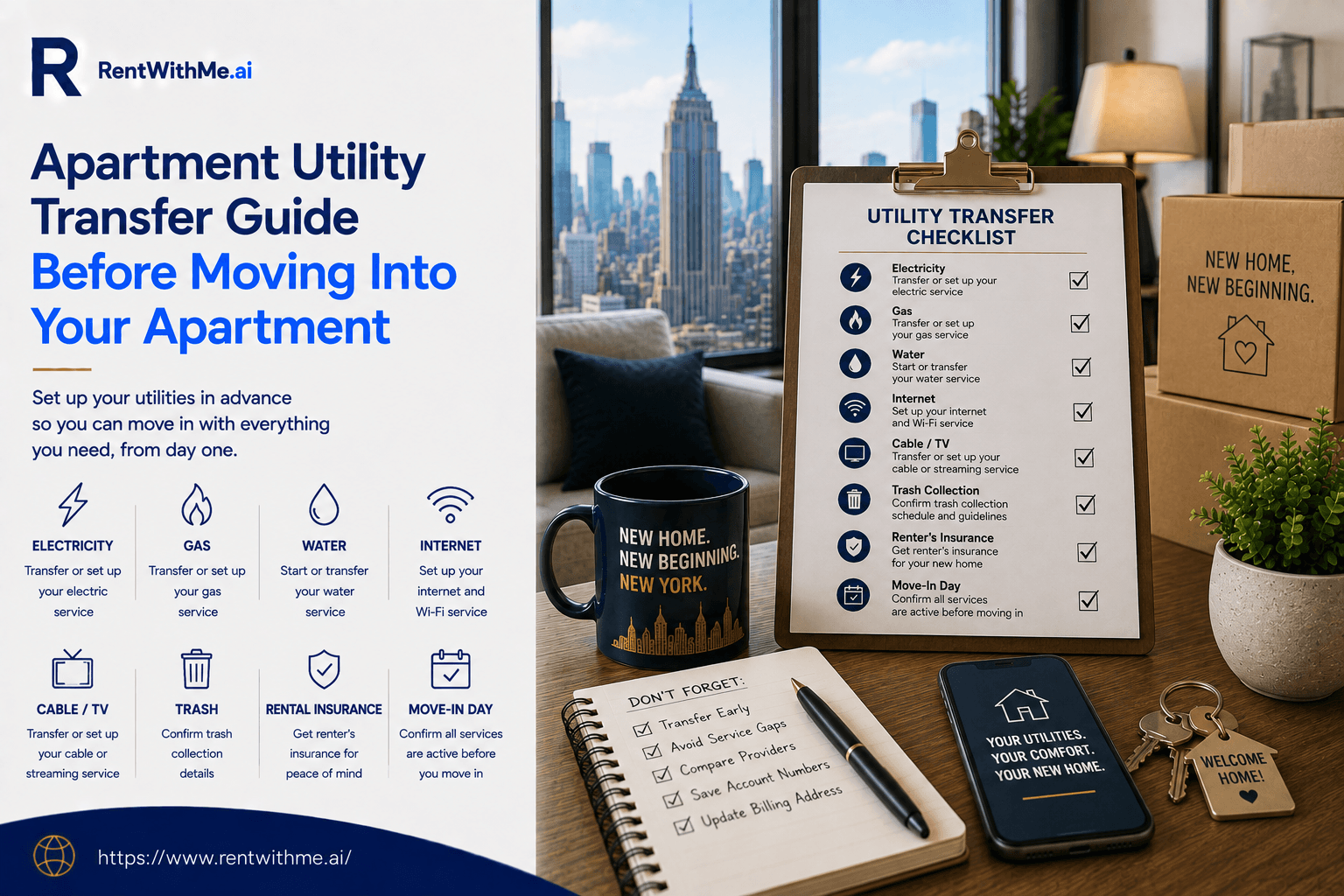
Apartment Utility Transfer Guide Before Moving Into Your Apartment
Introduction
Moving into a new apartment involves more than signing a lease and scheduling movers. Utilities need to be active at the right time, attached to the correct address, and coordinated carefully so you do not arrive without electricity, internet, hot water, or another essential service.
Utility transfers can feel straightforward until different providers, account rules, building systems, and billing dates begin overlapping. One apartment may include heat and water in the rent, while another may require the tenant to set up more services independently.
The safest approach is to confirm utility responsibilities before moving day. Review the lease, ask management questions where needed, contact providers early, and keep records showing when old service ends and new service begins.
This is especially important in New York City, where utility arrangements vary by building. A tenant moving only a few blocks may discover that the new apartment has a different internet provider, a different gas setup, or a different system for heat and hot water.
An organized utility transfer gives you more than convenience. It helps prevent service gaps, duplicate charges, final-bill disputes, and frustrating moving-day surprises.

Why Utility Transfers Should Be Planned Before Moving Day
Utilities should not be treated as a task for the morning you move in.
Some services can be activated quickly, but others may require identity verification, account setup, technician appointments, building access, deposits, or equipment delivery.
Internet installation is a common example.
If a technician must enter the apartment or building, waiting until move-in day to request service can leave you without reliable internet for several days or longer.
That may be inconvenient for anyone.
For someone who works remotely, it can become a serious problem.
Electricity deserves similar advance attention.
Even when service can be started remotely, you should not assume the apartment will automatically remain powered after the previous tenant leaves.
The same applies to gas where the tenant is responsible for establishing service.
A little advance planning allows you to solve these problems while you still have time.
Create a Utility Timeline Before Contacting Providers
Start with three dates.
Know when you lose responsibility for your old apartment.
Know when you gain access to the new one.
Know the actual moving date.
These dates may not be identical.
Suppose your old lease ends August 31, but you receive keys to the new apartment August 28.
You may need electricity in both homes for several days.
The old apartment still needs lighting for packing, movers, cleaning, and final inspection.
The new apartment may need power while you prepare it and move belongings in.
This temporary overlap is often preferable to disconnecting service too early.

Creating a Complete Utility Transfer Checklist
Before contacting anyone, create a list of services connected with both apartments.
Do not assume every utility uses the same provider or account structure.
A practical list might include:
- Electricity
- Gas where applicable
- Heat and hot water responsibilities
- Water or sewer charges where applicable
- Internet
- Cable or television service
- Landline service if used
- Mobile account address information
- Building-specific services or resident technology
Once you know which services apply, mark whether each one is included in rent, handled by management, transferred from an existing account, or opened as a new account.
This prevents you from calling providers unnecessarily while making sure an essential service is not forgotten.
Review Your Lease Before Setting Up Anything
The lease should be your first source for understanding utility responsibility.
Look for sections discussing electricity, gas, water, heat, hot water, air conditioning, internet, and other services.
Do not rely only on what you remember from the apartment listing.
A listing may say “utilities included” without making clear exactly which utilities are covered.
The lease should provide a more precise description.
If something remains unclear, ask management before opening an account.

Utilities Included in Rent Versus Tenant-Paid Services
A service being “included” usually means the landlord or building is responsible for providing and paying for it under the applicable arrangement.
A tenant-paid service generally requires the renter to establish an account directly with the provider or pay according to another arrangement stated in the lease.
Do not assume all utilities work the same way.
Heat may be included while electricity is not.
Hot water may be provided by the building while cooking gas is separately metered.
Internet may be entirely the tenant’s responsibility.
Understanding these distinctions helps you budget accurately.
Ask About Building-Specific Utility Systems
Some apartment buildings have systems that are not obvious during a showing.
For example, a building may provide centralized heat but require tenants to pay electricity for individual air-conditioning systems.
Another property might use electric cooking instead of gas.
A newer building could have an internet provider prewired throughout the property.
Ask management how the apartment is configured.
This is particularly useful if you are moving from a very different building.
The utility setup you are accustomed to may not exist in the new home.

Setting Up Electricity Before Move-In
Electricity should usually be one of the first services you confirm.
In New York City, many apartments are served by Con Edison for electricity, although specific arrangements can vary depending on location and building setup.
Before opening or transferring service, confirm the exact service address and apartment number.
Large buildings may have similar unit designations, so accuracy matters.
Use the address exactly as management or the utility recognizes it.
A small error can delay activation or attach service to the wrong unit.
Choose the Correct Electricity Start Date
The ideal start date is generally the date you become responsible for the apartment or the date you need electricity there, depending on the lease and arrangement.
Do not automatically choose moving day if you receive possession earlier.
You may need power for cleaning, inspection, appliance checks, internet installation, or preparation.
Likewise, avoid activating service weeks early without understanding whether you will be billed during that period.
Coordinate the account start date with the actual possession timeline.

Do Not End Old Electricity Too Early
Your old apartment may need power after most belongings are gone.
Lights are useful during final cleaning and inspection.
Vacuum cleaners need electricity.
Refrigerators may still be running.
Building staff or movers may need normal lighting.
If you are taking final condition photographs, good lighting makes documentation easier.
Consider ending electricity after the apartment is fully cleared and surrendered rather than immediately after furniture leaves.
Save Electricity Account Confirmation
When you establish or transfer service, save the confirmation information.
Record the requested start date.
Check the address carefully.
If an account number is issued, store it securely.
Do the same when ending service at the old apartment.
A written or electronic confirmation can help if a future bill uses the wrong dates.

Transferring or Starting Gas Service When Required
Not every NYC apartment requires the tenant to establish a gas account.
Some apartments use gas for cooking.
Others use electric ranges.
Some buildings may handle certain gas-related costs differently.
Check the lease and ask management before contacting a gas provider.
If the tenant is responsible, start the setup process early enough to handle any required appointment or access.
Gas activation can involve safety procedures that should never be rushed or improvised.
Never Attempt to Activate Gas Yourself
If gas service is off, do not try to restore it independently.
Use the authorized utility and follow management procedures.
The same applies to gas appliances.
If a stove does not ignite after service is active, report the issue rather than disassembling or modifying the appliance.
Gas-related concerns should be handled by qualified professionals.
Moving into an apartment is not the time for experimental repairs.
Confirm Whether a Technician Needs Access
Some utility work can be completed remotely.
Other situations may require someone to enter the apartment, access a meter, or coordinate with building staff.
Ask whether an appointment is necessary.
If so, check building access procedures.
A utility technician may need management or superintendent access to a basement, utility room, locked area, or meter location.
Scheduling the appointment without coordinating the building can result in a wasted visit.

Understanding Heating Responsibilities
Heating can be confusing because the source of heat and the cost of operating it are not always the same thing.
Many NYC apartment buildings provide centralized heat as part of the building’s systems.
However, other apartments may use systems that involve tenant-paid electricity or another energy source.
Review the lease.
Ask what type of heat the apartment uses.
Find out whether you control the thermostat.
If heating cost is your responsibility, ask which utility account covers it.
This information can materially affect your monthly budget.
Hot Water Can Follow a Different Arrangement
Do not assume heat and hot water are always handled together.
A building may provide both.
Another arrangement may differ.
Ask whether hot water is included in rent and how it is produced.
You do not need to understand the building’s entire mechanical system.
You simply need to know whether you have any account or payment responsibility.
This prevents unexpected bills after moving in.
Check Heating Controls During the Move-In Inspection
Identify thermostats, radiators, vents, or other heating equipment.
If the season allows, make sure the system appears functional.
Ask management how temperature control works.
Some centralized systems do not give tenants full individual control.
Knowing this before winter is much better than learning it during the first cold night.
If something appears nonfunctional, report it promptly.
Air Conditioning May Affect Electricity Costs
Air conditioning is often one of the largest seasonal electricity expenses.
If the apartment has central air, mini-split systems, through-wall units, or another installed cooling system, ask whether electricity for that equipment is billed directly to you.
If you plan to install your own window units, review building rules first.
Do not assume every window can accept one.
The type of cooling system can influence your utility costs significantly during NYC summers.
Water and Sewer Charges
In many NYC apartment rentals, tenants do not directly establish a standard city water account for the individual apartment.
The responsibility is often handled at the building or property level.
However, you should still confirm the arrangement rather than assume.
Some rental agreements may include water-related charges or other billing structures.
Read the lease.
If the tenant pays anything related to water, ask how the amount is calculated and who collects it.
The phrase “water included” should be understood clearly before you move in.
Watch for Utility Billing Through Management
Some buildings may bill certain services through management rather than directly through a utility provider.
This can apply to specific building systems or shared services.
Ask whether any utility-related charges appear on the monthly tenant ledger.
If they do, find out whether they are fixed or based on usage.
Understanding the billing method helps you compare your expected monthly housing cost with the advertised rent.
Choosing and Scheduling Internet Service
Internet has become an essential utility for many renters.
Do not assume the provider you used at the old apartment serves the new building.
Availability can vary by address and unit.
Check providers before moving.
If possible, compare speed, pricing, equipment, installation requirements, and contract terms.
For remote workers, reliability may matter more than choosing the absolute lowest monthly price.
Ask Management Which Providers Serve the Building
Building management often knows which companies have existing infrastructure in the property.
This can save time.
A provider may claim service is available in the neighborhood while installation in your particular unit requires additional work.
Ask whether the apartment has active cable, fiber, or another connection.
Find out where equipment is typically installed.
Do not drill holes or modify wiring yourself without building approval.
Schedule Installation Before You Need It
If a technician appointment is required, book early.
Popular appointment slots can fill.
This is particularly important near the beginning or end of a month when many people move.
If you work remotely, try to have internet functioning before your first required workday from the new apartment.
A mobile hotspot can provide temporary backup, but it should not automatically become your entire moving plan.
Confirm Whether Someone Must Be Present
Internet installations often require an adult to be present.
Building staff may also need to provide access to telecommunications rooms or utility areas.
Coordinate carefully.
Do not schedule a technician during a time when movers have blocked the apartment or elevators are unavailable.
A thoughtful installation window can save substantial frustration.
Decide What Happens to Old Internet Equipment
If you are closing an old internet account, determine whether routers, modems, cable boxes, remotes, or other devices belong to the provider.
Return required equipment promptly.
Keep the receipt or other proof of return.
Unreturned equipment can generate charges.
Do not assume that because the device has been in your apartment for several years it belongs to you.
Check the account records.
Transferring Existing Internet Service
If your current provider serves the new apartment, a transfer may be simpler than closing one account and opening another.
Still, verify the details.
The plan available at the new building may differ.
Equipment requirements may change.
Promotional pricing may not transfer.
Ask what happens to your billing cycle and whether any installation or transfer fee applies.
Do not assume the account will work automatically when you plug the old router into the new apartment.
Updating Mobile and Communication Services
Your mobile phone works regardless of where you move, but the account address should still be updated.
Review the billing address.
Check any emergency-service or location-specific information managed through the provider.
If you use a home phone, business line, or other communications service, determine whether it moves with you.
Keep these updates on the same checklist as internet service so they are not forgotten.
Cable and Television Services
If you still use traditional cable or another paid television service, decide whether to transfer it.
The new building may support the same provider.
It may also offer different options.
Review your actual usage before automatically carrying every old service into the new home.
Moving is a good time to cancel services you rarely use.
If equipment must be returned, keep documentation showing that it was received.
Transfer an Existing Utility Account or Open a New One?
A transfer can be convenient when the same provider serves both addresses.
It may preserve your account history and online profile.
However, not every provider treats a move as a true transfer.
The service at the old apartment may still be closed while a new service location is added to the same customer profile.
Read confirmation information carefully.
Make sure both addresses and dates are correct.
Do not assume one action automatically handles both sides.
When a New Account May Be Necessary
A new account may be required when the provider changes, account ownership changes, or the utility structure differs.
This is common when moving between roommates, couples, or properties with different services.
Ask what identification or documentation is required.
The provider may request identity verification, a Social Security number where applicable, prior account information, or other documentation.
Complete these steps before the activation deadline.
Timing Utility Start and Stop Dates
The safest strategy is to avoid gaps.
If you have overlapping leases, some overlapping utility charges may be unavoidable.
That is often better than arriving at the new apartment without power or losing electricity at the old apartment before cleaning is finished.
Choose dates based on actual possession.
Your old service should generally continue until you no longer need the apartment.
Your new service should begin when you need access.
The exact dates can differ from the day your furniture moves.
Example of a Short Utility Overlap
Suppose your old lease ends September 30.
You receive the new apartment September 27.
Movers are scheduled September 29.
Starting electricity at the new apartment on September 27 and ending the old account on September 30 may create three days of overlap.
That overlap costs something.
But it also gives you powered apartments on both sides of the move.
You can inspect the new home, install internet, clean the old unit, and complete the final move without unnecessary service interruptions.
Avoid Large Unnecessary Overlaps
A few days can be useful.
Several weeks may not be.
If you receive keys long before moving but do not plan to use the apartment, calculate whether early activation is necessary.
Some services may need to begin at possession because of lease requirements.
Others may not.
Ask management when uncertain.
The goal is reliability without paying for unused service longer than needed.
Common Utility Transfer Mistakes Renters Make
One common mistake is assuming every service will remain active automatically after the previous tenant leaves.
Another is canceling the old utilities too soon.
Some renters also forget to verify the exact apartment number when opening accounts.
In a large building, that can create serious confusion.
Another mistake is failing to ask what the lease already includes.
A tenant may waste time trying to establish a service that management handles.
Forgetting Internet Until the Last Minute
Internet is one of the most common moving-day frustrations because renters treat it as something that can be turned on instantly.
Sometimes it can.
Sometimes it requires a technician appointment.
Check early.
If your work, school, security devices, or entertainment rely heavily on internet access, treat it as an essential service rather than an optional afterthought.
Forgetting to Cancel the Old Account
Starting new service is memorable.
Ending old service is easier to forget.
Keep both actions on the same checklist.
A utility may continue billing until the account is formally closed or transferred according to its process.
Do not assume that returning the apartment keys tells the utility provider that you moved.
They are separate organizations.
Using the Wrong End Date
If you end service before your lease or possession actually ends, you may create problems during final cleaning and inspection.
If you end it too late, you may pay for usage after another person takes possession.
Choose the date carefully.
Keep confirmation.
If possible, compare the final bill’s service dates with your records when it arrives.
Forgetting the Apartment Number
NYC buildings can contain dozens or hundreds of residences sharing one street address.
Always verify the unit.
A missing apartment number can delay account setup, equipment delivery, technician appointments, or billing.
Use the exact format recognized by the provider.
If the utility system displays a slightly different unit format from your lease, confirm that it refers to the correct apartment before completing the request.
Assuming All Utilities Use the Same Name
If you live with a partner or roommate, different services may be placed in different people’s names.
Decide this intentionally.
Do not discover after moving that everyone assumed someone else opened the electricity account.
Keep a shared list showing the account holder for each service.
This becomes particularly important when the household later changes.
Not Saving Confirmation Numbers
Utility transfers create multiple transactions.
One closes the old address.
Another starts the new one.
Internet installation may generate an appointment number.
Equipment returns create receipts.
Store this information.
If a billing problem appears later, you will not have to reconstruct the entire move from memory.
Build a Utility Transfer File
Create one digital folder or note containing the important utility information.
Include provider names, old and new addresses, account numbers where safe to store them, start and stop dates, confirmation numbers, appointment times, and equipment-return receipts.
Do not store passwords in an unsecured document.
The goal is organization rather than creating a security risk.
A clean record makes final-bill review much easier.
Test Utilities Before Moving All Your Belongings In
If you have access to the new apartment before moving day, test what you reasonably can.
Turn on lights.
Check outlets.
Run hot and cold water.
Verify that supplied appliances have power.
Confirm the internet installation if it has already occurred.
If heating or cooling is seasonally available, learn how the controls work.
Finding a problem before the moving truck arrives gives you more room to solve it.
Coordinate With Building Management
Utilities and building systems are closely connected.
A technician may need access to a meter room.
Internet installers may need a locked telecommunications area.
Gas work may require building coordination.
Ask management whether appointments need advance notice.
The utility company controls the service, but the building may control physical access to part of the infrastructure.
Ignoring that distinction can lead to canceled appointments.
Preparing for the Billing Side of Utility Transfers
At this point, the main services should be identified and scheduled.
You know what is included in rent.
Electricity and gas responsibilities are clearer.
Heating and hot water arrangements have been reviewed.
Internet and communication services are being transferred or established.
The next stage is financial and operational.
You need to understand deposits, activation charges, rate plans, final bills, overlapping service periods, meter readings where appropriate, autopay, move-in testing, and what to do when a utility does not activate as expected.
Part 2 will continue with those details so the account setup itself is as organized as the service transition.
Understanding Utility Deposits, Activation Fees, and Account Setup Costs
Once you know which utilities must be transferred or opened, the next step is understanding what each account may cost to establish. Renters sometimes budget carefully for movers, security deposits, furniture, and rent while overlooking smaller utility-related charges that arrive during the same month.
Depending on the provider and circumstances, an account may involve a deposit, installation charge, equipment fee, activation cost, or another one-time expense. Ask about these charges before confirming service so the first bill does not contain an unexpected amount.
A provider may also have different requirements for existing customers and new customers. Someone transferring an established account could have a different setup experience from a renter establishing service with the company for the first time.
Ask About Charges Before Completing the Transfer
When arranging service, review the full cost rather than focusing only on the advertised monthly rate.
Ask whether there is an activation fee, installation charge, equipment rental, deposit, or other one-time cost. For internet service, also determine whether professional installation is required or whether self-installation is available.
If a deposit is required, ask how and when it may be returned or credited according to the provider’s policies. Keep the terms with your other moving records so you do not forget about the deposit months later.
Understand the Difference Between a Deposit and a Fee
A deposit and a fee are not the same thing.
A fee generally pays for a service or transaction, such as installation. A deposit may be held according to the provider’s policies and potentially returned or credited later if applicable conditions are met.
Read the provider’s explanation before paying.
If a charge is unclear, ask what it represents and whether it is refundable. Do not assume every amount collected during setup will eventually come back to you.
Reviewing Rate Plans Before Starting Service
Utility transfers are also an opportunity to understand how you will be charged.
Electricity and gas bills can include different components, while internet plans may include promotional rates, equipment charges, taxes, and pricing that changes after an introductory period.
Do not judge a service entirely by the headline price.
A plan advertised at one amount can have a noticeably different total once equipment and other applicable charges are included.
Look Beyond the Promotional Internet Price
Internet pricing deserves careful attention because introductory offers can be attractive.
Ask how long the advertised rate lasts.
Find out what the regular price becomes afterward.
Check whether equipment is included or billed separately.
If the service has data restrictions, installation requirements, cancellation terms, or other important conditions, understand them before committing.
A slightly more expensive plan with straightforward pricing may sometimes fit your household better than a heavily discounted offer that increases substantially later.
Choose Internet Speed Based on Actual Use
More speed is not automatically better value.
A household that mainly browses websites, streams video, and uses ordinary video calls may have different requirements from a home containing several remote workers, gamers, content creators, or people regularly transferring large files.
Consider how many people will use the connection simultaneously.
Think about the activities occurring at peak times.
Then select a plan that provides enough capacity without automatically paying for the most expensive tier.
Understand Your Electricity Billing Structure
Electricity bills can contain more than a simple multiplication of usage by one advertised rate.
Supply, delivery, taxes, adjustments, and other applicable components can contribute to the total bill.
Your first bill may also cover a different number of days from a normal monthly billing cycle.
This makes the first statement worth reviewing carefully.
Check the service period, usage, account address, and charges rather than looking only at the total amount due.
Confirming the Account Name and Service Address
Utility account accuracy starts with the service address.
Check the street number, street name, borough or city designation where applicable, ZIP Code, and apartment number.
Then verify the account holder’s name.
If a provider uses a particular unit designation that differs slightly from the way your lease displays it, confirm that the provider’s record refers to your actual apartment.
Do not guess when two units have similar identifiers.
Mailing Address and Service Address May Be Different Fields
Some providers maintain a service address and a separate mailing address.
The service address identifies the apartment receiving the utility.
The mailing address determines where paper correspondence goes.
For most renters, both may be the new apartment.
However, someone who receives mail elsewhere may need different information in each field.
Review both carefully rather than assuming one update automatically changes the other.
Keep Names Consistent Where Practical
Using consistent identification across important accounts can reduce confusion.
This becomes especially useful when building management, utility providers, and account verification systems need to identify the resident responsible for service.
Roommates should decide whose name will appear on each account.
If responsibility is being shared, keep a private household record showing which person owns each utility account and how expenses are divided.
Taking and Saving Meter Readings When Appropriate
Depending on the apartment and utility arrangement, you may be able to document a meter reading around the time responsibility changes.
This can provide a useful reference if questions arise about usage before or after your occupancy.
Do not enter locked utility areas or handle equipment you are not authorized to access.
If meters are accessible only to building staff or utility employees, follow their procedures.
The goal is documentation, not interfering with utility equipment.
Photograph Accessible Readings
If a meter is safely and legitimately accessible to you, a dated photograph can provide useful documentation.
Make sure the image is readable.
Keep it with your move-in records.
A photograph does not replace the utility provider’s official meter data, but it can help you remember what you observed at the beginning of service.
The same principle applies when leaving the old apartment.
Compare Your First Bill With the Start Date
When the first statement arrives, review the service period.
Make sure billing does not begin significantly earlier than the date you became responsible for the apartment unless there is a valid reason.
Look at the meter information where provided.
If something appears inconsistent, contact the provider promptly.
Billing questions are usually easier to investigate while the move and account setup are still recent.
Handling Final Bills at Your Previous Apartment
Closing an old utility account does not end your responsibility to review it.
A final bill may arrive after you have moved.
Do not ignore messages from the provider simply because the apartment is no longer yours.
Check the final service date.
Review usage.
Confirm that payments and credits were applied correctly.
If you had a deposit, determine how the provider handled it.
Give the Provider a Reliable Final Billing Destination
If the company mails final statements, provide a current mailing address.
Paperless billing can make this easier, but the account profile should still contain accurate contact information.
Keep access to the old account until the final balance has been resolved.
Do not immediately delete the provider’s app or discard account records.
You may need them to review the closing statement or download prior bills.
Save Proof That Service Was Ended
Keep the cancellation or transfer confirmation.
Record the effective date.
If you returned equipment, keep the return receipt.
These documents can be valuable if another charge appears later.
A screenshot of an online confirmation is often easier to locate than trying to remember what happened during a hectic moving week.
Avoiding Charges After You Leave the Old Apartment
One of the most frustrating moving expenses is a bill for service used after you surrendered the apartment.
Preventing this begins with selecting the correct termination date and documenting it.
Do not simply stop paying.
Closing the account through the provider’s formal process is essential.
An unpaid active account can create a much larger problem than a forgotten final statement.
Coordinate the Date With Key Return
Your utility end date should make sense relative to when you surrender possession.
If you return the keys on August 31, ending tenant-paid electricity several weeks later may expose you to unnecessary charges.
Ending it several days before you finish moving can create a different problem.
Align the dates carefully.
Keep proof of when you returned possession to management as part of your overall move-out documentation.
Managing Short-Term Utility Overlap
Overlap is not automatically a billing mistake.
If you control both apartments for several days, paying for electricity at both may be reasonable.
The key is knowing that the overlap is intentional.
Write the dates on your utility checklist.
This prevents you from seeing two simultaneous bills later and mistakenly assuming the provider made an error.
Calculate Whether Optional Overlap Is Worth It
Some overlap provides practical value.
You can clean the old apartment while preparing the new one.
Internet can be installed before your first workday.
The refrigerator can be running before groceries arrive.
However, unnecessary overlap increases moving expenses.
For optional services such as premium television packages, you may not need service at both addresses simultaneously.
Prioritize essentials.
Setting Up Auto-Pay Carefully
Auto-pay can simplify utility management once your accounts are established.
However, do not rush through setup without reviewing the first few bills.
Confirm that the provider has the correct account and service address.
Check the due date.
Verify the payment method.
If you transferred service, make sure an old account balance and a new service location are being handled as expected.
Automatic payments are convenient only when the underlying information is correct.
Avoid Accidental Duplicate Payments
If you manually pay a first bill and then activate auto-pay, check whether the automatic payment is still scheduled.
Provider systems differ.
Do not assume a recent manual payment will always cancel a pending automatic withdrawal.
Review the payment status after making changes.
This is particularly important during a move when your checking account may already be handling rent, movers, deposits, furniture, and other unusually large expenses.
Choosing Paperless Billing and Account Alerts
Paperless billing can reduce the risk of statements going to the wrong apartment.
It also makes it easier to manage old and new accounts during a transition.
Activate email or app alerts if they are useful to you.
Notifications for new bills, upcoming due dates, unusual usage, service interruptions, and successful payments can help you notice problems early.
Do not rely on alerts alone.
Log in periodically and review the actual account.
Update Your Email and Phone Number
A utility transfer is a good time to verify your contact information.
Make sure the provider has an email address you actively monitor.
Confirm your current mobile number.
Accurate contact information can be important for technician appointments, outage notifications, account security, and billing issues.
Remove obsolete contact information when appropriate.
Testing Electricity on Move-In Day
Do not assume that because one light turns on, everything electrical in the apartment is working correctly.
Test the apartment reasonably and safely.
Turn on installed light fixtures.
Check several accessible outlets with an ordinary device or charger.
Confirm that supplied appliances have power.
If something does not work, determine whether the issue affects the entire apartment or only one fixture or outlet.
Do not begin electrical repairs yourself.
Report suspected building or apartment electrical problems to management.
Learn Where the Electrical Panel Is
Ask management or the superintendent where the apartment’s electrical panel is located if it is accessible to tenants.
Know how to recognize a tripped breaker, but do not perform work beyond what you are authorized and comfortable doing.
If breakers repeatedly trip, report the issue.
Repeated electrical problems can indicate something that requires professional attention.
Do not solve them by repeatedly resetting equipment without investigating the cause.
Testing Water When You Move In
Run water from the kitchen and bathroom fixtures.
Check both hot and cold water.
Observe water pressure and drainage.
Look underneath sinks for visible leaks while the faucets are running.
Flush toilets.
Check around their bases for obvious water problems.
These simple observations can reveal maintenance issues before your belongings fill the apartment.
Report problems promptly and document significant preexisting conditions.
Check Hot Water at a Reasonable Time
Hot water may not appear instantly at every fixture.
Allow a reasonable amount of time.
If it never becomes appropriately hot, contact building management rather than assuming you need to open another utility account.
In many apartment buildings, hot-water service is part of the property’s systems.
Management can explain the setup and investigate problems.
Testing Gas Appliances Where Applicable
If your apartment has authorized gas service and a gas cooking appliance, follow the manufacturer’s normal operating procedure.
Do not attempt to relight, modify, disconnect, or repair gas equipment unless you are qualified and authorized to do so.
If you smell gas, treat the situation seriously.
Leave the affected area and follow the emergency instructions of the appropriate utility and local authorities.
Do not use switches, flames, or equipment in a way that could create an ignition source.
Gas safety always takes priority over troubleshooting an appliance.
Checking Heating and Cooling
Heating and cooling systems should be understood before you urgently need them.
Identify the controls.
Ask management which systems are tenant-controlled.
If you have through-wall or mini-split equipment, learn the basic operating settings.
For central building heat, understand that control may work differently from a private home’s thermostat.
Do not wait until extreme weather to learn how the system functions.
Report Problems Early
A weak air conditioner during mild weather may become a serious comfort issue during a heat wave.
A radiator problem discovered in early autumn is easier to address before colder conditions arrive.
Report unusual noises, leaks, nonfunctional controls, or obvious damage.
Document conditions at move-in.
That protects both your comfort and your record of the apartment’s initial condition.
Testing Internet Service
Once internet service is activated, test it in more than one location.
A connection can be fast near the router but weak in a bedroom or home office.
Walk through the apartment with a phone or laptop.
Check the areas where you expect to work, stream, or use connected devices.
If coverage is poor, router placement may help.
Larger apartments or difficult layouts may require additional networking equipment.
Test the Connection Before a Critical Workday
Remote workers should not wait until five minutes before an important meeting to test the new connection.
Run video calls.
Connect to required workplace systems.
Test upload performance if your job involves large files.
Make sure your computer can connect from the planned workspace.
Keep a temporary backup connection available during the first few days if uninterrupted access is essential.
What to Do if Electricity Is Not Active
First, verify the account activation date.
Check whether the provider shows service as active.
Then determine whether the problem affects the whole apartment.
If the provider believes service should be active but the apartment has no electricity, follow the provider and building management’s troubleshooting procedures.
Do not tamper with meters or building electrical equipment.
Contact the appropriate professionals.
Keep notes showing whom you spoke with and when.
Separate Utility Problems From Apartment Maintenance Problems
A service can be active while an individual fixture remains broken.
For example, electricity may work throughout the apartment while one outlet does not.
That is different from the utility failing to provide service to the unit.
Understanding the distinction helps you contact the right party.
Utility providers generally handle the service they deliver, while management may be responsible for building or apartment systems on its side of the arrangement.
When uncertain, describe the symptoms accurately and let the appropriate parties determine responsibility.
What to Do if Internet Installation Fails
Installation problems are common enough that renters should have a backup plan.
A technician may discover that additional building access is required.
Existing wiring may not function.
The appointment may be delayed.
Contact the provider and management promptly.
Ask exactly what is preventing installation.
If access to a telecommunications room is required, coordinate a new appointment when authorized building staff can provide entry.
Avoid allowing an installer to make unapproved modifications to the apartment or common areas.
Coordinating Utility Access With Building Management
Building management can be an essential part of utility setup even when it does not control the account.
Technicians may need access to basements, roofs, utility closets, telecommunications rooms, meter rooms, or other restricted spaces.
Tell management about appointments in advance when necessary.
Ask whether contractors must provide identification, insurance information, or other documentation.
Larger NYC buildings may have formal procedures for outside vendors.
Ignoring them can result in a technician being denied entry.
Ask About Service Hours
Some buildings restrict contractor work to certain hours.
A utility or internet company may offer an evening appointment that your building does not permit.
Check before confirming.
This is particularly important for installations involving drilling, wiring, or access to common areas.
A five-minute conversation with management can prevent a missed appointment.
Updating Emergency Contact Information
Utility accounts should contain current contact information.
If the provider sends outage alerts, safety notices, or technician updates, you want them reaching the right phone and email.
Review emergency notification settings where available.
If you have accessibility or medical circumstances that affect utility planning, contact the provider to learn about any programs or procedures that may apply to your situation.
Do not assume eligibility or special protections.
Ask the provider directly about current requirements.
Managing Utilities With Roommates
Shared apartments require clear financial organization.
Decide who will be the account holder for electricity, gas where applicable, internet, and other shared services.
Then agree on how bills will be divided.
Do this before the first statement arrives.
Arguments become more likely when expectations were never discussed.
A simple written household agreement can clarify payment dates, percentages, and what happens when a roommate moves out.
Equal Splits Are Not the Only Option
Many roommates divide utilities equally because it is simple.
That may work well when everyone uses the apartment similarly.
Other households may choose a different arrangement.
Someone with a substantially larger room, a private air-conditioning unit, or unusual usage patterns may agree to a different contribution.
The important issue is transparency.
Choose the method before bills begin accumulating.
Decide Who Controls the Internet Account
Internet service often becomes complicated when the account holder moves out.
If possible, discuss this when the household is formed.
Know whether the provider permits an account transfer or whether a new account would need to be opened.
Keep shared expenses separate from personal passwords.
Roommates need to know how much is owed, not necessarily have full access to another person’s private provider credentials.
Utility Planning for Couples
Couples may prefer to divide responsibility by service.
One person can manage electricity while the other handles internet.
Alternatively, one person may manage all household accounts while both contribute financially.
Either method can work.
The important part is that both people know where essential information can be found if the usual account manager is unavailable.
Keep confirmation details and provider contact information somewhere appropriate and accessible to the household.
Consider Whose Name Goes on the Account
The account holder may be responsible for payments and communication with the provider.
Choose deliberately.
Do not place every account in one person’s name simply because that person happened to make the first phone call.
Consider how the household handles budgeting and whether both partners need authorized access.
Provider policies vary, so ask what options exist.
Families Should Think About Service Reliability
Families may have greater dependence on continuous electricity and internet service.
Children may need internet for schoolwork.
Parents may work from home.
Food storage and household routines depend on reliable power.
Plan utility transitions with a little extra buffer.
Avoid unnecessary same-day cancellations and activations when a small overlap would provide greater security.
Keep Essential Devices Charged During the Move
Even a well-planned transfer can encounter delays.
Charge phones, laptops, battery packs, and other essential devices before moving day.
This is a practical backup rather than a substitute for proper utility setup.
Keep chargers accessible rather than packing them deep inside boxes.
The first evening becomes much easier when basic electronics are usable.
Reviewing Your First Utility Bills
The first billing cycle deserves more attention than later ones.
Check the service address.
Check the dates.
Review usage.
Look for deposits, installation fees, equipment charges, credits, and promotional discounts.
Compare the bill with what you were told during account setup.
If something differs materially, ask the provider for an explanation.
Do not wait several months while the same error repeats.
Expect the First Billing Period to Look Different
A first bill may cover a partial month or an unusual number of days.
That can make it look unusually high or low.
Review the billing period before deciding whether the amount is reasonable.
Internet bills may also include one-time installation or equipment costs.
Utility accounts may include deposits or adjustments.
Separate recurring charges from one-time charges when evaluating your future monthly budget.
Building a Realistic Monthly Utility Budget
After the first few billing cycles, calculate your normal utility spending.
Do not rely solely on the first statement.
Seasonal electricity and heating-related costs can change significantly.
Create a range rather than expecting the same total every month.
A household might have lower electricity use during mild weather and substantially higher consumption during heavy air-conditioning periods.
Internet costs are usually more predictable unless promotions expire or services change.
Watch for Promotional Expiration Dates
If your internet plan has introductory pricing, record when it ends.
Do not wait until the first higher bill to remember.
Add a calendar reminder several weeks before expiration.
At that point, you can review available plans and determine whether your current service still offers good value.
This turns a future surprise into a planned decision.
Preparing for the Final Utility Transfer Review
By now, the utility transfer should be moving beyond simple activation.
You have considered deposits, setup fees, billing structures, service dates, final bills, meter documentation, autopay, account alerts, and move-in testing.
You also know how building management can affect technician access and why roommate or household responsibilities should be established early.
The remaining step is to bring everything together into a system you can use during an actual move.
Part 3 will cover real-world transfer scenarios, a complete utility checklist, commonly forgotten services, billing disputes, previous-tenant account problems, NYC apartment moves, cost-control strategies, final verification steps, and a comprehensive conclusion for completing the move with every essential service properly organized.
Real-Life Utility Transfer Examples for Apartment Moves
Utility planning becomes easier when you see how the process works in realistic moving situations. The exact combination of electricity, gas, internet, heat, hot water, and other services can vary considerably between apartments, even when the two properties are located in the same neighborhood.
The most reliable approach is to work from the lease and confirmed building information rather than assuming the new apartment operates like the old one. Once responsibilities are clear, you can coordinate start dates, stop dates, billing, appointments, and final verification.
Moving Between Two NYC Apartments
Consider a renter whose current lease ends on September 30 but whose new lease begins on September 27.
The renter plans to move on September 29.
Rather than shutting off electricity at the old apartment on September 27, the renter keeps it active through September 30. Electricity at the new apartment begins September 27, creating a short and intentional overlap.
That overlap makes the move easier.
The renter can inspect the new apartment with working lights, test appliances, prepare the refrigerator, and have internet installed before furniture arrives. Meanwhile, the old apartment still has electricity for packing, cleaning, and the final inspection.
Internet requires separate planning.
The existing provider serves the new building, but the renter confirms that a technician appointment is necessary. Installation is scheduled for September 28, giving the household a day to test the connection before the main move.
The renter also discovers that heat and hot water are handled through the new building’s arrangement, while electricity is the tenant’s responsibility.
Because this was confirmed before opening accounts, the renter avoids wasting time trying to establish unnecessary services.
Moving Into Your First Apartment
A first-time renter has a different challenge.
There may be no existing utility accounts to transfer.
Instead, the renter must determine exactly which services require new accounts.
The lease shows that electricity is the tenant’s responsibility, while certain other building services are included according to the rental agreement.
Internet is optional but essential to the renter because of remote work.
The renter contacts the appropriate electricity provider before move-in and arranges service to begin when possession starts.
Internet installation is scheduled in advance.
The renter also asks management whether technicians need access to any restricted building areas.
By moving day, the apartment has electricity and the internet installation is already complete.
The renter avoids trying to solve every utility problem while movers are carrying furniture through the door.
Moving in With Roommates
Suppose three roommates sign a new apartment lease.
The lease makes them responsible for electricity and internet.
Rather than waiting until the first bill arrives, they decide beforehand who will hold each account.
One roommate opens the electricity account.
Another manages internet service.
They agree that ordinary monthly utility costs will be divided equally and choose a regular date for reimbursements.
They also record whose name appears on each service.
This simple arrangement makes future changes easier.
If one roommate eventually moves out, the household knows immediately which services could be affected.
Moving With a Family
Families often benefit from a larger overlap between old and new services.
Parents may need internet for work while children need it for school and entertainment.
Food may need to remain refrigerated at both apartments during the transition.
Instead of trying to synchronize everything to one exact moving hour, the family creates a short overlap.
The new apartment receives essential services before the main move, while the old utilities remain active until cleaning and final departure are complete.
This costs slightly more for a few days.
However, the added reliability can be worthwhile during a complicated household move.
Frequently Asked Questions About Apartment Utility Transfers
Utility transfers generate many questions because every building and provider can operate differently.
The answers below provide general planning principles, but your lease, building management, and utility provider should determine the exact procedure for your apartment.
When Should I Start Transferring Utilities?
Begin planning as soon as your lease and move-in date are confirmed.
You do not necessarily need every service activated weeks in advance, but you should know which providers you need and whether appointments are required.
Electricity and gas responsibilities deserve early attention.
Internet should also be investigated quickly if a technician must visit.
Starting early gives you time to solve address problems, appointment delays, account verification issues, or building-access requirements.
Should Utilities Start on My Lease Date or Moving Date?
That depends on when you become responsible for the apartment and what your lease requires.
If your lease begins several days before you physically move, you may still need certain tenant-paid utilities active from the beginning of your tenancy.
Confirm your responsibility rather than guessing.
The date you receive possession can matter more than the date the moving truck arrives.
Can I Have Utilities at Two Apartments at the Same Time?
In many circumstances, yes.
A temporary overlap is common when leases overlap.
The exact account arrangement depends on the provider.
Keeping essential services at both apartments for a few days can make moving much easier.
The important thing is to know that the overlap is intentional and understand the resulting charges.
Should I Turn Off Electricity the Day Movers Leave?
Not necessarily.
You may still need electricity for cleaning, repairs, inspections, appliance removal, or other move-out tasks.
Choose the end date based on when you actually stop needing the apartment and your responsibilities under the lease.
Do not leave service running indefinitely after surrendering possession.
Document the termination date.
Do I Need to Open a Water Account for an NYC Apartment?
Many NYC apartment renters do not directly establish a standard individual water account because water service is commonly handled at the property level.
However, rental arrangements can differ.
Review your lease and ask management what you are responsible for paying.
Never assume a utility is included simply because it was included in your previous apartment.
Is Heat Always Included in NYC Rent?
Do not assume that your personal cost arrangement will be identical from one building to another.
NYC landlords have legal obligations regarding the provision of heat during the city’s designated heat season, but how a particular apartment’s heating system operates and which energy costs a tenant pays can depend on the property and lease arrangement.
NYC’s current heat rules generally apply from October 1 through May 31. During the day, when the outside temperature falls below 55°F, indoor temperatures must generally be at least 68°F; overnight, apartments must generally be at least 62°F regardless of the outside temperature.
Review your lease to understand the financial arrangement for your apartment.
If you have a heat problem, building management should be contacted promptly, and NYC provides complaint procedures when required heat is not restored.
What Happens if I Forget to Cancel My Old Utility?
Contact the provider immediately.
Explain when you moved and provide any documentation the provider requests.
Do not assume the account will automatically be corrected retroactively.
Your lease termination, key-return documentation, move-out inspection, utility confirmation records, and other evidence may help establish when you stopped occupying the apartment.
The provider’s procedures will determine how a billing dispute is handled.
Can My Landlord Transfer My Utility Account for Me?
Do not assume so.
If the lease makes you responsible for establishing a utility account, you should complete the provider’s required process yourself unless management has clearly explained another arrangement.
The landlord and utility provider are separate organizations.
Giving your landlord the keys at move-out does not necessarily tell the utility company to close your account.
Complete Apartment Utility Transfer Checklist
Use this as a master reference and remove items that do not apply to your apartment.
- Review the lease for utility responsibilities.
- Confirm the date you receive possession.
- Confirm the date responsibility for the old apartment ends.
- Identify the electricity provider.
- Schedule electricity at the new apartment.
- Schedule termination or transfer at the old apartment.
- Confirm whether tenant-paid gas service applies.
- Arrange authorized gas service when required.
- Confirm how heat is provided and paid for.
- Confirm how hot water is provided and paid for.
- Confirm whether any water-related charges apply.
- Ask about utility charges billed through management.
- Check internet providers available in the building.
- Compare internet plans and total costs.
- Schedule internet installation if necessary.
- Coordinate technician access with management.
- Determine whether old internet equipment must be returned.
- Save equipment-return receipts.
- Transfer or cancel cable and other communication services.
- Update the billing address on mobile accounts.
- Verify the complete new service address.
- Verify the apartment number on every account.
- Record utility start and stop dates.
- Save confirmation numbers.
- Ask about deposits and activation fees.
- Review recurring equipment charges.
- Document meter readings when appropriate and authorized.
- Save relevant move-in photographs.
- Set up paperless billing if desired.
- Configure account alerts.
- Set up auto-pay after verifying account details.
- Test electricity at move-in.
- Test hot and cold water.
- Check supplied appliances.
- Understand heating and cooling controls.
- Test internet before an important work or school day.
- Review the final bills from the previous apartment.
- Confirm deposits or credits were handled properly.
- Review the first bills at the new apartment.
- Check for incorrect service dates.
- Confirm promotional internet pricing and expiration dates.
- Establish a utility-sharing arrangement with roommates.
- Store important utility records securely.
- Review accounts again after the first full billing cycle.
Do not try to complete the list mechanically.
Some apartments require only a few tenant-managed services, while others involve more. The purpose of the checklist is to ensure that every applicable responsibility is considered.
Utilities and Services Renters Commonly Forget
Electricity and internet are difficult to forget because their absence becomes obvious immediately.
Secondary services are easier to overlook.
A renter may transfer electricity and internet successfully while forgetting a cable subscription, equipment rental, mobile billing address, recurring building service, or old utility account.
These forgotten services can continue producing charges long after the move.
Equipment Returns Are Easy to Miss
Provider-owned equipment deserves its own checklist entry.
Modems, routers, cable boxes, remotes, adapters, and other devices can look like ordinary household electronics after years in an apartment.
Before packing them, determine who owns them.
If equipment must be returned, follow the provider’s instructions.
Keep proof of return.
Do not discard that proof immediately after the account closes.
Paid Add-Ons Can Follow the Account
Review optional services attached to internet or communication accounts.
Security packages, premium channels, equipment protection, enhanced support, additional devices, or other features may continue after a transfer.
A move is a useful opportunity to remove services you no longer use.
Look at the entire account rather than transferring it blindly.
Tracking Start Dates, Final Bills, and Confirmations
A utility tracker can be simple.
You do not need sophisticated moving software.
A spreadsheet, secure note, or printed checklist can work well.
The important thing is capturing enough information to reconstruct what happened if a billing question appears.
| Service | Old End Date | New Start Date | Status | Follow-Up |
|---|---|---|---|---|
| Electricity | Confirmed | Confirmed | Active | Review first bill |
| Gas | If applicable | If applicable | Check | Confirm account |
| Internet | Confirmed | Installation booked | Pending | Test connection |
| Cable | Cancelled | Not transferring | Closed | Return equipment |
| Mobile | N/A | Address updated | Complete | Check next bill |
Avoid storing passwords or unnecessary sensitive information in the tracker.
Account numbers should also be handled securely.
The document is primarily a workflow tool.
Keep Records Until Billing Is Settled
Do not throw away confirmations immediately after moving.
Wait until final old-apartment bills are resolved and the new accounts have completed at least one normal billing cycle.
Keep equipment-return documentation longer if a provider could later claim equipment remains outstanding.
Digital copies are useful because paper receipts can disappear during unpacking.
Photograph important receipts if necessary.
Protecting Yourself From Utility Billing Errors
Documentation is your strongest practical protection against billing confusion.
Know when your responsibility began.
Know when it ended.
Save provider confirmations.
Keep move-in and move-out records.
When a bill appears incorrect, compare the service dates first.
Many disputes become easier to understand once you determine exactly which days the provider billed.
Check More Than the Total Amount
A high bill does not automatically mean the usage is wrong.
The first statement may contain installation fees, deposits, equipment charges, partial billing periods, or other one-time items.
Read the individual line items.
Compare them with the terms you accepted.
If something remains unclear, contact the provider and ask for an explanation.
Record the date and outcome of important billing conversations.
What to Do if You Are Charged After Moving Out
Start by checking the account’s official termination date.
If it remained open beyond your requested date, locate the confirmation showing when you asked for service to end.
Then contact the provider.
Explain the discrepancy clearly.
Provide documentation if requested.
Your goal is to establish the correct period during which you were responsible for service.
Compare the Bill With Your Move-Out Documentation
Useful documentation can include your lease end date, utility cancellation confirmation, final inspection information, key-return record, and other legitimate evidence showing when you surrendered the apartment.
Not every dispute will require all of these documents.
Keep them available until everything is settled.
Do not alter or fabricate records.
Clear original documentation is far more useful.
What if the Previous Tenant’s Utility Account Is Still Active?
You may arrive at the new apartment and discover that electricity or another service is currently functioning.
Do not assume that means you can simply use the previous resident’s account indefinitely.
Contact the provider and establish your service according to its procedures.
You want your responsibility to begin on the correct date and under the correct name.
Continuing to use service associated with another person’s account can create unnecessary billing complications.
Do Not Pay a Previous Tenant’s Bill Without Understanding It
If you encounter a balance associated with the apartment, determine whether it actually belongs to you.
A previous resident’s personal debt should not automatically be treated as your responsibility simply because you now live at the same address.
Contact the provider and explain that you are a new occupant.
Be prepared to establish your identity and occupancy dates according to the provider’s requirements.
Keep your lease accessible because it can help document when your tenancy began.
Managing Utilities When Moving Between NYC Apartments
An NYC move can involve only a few miles while still producing major differences in utilities.
The new building may have different internet infrastructure.
Cooking may switch from gas to electric.
Cooling may change from window units to central air.
Heat may operate differently.
Ask questions based on the new apartment rather than transferring your assumptions from the old one.
Compare the Utility Setup During Your Apartment Search
Whenever possible, learn about utilities before signing the lease.
Ask which services are included.
Ask which utilities tenants pay directly.
Find out what kind of heating and cooling the apartment uses.
Check internet availability if connectivity matters to your household.
These details can affect the real monthly cost of an apartment.
A lower advertised rent does not always mean a lower total housing expense if the tenant assumes more utility costs.
Special Considerations for Remote Workers
Remote workers should treat electricity and internet as business-critical services.
Schedule internet early.
Test it before your first full workday.
Check Wi-Fi coverage at the exact location where your desk will be placed.
If uninterrupted connectivity is essential, maintain a reasonable temporary backup.
A mobile hotspot or phone tethering may help during an unexpected installation delay, depending on your plan and signal quality.
Think About Power Requirements
A home office may contain monitors, computers, chargers, networking equipment, printers, lighting, and other devices.
Use electrical systems appropriately.
Avoid overloading outlets or relying on unsafe extension arrangements.
If the workspace lacks adequate outlets or you notice electrical problems, discuss the issue with management rather than improvising unsafe modifications.
Special Considerations for Families
Families should prioritize continuity.
Electricity, hot water, refrigeration, internet, heating or cooling, and other essentials support everyday routines.
A short service overlap can provide additional flexibility.
Have essential phone numbers and account information available on moving day.
Do not pack everything inside inaccessible boxes.
If a service fails, you should be able to contact the provider or management immediately.
Special Considerations for Roommates
Utility sharing should be agreed upon before bills arrive.
Decide whose name appears on each account.
Agree on how costs will be divided.
Set a payment deadline.
Discuss what happens if someone moves out before the lease ends.
A simple written arrangement can prevent misunderstandings.
It does not need to be complicated.
Everyone should understand the basic responsibilities.
Review Accounts Whenever a Roommate Changes
A roommate leaving the apartment can affect utilities even when everyone else stays.
If the departing person controls the internet or electricity account, determine whether the account can be transferred or whether new service must be established.
Do this before the roommate leaves.
Waiting until afterward can result in service interruption.
Common Utility Transfer Mistakes to Avoid
The most common mistake is waiting too long.
Electricity may be straightforward to establish, but internet installations, account verification, or building access can require advance planning.
Another mistake is assuming that every utility must be opened personally.
Read the lease first.
Do not create accounts for services handled through the building.
Do Not Cancel Services Simply Because You Packed
Packing and surrendering an apartment are different events.
Your furniture might leave on Friday while your lease continues through Monday.
You may still need electricity for cleaning and inspection.
Choose termination dates based on actual responsibility and practical need.
Avoid arbitrary dates.
Do Not Ignore the First and Final Bills
These two bills deserve the most scrutiny.
The final old-apartment statement determines whether the account closed correctly.
The first new-apartment statement reveals whether the service began on the correct date and whether setup charges match expectations.
Review both.
Fix errors early.
Do Not Forget Equipment
Returning equipment can feel unimportant compared with moving furniture.
It can still cost money if ignored.
Put provider-owned devices in a clearly labeled box.
Do not mix them with electronics you own.
Return them promptly and save the receipt.
Expert Tips for Reducing Utility Costs After Moving
Once the transfer is complete, attention can shift from activation to efficiency.
Start by understanding your normal usage rather than making dramatic changes immediately.
Review several billing cycles.
Identify which costs are fixed and which change with consumption.
Seasonal differences matter, particularly for electricity used for air conditioning or heating systems where the tenant bears the energy cost.
Adjust Heating and Cooling Thoughtfully
Heating and cooling can consume substantial energy depending on the apartment’s systems.
Use tenant-controlled settings sensibly.
Avoid running cooling aggressively while windows are open.
If the apartment has individual heating controls and you pay the associated energy cost, use them responsibly while maintaining safe and comfortable conditions.
Do not interfere with building heating equipment or block systems in unsafe ways.
Use Energy-Efficient Lighting
If your lease and building rules permit tenants to replace ordinary bulbs, energy-efficient lighting can reduce electricity consumption.
LED bulbs also tend to last much longer than older incandescent alternatives.
You do not need to replace functioning building-owned fixtures unnecessarily.
Focus on tenant-controlled lamps and approved replaceable bulbs.
Manage Standby Electricity Sensibly
Many electronics continue drawing small amounts of electricity while idle.
You do not need to unplug every device each night.
Instead, focus on equipment that consumes meaningful power or does not need to remain active.
Smart power strips or ordinary switched strips can help organize certain electronics when used safely and according to manufacturer instructions.
Never compromise safety simply to reduce a small amount of electricity use.
Maintain Air-Conditioning Equipment Properly
Dirty filters can reduce the effectiveness of certain cooling systems.
Determine whether filter maintenance is the tenant’s responsibility or management’s.
Follow manufacturer and building instructions.
Do not open or service equipment that tenants are not authorized to maintain.
Simple appropriate maintenance can improve comfort while helping equipment operate effectively.
Review Internet Plans Periodically
Internet bills can increase after promotional periods.
Set a reminder before your introductory rate expires.
Review your current speed and usage.
If you are paying for significantly more capacity than your household needs, consider whether a lower tier would be adequate.
Also review equipment charges.
In some circumstances a provider may permit compatible customer-owned equipment, but you should confirm technical compatibility and provider policies before purchasing anything.
Building a Utility Emergency Plan
Utility planning should include the possibility of outages.
Save the official contact information for your electricity, gas, internet, and building management providers.
Know how to report an outage or maintenance problem.
Keep phones and basic backup batteries charged when severe weather or another disruption is expected.
Do not use unsafe heating, cooking, or electrical alternatives during an outage.
Follow official safety guidance.
Know Who Handles Which Problem
Not every outage is a utility-provider issue.
If the entire neighborhood loses electricity, the electric utility is the obvious contact.
If only one outlet in your apartment fails, building maintenance may be more appropriate.
If your Wi-Fi disappears but the provider reports no outage, the problem could involve your router or apartment connection.
Understanding these distinctions can speed up troubleshooting.
Your Final Pre-Move Utility Review
Several days before moving, perform one last review.
Confirm that new electricity service has the correct start date.
Verify any required gas arrangements.
Check internet appointments.
Confirm technician access with management.
Make sure old services have appropriate end dates.
Gather equipment that needs to be returned.
Keep account confirmations accessible.
Then verify what the lease says about heat, hot water, water, and other building-provided services one final time.
You should be able to answer a simple question for every major utility: who provides it, who pays for it, when does your responsibility begin, and what action remains?
If you can answer those four points, your utility transfer is probably well organized.
The First 24 Hours in Your New Apartment
Once you receive the keys, verify that essential services actually work.
Turn on the lights.
Check water.
Test supplied appliances.
Learn the heating and cooling controls.
Connect to the internet.
Confirm your phone receives an adequate signal in important areas of the apartment.
Report problems rather than waiting.
Early documentation makes it easier to distinguish preexisting issues from problems that develop later.
The First Week
During the first week, finish administrative cleanup.
Activate account alerts.
Verify online profiles.
Return old equipment.
Check whether any technician follow-up is required.
Make sure roommates understand payment responsibilities.
Keep an eye on service reliability.
An internet connection that disconnects repeatedly or an electrical issue that keeps recurring deserves attention before it becomes part of everyday life.
The First Month
When the first bills arrive, review them carefully.
Confirm the service address and billing dates.
Separate one-time setup charges from recurring costs.
Check deposits, installation fees, equipment rentals, promotional discounts, and other line items.
Then update your monthly housing budget.
You now have real information rather than estimates.
Conclusion
A successful apartment utility transfer begins well before moving day.
The first step is not calling an electricity company or scheduling an internet technician. It is understanding the apartment itself.
Read the lease.
Identify which services the landlord or building handles and which ones are your responsibility.
Confirm electricity, gas, heat, hot water, water-related charges, internet, cable, and any building-specific services that affect your monthly costs.
Once responsibilities are clear, build a timeline around possession rather than focusing only on the day movers arrive.
Your old apartment may need electricity after most furniture is gone.
Your new apartment may need power and internet several days before the main move.
A short, intentional overlap can provide valuable flexibility.
Electricity deserves early attention because so much of the move depends on it.
Gas service, where applicable, should be handled only through authorized procedures.
Never attempt to activate or repair gas systems yourself.
Internet also deserves advance planning, particularly for remote workers and families.
Check which providers actually serve the building.
Ask whether installation is required.
Coordinate building access.
Schedule the appointment early enough to handle delays.
Then focus on the financial details.
Understand deposits, activation charges, equipment fees, promotional pricing, and recurring costs.
Keep confirmation numbers.
Document start and stop dates.
Save equipment-return receipts.
Review both the final statement from your previous apartment and the first statement from your new one.
Households should also decide who manages each utility.
Roommates need clear account ownership and payment expectations.
Couples and families should know where important service information is stored.
Remote workers should test internet and electricity before relying on the new apartment for a full workday.
Once you move in, test the essentials instead of assuming activation means everything works perfectly.
Check electricity, water, hot water, supplied appliances, internet, heating controls, and cooling systems where appropriate.
Report problems quickly.
Moving creates enough uncertainty without adding avoidable utility confusion.
A checklist turns dozens of small decisions into an orderly process.
The objective is simple: when you open the door to your new apartment, the essential services should already be ready for everyday life.
With the right planning, utility transfers become one of the more predictable parts of moving rather than one of the most stressful.