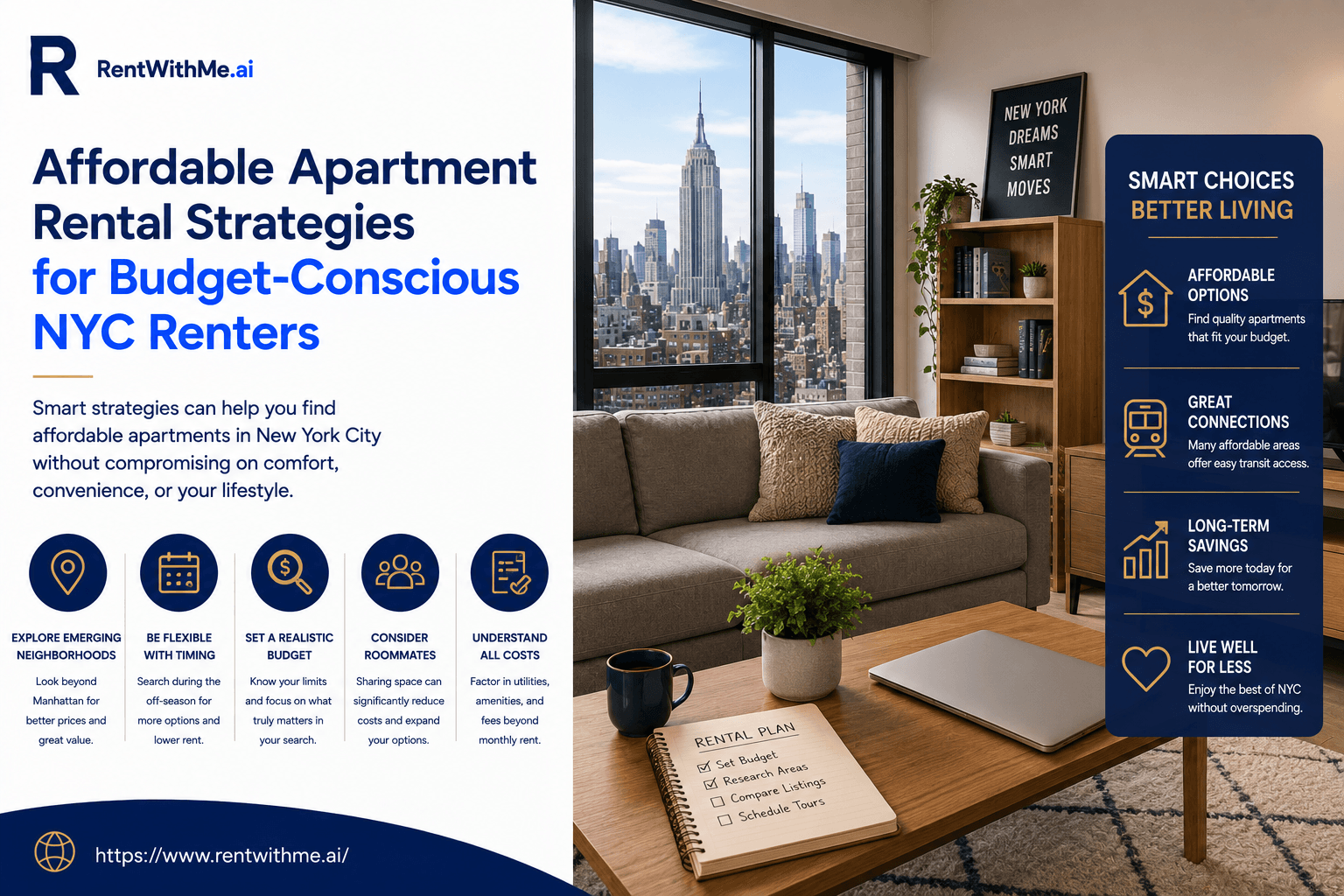
Affordable Apartment Rental Strategies for Budget-Conscious NYC Renters
Introduction
Finding an affordable apartment in New York City can feel like solving a puzzle with too many moving pieces. Rent, location, commute time, apartment size, upfront costs, utilities, and building quality all compete for attention, and the cheapest option on paper is not always the one that saves the most money over time.
For budget-conscious renters, the goal should be broader than simply finding the lowest advertised rent. A smart rental decision balances housing cost with transportation, everyday expenses, apartment condition, neighborhood convenience, and the amount of financial flexibility you still have after paying for housing.
This matters because New York renters often face tradeoffs. A lower-cost apartment may require a longer commute, a smaller floor plan, fewer amenities, or an older building, while a more expensive unit may include features that reduce other monthly expenses or save substantial time.
Affordable renting therefore requires strategy. The more clearly you understand your budget, priorities, and non-negotiable needs before searching, the easier it becomes to recognize real value when you see it.
Preparation also helps renters avoid emotional decisions. Apartment hunting moves quickly, and it is easy to stretch a budget for a unit that looks attractive during a tour but becomes financially uncomfortable several months later.
This guide focuses on practical rental strategies for people who want to control housing costs without making unnecessary sacrifices. The goal is to help you find an apartment that feels financially sustainable, functional, and realistic for everyday life in New York City.
What Affordable Renting Really Means in New York City
Affordable does not necessarily mean inexpensive.
In a high-cost rental market, affordability is better understood as the relationship between housing expenses and the rest of your financial life. An apartment may have a relatively low monthly rent but still feel unaffordable if it creates high transportation costs, large utility bills, or other recurring expenses.
The opposite can also be true.
A slightly higher-rent apartment may offer better value if it is close to work, includes certain utilities, reduces commuting expenses, or eliminates the need for paid amenities you would otherwise purchase separately.
This is why renters should focus on total housing value rather than one number.
Affordability should allow room for groceries, transportation, insurance, healthcare, debt payments, savings, emergencies, and personal spending after rent is paid.
If housing consumes so much of your monthly income that every unexpected expense creates financial stress, the apartment may not be truly affordable regardless of how attractive the rent seemed during the search.

Setting a Realistic Rental Budget Before You Start Searching
A strong apartment search begins with a clear maximum budget.
Do not begin by browsing listings and then decide what you can afford based on the apartments you like. That approach often leads renters to gradually increase their spending because slightly more expensive properties keep appearing more appealing.
Start with monthly income and recurring financial obligations.
Include debt payments, transportation, food, insurance, subscriptions, healthcare, savings goals, and other regular commitments. Then determine how much housing expense can fit comfortably alongside those priorities.
Build some flexibility into the number.
A budget that works only when every month goes perfectly is risky.
Unexpected expenses happen, and renters should ideally maintain enough room to handle them without relying on credit or sacrificing essential needs.
Also remember that the monthly rent is only the beginning.
Your actual housing budget should account for utilities, internet, renters insurance when applicable, laundry, transportation, and other costs that may differ between properties.
A realistic budget creates boundaries that make apartment comparisons easier.
Understanding the Difference Between Cheap Rent and Good Value
The lowest rent does not always produce the lowest overall cost.
Imagine two apartments.
One costs less but is far from public transportation, requires significant utility spending, and lacks laundry access. The other costs slightly more but is close to useful transit, includes some utilities, and has affordable laundry in the building.
The second apartment may provide better overall value.
Good value means receiving enough practical benefit for what you pay.
This can include a manageable commute, a safe and functional layout, reasonable utility costs, reliable building maintenance, and access to everyday services.
Cheap rent can become expensive when hidden tradeoffs create recurring costs.
Long transportation times, frequent ride-share use, poor insulation, costly parking, or constant repairs to personal belongings caused by an unsuitable apartment can all reduce the value of a low rental price.
Budget-conscious renters should therefore ask, “What will this apartment cost me to live in?” rather than only, “What is the rent?”

Choosing NYC Neighborhoods That Better Match a Limited Budget
Location has a major influence on rent.
Highly demanded areas often carry higher housing costs because many renters compete for convenient transportation, entertainment, restaurants, schools, or proximity to major employment centers.
Budget-conscious renters can sometimes find better value by expanding the search beyond the most obvious neighborhoods.
This does not mean choosing a location simply because it is cheaper.
The neighborhood still needs to support your commute, everyday errands, and personal comfort.
Consider areas where transportation keeps your regular destinations accessible even if the apartment is farther from the center of your usual search.
A neighborhood with strong subway or bus connections may provide excellent value because it combines lower rent with manageable travel time.
Walk through potential areas before making a decision.
Look at grocery stores, pharmacies, laundry options, transportation, parks, and other services you use regularly.
Affordable housing works best when the surrounding neighborhood also supports an affordable lifestyle.
Balancing Commute Time With Lower Housing Costs
One of the most common tradeoffs in New York renting is between housing cost and commute time.
Moving farther from work may reduce rent, but those savings should be weighed against additional travel time and possible transportation expenses.
A modest increase in commute time may be completely reasonable if the rent savings are substantial.
A much longer commute can be harder to justify.
Consider the weekly impact rather than evaluating one trip.
Adding twenty minutes each way to a five-day commute means several additional hours spent traveling every week.
Time has value even though it does not appear as a line item in your budget.
Long commutes can affect sleep, exercise, meal preparation, social activities, and overall energy.
The best balance is usually a location where the rent savings are meaningful but the commute remains sustainable.

Evaluating Transportation Cost Alongside Rent
Transportation should be part of the apartment budget.
A lower-rent property may require more transfers, additional bus connections, occasional ride-share use, or car expenses.
Compare those costs with apartments closer to work or better connected to public transportation.
Also think about convenience during evenings and weekends.
If you frequently travel across the city, a location that makes every trip difficult may reduce your quality of life even if the apartment itself is inexpensive.
Budget-conscious renting requires looking at the whole monthly routine.
A slightly higher rent may still produce lower total lifestyle costs when transportation becomes easier.
Deciding Which Apartment Features Are Essential and Which Can Be Flexible
Budget-conscious renters usually need to compromise somewhere.
The key is compromising on features that matter less rather than sacrificing the basics that affect everyday comfort.
Before touring apartments, separate needs from preferences.
Your essentials might include:
- A maximum monthly housing cost.
- A reasonable commute.
- Enough sleeping space.
- Reliable heating and basic building maintenance.
- Safe, functional doors and windows.
- Access to necessary transportation.
Preferences might include a dishwasher, balcony, gym, doorman, newer finishes, or a particular view.
This distinction prevents attractive extras from pushing the budget upward.
A renovated kitchen may be enjoyable, but it should not matter more than financial stability.

Understanding Which Amenities Actually Save Money
Some apartment amenities can reduce outside expenses.
In-building laundry may lower transportation effort or laundromat costs.
A strong building gym may eliminate a commercial fitness membership.
Included storage may reduce the need for an outside storage unit.
Parking can sometimes save money compared with nearby garages, depending on the neighborhood and arrangement.
However, amenities should be evaluated based on real usage.
A gym adds no meaningful financial value if you never use it.
A balcony may improve quality of life but does not necessarily reduce recurring costs.
Budget-conscious renters should distinguish cost-saving amenities from lifestyle amenities.
Both can be worthwhile, but they affect affordability differently.
Comparing Studios, One-Bedrooms, Roommates, and Shared Housing Options
Apartment type has a major impact on monthly cost.
Studios may offer lower rent than one-bedroom apartments, although the difference depends on neighborhood, building, size, and demand.
A studio can work well for a renter who values location and affordability more than separate living and sleeping areas.
One-bedroom apartments provide more separation and privacy but often come with higher rent.
Roommates can change the economics significantly.
Sharing a larger apartment may provide more space per person at a lower individual cost than renting alone.
However, shared housing requires compatibility.
Renters should consider schedules, cleaning habits, guest expectations, shared expenses, and communication before choosing roommates purely for financial reasons.
The cheapest living arrangement is not always the most sustainable one.

When a Studio Makes Financial Sense
A studio can be an effective strategy for renters who spend much of their time outside the apartment or who prioritize location over separate rooms.
The smaller footprint may also reduce furniture needs and some utility usage.
However, layout matters.
A well-designed studio can feel comfortable, while an awkward one can create constant clutter.
Look for usable wall space, adequate storage, and enough separation between sleeping, cooking, and work areas.
Remote workers should be particularly careful.
If you spend most of the day at home, saving money on a studio may be less valuable if the limited space makes working uncomfortable.
When Paying More for a One-Bedroom May Be Worth It
A one-bedroom may justify higher rent when privacy and separation significantly improve daily life.
Remote workers may benefit from keeping the bedroom separate from the workspace.
Couples may appreciate having different areas for sleeping and relaxing.
A separate bedroom can also make hosting guests more comfortable.
However, the premium should remain reasonable within your budget.
Do not automatically upgrade because one-bedrooms feel more conventional.
Compare how much additional usable value the extra room actually provides.

When Roommates Create the Biggest Savings
Shared housing can be one of the strongest affordability strategies in an expensive rental market.
Splitting rent and utilities can make larger apartments and more convenient neighborhoods accessible at a lower individual cost.
The savings can be substantial.
However, renters should understand how expenses will be divided before signing.
Rent, utilities, internet, household supplies, and other recurring costs should have a clear system.
Bedroom size may also justify different rent shares.
A roommate with a significantly larger bedroom or private bathroom may reasonably pay more depending on the household agreement.
Financial savings are most successful when expectations are clear from the beginning.
Understanding Upfront Move-In Costs Before Applying
Monthly affordability does not guarantee that move-in costs will be manageable.
Renters need to understand how much money may be required before receiving keys.
Depending on the rental and applicable rules, upfront expenses may include the first rent payment, a security deposit, application-related costs, moving expenses, utility setup, insurance, furniture, and other household needs.
Do not spend your entire savings on move-in.
Maintaining an emergency cushion after the move is important.
A renter who drains every available dollar to secure an apartment may struggle immediately when an unexpected expense appears.
Ask for a clear breakdown of legitimate move-in costs before committing financially.
Avoid sending money when the rental arrangement or recipient has not been properly verified.

Budgeting for Furniture and Household Setup
Moving into an apartment often creates hidden spending.
Curtains, kitchen supplies, bedding, cleaning products, furniture, storage, and other basics can add up quickly.
Budget-conscious renters should avoid furnishing the entire apartment at once.
Start with essentials.
A bed, basic seating, lighting, cooking equipment, and necessary storage may be enough during the first few weeks.
Add decorative items gradually.
This reduces the financial pressure that often follows move-in.
Secondhand furniture and carefully chosen lower-cost options can also help when appropriate.
The goal is to create a functional home before creating a fully decorated one.
Understanding Utilities Before You Compare Rents
Utility costs can change the value of an apartment.
Ask which services are included in the rent and which are paid separately.
Heating, electricity, gas, water, internet, and other expenses may be structured differently between buildings.
Older apartments are not automatically expensive to operate, and newer buildings are not automatically inexpensive.
The actual setup matters.
A lower-rent apartment with high recurring utility expenses may offer less savings than expected.
Budget estimates should include a reasonable allowance for these costs rather than treating them as an afterthought.
Evaluating Older Buildings Versus Renovated Apartments
Older buildings can sometimes provide excellent value.
They may offer larger rooms, established neighborhoods, and lower rent than newer luxury developments.
However, condition varies widely.
Inspect windows, floors, plumbing fixtures, heating, electrical outlets, appliances, and overall maintenance.
Do not confuse older with poorly maintained.
A well-managed older property can provide a strong rental experience.
Newly renovated apartments may offer updated kitchens, bathrooms, and finishes but command higher rent.
The decision should be based on function and total cost rather than age alone.
Common Mistakes Budget-Conscious Renters Make During Apartment Searches
One common mistake is choosing the lowest rent without calculating total living costs.
Another is expanding the budget after seeing more attractive apartments.
Some renters also ignore transportation.
A cheaper apartment with a difficult commute can create hidden costs in both money and time.
Another mistake is failing to inspect the apartment carefully because the price seems unusually good.
Low rent should increase the importance of due diligence, not reduce it.
Renters can also waste money by prioritizing amenities they rarely use.
Finally, waiting until the last minute can force people into expensive decisions because they lose time to compare alternatives.
Avoiding Emotional Budget Creep
Budget creep happens gradually.
You may begin searching at one price and then notice that apartments slightly above the limit offer nicer kitchens.
Then another small increase provides laundry.
Another provides a better location.
Soon the search is hundreds of dollars above the original budget.
Set a firm maximum before touring.
If you choose to increase it, do so only after reviewing the entire financial picture.
Do not let each individual apartment reset what you consider affordable.
Benefits of Preparing Documents and Finances Before Touring Apartments
Preparation can improve both speed and discipline during the rental search.
Organize the documents commonly required for applications before you find the apartment you want.
The exact requirements vary by property, but renters may need identification, income documentation, employment information, financial records, or rental history.
Having paperwork ready allows you to move efficiently when an appropriate rental appears.
Financial preparation matters equally.
Know how much cash you can comfortably use for legitimate move-in costs without damaging your emergency savings.
A prepared renter is less likely to panic, overbid emotionally, or accept unclear terms because another applicant appears ready to move faster.
Creating an Affordable Apartment Comparison System
A simple comparison system can prevent rent from dominating every decision.
For each apartment, record the major financial and lifestyle factors.
Consider rent, expected utilities, commute time, transportation, laundry, storage, building condition, and important neighborhood services.
You can organize the comparison like this:
| Category | Apartment A | Apartment B | Apartment C |
|---|---|---|---|
| Monthly rent | |||
| Estimated utilities | |||
| Commute | |||
| Laundry | |||
| Transportation access | |||
| Storage | |||
| Building condition | |||
| Major tradeoff |
The purpose is not to turn housing into a mathematical formula.
The table simply makes tradeoffs easier to see.
Looking at Annual Housing Cost Instead of Monthly Rent Alone
Monthly numbers can hide the true scale of a decision.
A $100 difference in rent becomes $1,200 over one year.
A $250 difference becomes $3,000.
That perspective makes it easier to evaluate upgrades.
Would you pay $3,000 per year for a better kitchen?
Perhaps.
Would you pay it for a twenty-minute shorter commute every workday?
Possibly.
Would you pay it for an amenity you expect to use twice?
Probably not.
Annual cost encourages more deliberate decisions.
Recognizing the Value of Financial Breathing Room
The cheapest possible apartment is not necessarily the goal.
The goal is a housing arrangement that leaves enough financial flexibility to live comfortably.
Breathing room allows you to handle an unexpected bill.
It allows you to save.
It gives you the freedom to enjoy New York rather than spending nearly every dollar on housing.
A renter who chooses slightly less space or fewer amenities may gain significantly more financial stability.
That tradeoff can be one of the smartest affordability strategies available.
Preparing for the Next Stage of an Affordable Apartment Search
At this point, affordable renting should be viewed as a complete financial strategy rather than a hunt for the lowest advertised price.
A realistic budget sets the foundation.
Neighborhood flexibility, commute analysis, thoughtful compromises, shared housing, and careful attention to utilities help determine which properties offer genuine value.
The next stage is about improving the search itself.
Timing, listing comparison, recurring fees, transportation tradeoffs, older versus newer buildings, roommate strategies, negotiation opportunities, rental scams, and detailed apartment-tour questions can all influence how much you ultimately spend.
Those practical strategies can help budget-conscious NYC renters move beyond simply finding a cheaper apartment and toward choosing a home that remains financially sustainable throughout the entire lease.
Timing Your Apartment Search to Improve Your Options
The timing of an apartment search can influence both choice and negotiating power. Rental demand changes throughout the year, and some periods may bring more listings, while others may create less competition.
In New York City, renters should avoid assuming that one season is always cheapest or easiest. Market conditions vary by neighborhood, building type, and broader demand, so timing should be treated as one factor rather than a guarantee.
What matters most is giving yourself enough time to compare properties properly.
Starting too late can create pressure to accept an apartment that does not fit your budget simply because your current lease is ending.
A better approach is to begin researching before you urgently need to move.
This gives you time to understand typical pricing, compare neighborhoods, prepare documents, and recognize when a listing offers genuine value.
Comparing Listings Without Being Misled by the Advertised Rent
Advertised rent can be useful, but it does not always tell the whole story.
Some listings highlight a promotional or effective monthly amount that depends on specific lease terms. Others may exclude recurring charges that materially affect what you actually pay.
Budget-conscious renters should always calculate the real monthly and annual cost.
Ask whether the advertised amount represents the actual monthly payment due under the lease.
If a concession or promotional period is involved, understand exactly how it works.
Do not assume that every attractive headline number reflects the amount you will pay each month.
Also review whether utilities, parking, storage, amenity fees, or other recurring costs are separate.
The more complete your cost picture, the easier it becomes to compare apartments fairly.
Understanding Gross Rent and Promotional Pricing
Promotional pricing can make a listing appear more affordable.
For example, a landlord may offer a concession that lowers the effective cost over the lease term while the actual monthly payment remains higher.
That distinction matters for budgeting.
You should understand both the legal rent structure in the lease and the amount you are expected to pay each month.
A renter who plans around an averaged promotional figure may face cash-flow problems if the monthly payment schedule is higher.
Always review the actual lease terms rather than relying on listing language alone.
Evaluating Utilities, Fees, and Other Recurring Housing Costs
A lower base rent can lose its advantage once recurring expenses are added.
Utilities can vary significantly between apartments.
One building may include certain services while another requires tenants to pay separately.
Internet, laundry, parking, storage, renters insurance, and other expenses can further change the monthly total.
Create a simple estimated housing cost for every property.
Include all known recurring expenses rather than comparing rent alone.
This gives you a better picture of what the apartment will actually cost to live in.
Avoiding Small Fees That Add Up Over Time
Individual charges can look insignificant when viewed separately.
A monthly storage fee, parking charge, amenity fee, and additional service cost may each seem manageable.
Together, they can increase housing expenses substantially.
Annualize them.
A $50 monthly charge becomes $600 per year.
A $125 monthly charge becomes $1,500.
Budget-conscious renters should question whether each recurring expense delivers enough value to justify its cost.
Deciding When a Longer Commute Is Worth Lower Rent
Moving farther from major employment centers can reduce rent, but the savings need to be meaningful.
A slightly longer commute may be worthwhile if it allows you to save hundreds of dollars each month.
A dramatically longer commute for a small discount may provide poor value.
Think about the weekly time cost.
An extra fifteen minutes each direction over five workdays adds two and a half hours of travel every week.
That time can affect sleep, exercise, cooking, and personal life.
The best compromise usually provides enough rent savings to justify the added travel without making the commute exhausting.
Evaluating Direct Routes Versus Shorter Distance
Distance does not always determine commute quality.
A farther apartment located on a direct subway line may provide a simpler trip than a closer property requiring several transfers.
Count the number of steps in the journey.
Walking, waiting, transferring, and final destination access all matter.
A direct forty-minute commute can sometimes feel easier than a thirty-minute route with multiple complicated connections.
Renters should test the actual trip when possible.
Saving Money Through Roommates and Shared Housing
Sharing housing can dramatically reduce individual rental costs.
A two-bedroom apartment divided between two renters may cost far less per person than two separate studios.
Three- or four-bedroom arrangements can create even larger savings in some situations.
However, the financial benefits depend on how responsibly the household is managed.
Roommates should understand how rent, utilities, internet, household supplies, and other expenses will be divided.
Expectations about cleaning, guests, noise, shared spaces, and payment timing should also be discussed.
A lower rent is valuable only when the living arrangement remains workable.
Comparing Equal and Unequal Rent Splits
Not every roommate needs to pay exactly the same amount.
If one bedroom is significantly larger, includes a private bathroom, or offers better features, a different rent split may feel fairer.
Agree on the method before signing.
Some households divide rent based on bedroom size and private features.
Others choose an equal split for simplicity.
The most important factor is clarity.
Disagreements become more likely when expectations are vague.
Considering Flex Walls and Shared Spaces Carefully
Some renters look for ways to create additional sleeping areas in larger apartments.
Before considering any modification, verify whether it is permitted by the lease, building, and applicable rules.
Do not assume that a temporary wall, room divider, or altered layout is automatically allowed.
Safety and legal requirements matter.
Budget savings should never depend on an arrangement that violates property rules.
Evaluating Older Buildings Versus Newer Developments
Older buildings can offer some of the best affordability opportunities in New York.
They may provide lower rents, larger rooms, or more established neighborhoods than newer developments.
However, condition varies widely.
Inspect windows, heating, plumbing, electrical outlets, floors, and appliances carefully.
Ask how maintenance requests are handled.
Older does not automatically mean worse.
A well-managed older property can provide excellent value.
Newer buildings may offer updated systems, modern finishes, and additional amenities, but they can also command higher rents.
Choose based on function and total cost rather than age alone.
When Renovation Premiums Are Worth Paying
A renovated apartment can justify higher rent when the improvements solve real problems.
Updated windows may improve comfort and noise control.
A functional kitchen can make everyday life easier.
Modern heating or cooling can improve reliability.
However, cosmetic upgrades alone may not justify a large premium.
New cabinet doors and trendy finishes provide less practical value than stronger infrastructure or a better location.
Look beyond appearance.
Negotiating Rent, Lease Terms, and Move-In Incentives When Appropriate
Negotiation is not always possible, but it can be worth asking when conditions are favorable.
A landlord may be more flexible when an apartment has been available for an extended period or when there is less competition.
Keep requests reasonable and professional.
You might ask whether the rent has any flexibility, whether a longer lease changes the pricing, or whether certain move-in costs can be adjusted where appropriate.
Do not assume negotiation will succeed.
The goal is simply to understand whether the listed terms are firm.
If the apartment is already priced attractively and demand is high, pushing too aggressively can be counterproductive.
Negotiating Beyond the Monthly Rent
Rent is only one part of the agreement.
Sometimes other terms matter just as much.
A landlord may be unwilling to reduce rent but open to another concession.
Examples might include a later move-in date, storage arrangement, parking adjustment, or another legitimate term connected to the lease.
Focus on what creates real value for you.
A small practical concession can sometimes be more useful than a minor rent reduction.
Avoiding Rental Scams and Deals That Look Too Good to Be True
Budget-conscious renters can be particularly vulnerable to scams because unusually low prices attract attention.
Be cautious when a listing is priced far below comparable properties without a clear reason.
Verify the apartment and the person or company involved before sending money.
Avoid pressure tactics that demand immediate payment before you have reviewed the rental properly.
Never rely only on attractive photos.
Ask to see the property or use a legitimate verification process when an in-person visit is not possible.
Be especially careful when payment instructions seem unusual.
A bargain is not valuable if the listing is fraudulent.
Recognizing Common Scam Warning Signs
Warning signs can include inconsistent contact information, refusal to show the apartment, requests for payment before basic verification, and stories designed to create urgency.
Poorly copied listing text or photos appearing under multiple unrelated addresses can also justify caution.
One red flag alone does not always prove fraud.
The important thing is to slow down when details do not add up.
Budget pressure should never force you to skip verification.
Evaluating No-Fee and Broker-Fee Listings Carefully
Fee structures can affect move-in costs significantly.
A no-fee listing may reduce upfront expenses, which can be useful for renters with limited savings.
However, no-fee does not automatically mean lower overall cost.
The rent may be higher.
A fee-based apartment could still provide better long-term value if the monthly rent is substantially lower.
Compare the full lease cost.
Do not judge affordability based only on move-in expenses.
Calculating the Total Lease Cost
A simple annual calculation can clarify the real difference between apartments.
Suppose Apartment A costs $2,500 per month with no additional recurring housing fee.
Apartment B costs $2,400 but adds $150 per month in mandatory charges.
Apartment B appears cheaper at first.
In reality, its recurring housing cost is $2,550.
Over twelve months, that becomes $30,600 compared with $30,000 for Apartment A.
Small differences matter.
Questions to Ask During an Affordable Apartment Tour
An apartment tour should help you identify hidden costs and practical limitations.
Useful questions include:
- Which utilities are included?
- Are there mandatory building fees?
- How is laundry handled?
- Is internet available from multiple providers?
- How are maintenance requests submitted?
- Are there storage charges?
- Is parking available and what does it cost?
- Are there move-in scheduling requirements?
- What is the lease length?
- Are there promotional terms affecting the advertised rent?
- What is the actual monthly payment?
- Are pets permitted and are there related charges?
- How is heating controlled?
- Are window air conditioners permitted if needed?
- Has the apartment had recent maintenance issues?
These questions help reveal the true cost of the rental.
The goal is not to interrogate the leasing representative but to understand the agreement fully.
Inspecting an Affordable Apartment Without Rushing
Low-priced listings can create pressure to move quickly.
Do not let urgency prevent basic inspection.
Check water pressure.
Look for visible leaks or staining.
Open windows where appropriate.
Test doors and locks.
Look at appliance condition.
Listen for noise.
Check storage.
Ask about heating and cooling.
A budget apartment should still be functional.
Affordable does not mean accepting obvious maintenance problems without understanding how they will be addressed.
Evaluating Noise as a Financial Tradeoff
Noise can influence rent.
Apartments facing busy streets, elevated transportation, commercial areas, or building systems may cost less than quieter units.
For some renters, this is an acceptable tradeoff.
Others may find that poor sleep or difficulty working from home makes the savings irrelevant.
Visit during different times when practical.
A quiet midday tour may not reveal evening or early morning conditions.
Low rent is valuable only if the apartment remains comfortable enough to use.
Evaluating Floor Level and Walk-Up Savings
Walk-up apartments can sometimes offer lower rent than elevator buildings.
The savings may be worthwhile for renters who are comfortable with stairs.
However, evaluate daily reality.
Carrying groceries, laundry, luggage, or furniture up several flights can become tiring.
Visitors may also find access difficult.
Higher floors may offer more light or reduced street noise, but the physical effort should not be ignored.
The best bargain is one that fits your lifestyle.
Deciding Whether a Doorman Is Worth the Premium
Doorman buildings often cost more.
They can provide convenience with deliveries, visitors, and building access.
Budget-conscious renters should ask whether those benefits matter enough to justify the premium.
A secure, well-managed non-doorman building may provide excellent value.
If you rarely receive packages or do not care about staffed entry, you may prefer to spend less.
Amenities should be evaluated based on actual use.
Evaluating Laundry as a Budget Factor
Laundry can influence total monthly cost and time.
An apartment without in-building laundry may be cheaper.
If the nearest laundromat is expensive or inconvenient, the savings may feel smaller after move-in.
In-building laundry can provide a useful middle ground.
In-unit machines offer the highest convenience but may come with higher rent.
Calculate both cost and time.
A budget decision should reflect how often you use the feature.
Evaluating Parking for Budget-Conscious Renters
Vehicle owners need to include parking in the housing calculation.
A lower-rent apartment can become expensive if nearby parking costs several hundred dollars per month.
Street parking may reduce expenses but can require more time and flexibility.
Compare housing and vehicle costs together.
If you rarely drive, it may even be worth considering whether the vehicle itself still provides enough value relative to the cost of parking and ownership.
The apartment decision can sometimes reveal broader savings opportunities.
Avoiding Unnecessary Amenity Premiums
Luxury-style amenities can increase rent.
Pools, lounges, rooftops, gyms, package rooms, and concierge services may all sound appealing.
Ask which ones you will genuinely use.
A renter focused on affordability may receive better value from a simpler building with a good apartment and location.
You can often purchase specific services outside the building for less than the rent premium associated with a full amenity package.
Do not pay automatically for convenience you do not need.
Building a Low-Cost Move-In Strategy
Move-in spending can undermine an otherwise affordable rental.
Plan purchases in stages.
Start with essentials.
Delay decorative upgrades.
Use furniture you already own when practical.
Measure the apartment before buying anything.
Avoid purchasing large pieces that do not fit.
Budget for transportation and moving assistance realistically.
A cheaper apartment does not remain cheap if the move creates unnecessary debt.
Creating a Monthly Housing Buffer
A smart rental budget includes some breathing room.
Do not commit every available dollar to recurring expenses.
A small monthly buffer can help with utility fluctuations, unexpected household purchases, transportation changes, or other surprises.
This can reduce financial stress significantly.
The right apartment should fit your budget without requiring perfect spending behavior every month.
Comparing Rent Savings With Lifestyle Costs
Every cheaper apartment comes with tradeoffs.
The important question is whether those tradeoffs create costs elsewhere.
A long commute costs time.
Poor laundry access costs time and possibly money.
A lack of storage may lead to outside storage costs.
A distant grocery store can increase transportation spending.
A poorly maintained building can create inconvenience.
Think in systems.
Housing affordability is about the complete living arrangement.
Creating a Total Monthly Cost Table
A simple table can help you compare properties more accurately.
| Cost Category | Apartment A | Apartment B | Apartment C |
|---|---|---|---|
| Rent | |||
| Utilities | |||
| Internet | |||
| Laundry | |||
| Transportation | |||
| Parking | |||
| Storage | |||
| Other recurring fees | |||
| Total monthly estimate |
The table does not need perfect numbers.
Reasonable estimates are enough to reveal whether a low-rent apartment actually remains inexpensive after other costs are included.
Preparing for the Final Affordable Apartment Comparison
By this stage, affordability should be evaluated through total cost, practical tradeoffs, and financial sustainability.
Timing can improve your options.
Careful listing analysis can prevent misleading price comparisons.
Roommates, older buildings, flexible neighborhoods, and direct transit can all create meaningful savings.
Negotiation may occasionally improve terms.
Scam awareness protects you from losing money while searching for unusually good deals.
The final stage is to bring these strategies into realistic renter scenarios, answer common affordability questions, build a complete apartment checklist, identify mistakes that become expensive over time, and explore ways to keep monthly living costs under control after move-in.
Real-Life Affordable Apartment Rental Examples for Different NYC Renters
Affordable renting becomes much easier to understand when strategies are applied to realistic situations. Two renters with identical incomes may make completely different apartment choices because their commutes, household sizes, work arrangements, transportation needs, and financial goals are different.
The following fictional examples show how budget-conscious renters can evaluate tradeoffs instead of automatically choosing the apartment with the lowest advertised rent. The strongest decision usually comes from considering total monthly cost alongside everyday practicality.
A Young Professional Chose a Longer but Direct Commute
Marcus had recently started his career in New York and wanted to keep housing expenses manageable while building emergency savings. His initial search focused heavily on apartments close to his workplace, but many of the options required more rent than he felt comfortable paying.
He gradually expanded his search to neighborhoods farther from work. Instead of focusing only on geographic distance, he looked specifically for apartments near transportation that provided a relatively straightforward commute.
Marcus eventually found an apartment with a longer travel time but a direct route that required fewer transfers. The monthly rent savings were meaningful enough to strengthen his savings without making his weekday routine unreasonable.
The decision worked because he did not move farther away merely to save a small amount. He accepted additional commuting time only after deciding that the financial benefit justified the tradeoff.
A Remote Worker Paid Slightly More for a Better Apartment
Nina worked remotely most of the week and initially assumed that the cheapest studio she could find would be her smartest option. During apartment tours, however, she realized that several low-cost units had poor natural light, limited space for a desk, and substantial daytime noise.
Another apartment cost slightly more but offered a layout that allowed her to separate her work area from her sleeping space. It also had better natural light and enough storage to keep the main room organized.
Nina chose the more expensive apartment.
Because she spent most of her working and personal time at home, apartment quality affected her more than it would affect someone who left for an office every morning. Saving a relatively small amount each month was not worth making both work and home life uncomfortable.
Her experience demonstrates an important affordability principle. The cheapest apartment is not automatically the most sensible apartment when a slightly higher cost solves several important problems.
Two Roommates Used Shared Housing to Lower Individual Costs
Ava and Rachel each wanted to live within convenient reach of their jobs but found that studios in their preferred areas exceeded their individual budgets.
Instead of moving separately to distant neighborhoods, they compared two-bedroom apartments.
Sharing allowed them to divide rent, internet, and certain household expenses. Their individual housing costs became more manageable while they maintained the location they preferred.
Before signing, they discussed finances carefully.
One bedroom was larger, so they agreed that the person occupying it would pay a somewhat greater share of the rent. They also established a clear method for dividing utilities and household expenses.
The arrangement worked because roommate savings were supported by communication rather than assumptions.
A Renter Chose an Older Building Instead of Paying for Amenities
David initially toured several newer apartment buildings.
He liked the modern finishes, resident lounges, fitness facilities, and impressive common areas. However, he realized that he already exercised near his workplace and rarely used shared residential amenities.
He expanded his search to well-maintained older buildings.
One apartment had a less modern kitchen and no resident gym, but it provided enough space, good transportation access, and a lower monthly rent.
David chose the older property.
He gave up features that had little practical value to him while keeping the qualities that affected his everyday routine.
A Couple Discovered That the Lower Rent Was Not the Lower-Cost Option
Elena and Chris were deciding between two apartments.
The first had noticeably lower rent, which initially made it their preferred option. However, it was farther from both workplaces and required a more complicated commute.
The second apartment cost more but offered better transportation and included certain costs that were separate at the first property.
After estimating transportation and other recurring expenses, the difference between the two apartments became much smaller.
They selected the second property because the slightly higher housing expense purchased a more manageable daily routine.
Their decision demonstrates why advertised rent should be the beginning of an affordability calculation rather than the end.
Frequently Asked Questions About Finding Affordable Apartments in NYC
Budget-conscious renters often face the same fundamental questions about location, timing, roommates, apartment quality, and total cost. Clear answers can help renters make decisions based on financial sustainability rather than pressure.
Individual circumstances vary, so affordability should always be evaluated against your own income, obligations, savings goals, and lifestyle.
Should I always choose the apartment with the lowest rent?
No.
The lowest advertised rent can sometimes provide excellent value, but only after transportation, utilities, recurring fees, apartment condition, and other practical costs are considered.
A slightly more expensive apartment may reduce expenses elsewhere.
Is living farther from Manhattan always cheaper?
Not necessarily.
Rental prices vary considerably between neighborhoods, buildings, apartment types, and market conditions. Distance alone does not determine affordability.
Transportation quality also matters.
A property farther away with a convenient route may be more practical than a geographically closer apartment with difficult connections.
Can roommates significantly reduce housing costs?
They can.
Sharing rent and certain household expenses can make larger apartments or more convenient locations financially accessible.
However, the household needs a clear system for paying rent, utilities, internet, and shared expenses.
Compatibility matters just as much as savings.
Are older apartments usually more affordable?
Older buildings may sometimes provide better value than newer developments, particularly when they offer fewer premium amenities.
However, renters should inspect maintenance, heating, plumbing, windows, appliances, and general condition carefully.
A well-maintained older apartment can be an excellent budget option.
Should I sacrifice my commute to reduce rent?
That depends on the amount saved and the additional travel required.
A modest increase in commuting time may be worthwhile when the monthly savings are substantial.
A very long or complicated commute may be difficult to sustain for a relatively small reduction in rent.
Is a studio always cheaper than having roommates?
No.
Pricing varies by neighborhood and property.
A room in a shared apartment may cost substantially less than a studio, while a reasonably priced studio in another location may provide better value for someone who prioritizes privacy.
Compare actual options instead of assuming one arrangement is always cheaper.
Should I pay more for in-unit laundry?
Only if the convenience is worth the premium within your budget.
Compare the additional rent with the cost and inconvenience of other laundry options.
In-building shared laundry can sometimes provide a useful compromise.
Is a building gym worth higher rent?
It can be if you use it regularly and it replaces a separate membership.
If you rarely exercise at a gym, paying a significant rental premium for the facility provides little financial value.
Evaluate amenities according to actual habits.
Can I negotiate apartment rent?
Sometimes, but flexibility depends on the property and current demand.
Renters can ask professionally whether pricing or other terms have flexibility, but they should not build their entire strategy around receiving a discount.
The listed terms may be firm.
How much should I save before moving?
There is no single amount that fits every renter.
You should understand legitimate move-in expenses and ideally avoid exhausting your available savings to secure the apartment.
Keeping an emergency reserve after moving provides important financial protection.
Complete Budget-Conscious Apartment Evaluation Checklist
A consistent checklist can help you compare apartments without becoming distracted by one attractive feature or a surprisingly low advertised price. It also reduces the chance that important expenses will appear only after you have committed to a property.
Use the following points as a practical framework:
- Confirm the actual monthly rent.
- Understand any promotional pricing or concessions.
- Calculate the approximate annual rent.
- Identify legitimate upfront costs.
- Determine which utilities are included.
- Estimate utilities you must pay separately.
- Include internet in your monthly calculation.
- Estimate laundry expenses.
- Calculate expected transportation costs.
- Include parking if you own a vehicle.
- Identify required recurring building charges.
- Review storage availability and costs.
- Calculate pet-related expenses if relevant.
- Compare your commute from each property.
- Test transportation routes when practical.
- Walk around the neighborhood.
- Check access to affordable groceries and everyday services.
- Inspect apartment storage.
- Evaluate natural light.
- Listen for street and building noise.
- Check windows and doors.
- Inspect visible plumbing fixtures.
- Look for signs of leaks or moisture problems.
- Evaluate heating and cooling arrangements.
- Inspect appliances.
- Ask about maintenance procedures.
- Understand laundry arrangements.
- Evaluate building security and access.
- Confirm lease length.
- Review roommate responsibilities where relevant.
- Verify the rental before transferring money.
- Read the lease carefully.
- Compare the total monthly cost with other apartments.
- Keep enough financial breathing room after rent.
- Avoid committing solely because a listing appears cheap.
The checklist should not replace your personal priorities. Instead, it creates a consistent baseline so that every apartment receives roughly the same level of financial and practical evaluation.
Expert Tips for Reducing Housing Costs Without Sacrificing Essential Needs
Saving money on rent becomes much easier when you know which compromises have relatively little effect on your quality of life.
Start with features you do not use.
A renter who rarely exercises in a building gym may lose very little by choosing a property without one. Someone who does not care about a staffed lobby may be comfortable in a simpler building with secure access.
Cosmetic finishes are another area where flexibility can create savings.
An older kitchen that is clean, safe, and functional may serve you perfectly well even if the cabinets and countertops are not fashionable.
Location flexibility can also produce meaningful opportunities.
Instead of searching only within one highly competitive area, identify several neighborhoods connected to your important destinations.
Apartment size deserves the same practical analysis.
A smaller apartment with a strong layout can sometimes function better than a larger unit with wasted space.
The key is preserving essentials while becoming flexible about preferences.
Prioritize Function Over Appearance
Beautiful listing photos can make cosmetic features seem more important than they really are.
Updated finishes, stylish lighting, and modern appliances may improve the experience, but they should not automatically outweigh affordability.
Look first at the fundamentals.
Is there enough usable space?
Does the apartment have adequate storage?
Is the building maintained?
Can you reach work and essential services reasonably?
Does the total monthly cost fit comfortably within your budget?
Once those questions have satisfactory answers, appearance can become part of the comparison.
Use Your Current Apartment as a Budgeting Lesson
Your current housing experience can provide useful information for your next search.
Think about what you actually use.
Perhaps you discovered that a dishwasher matters much less than you expected.
Maybe laundry access matters much more.
You may have learned that street noise significantly affects your sleep or that a long commute is more exhausting than anticipated.
Use those experiences to decide which features deserve money in your next apartment.
Real habits provide a stronger basis for budgeting than imagined preferences.
Consider the Cost of Moving Before Chasing Lower Rent
Moving has costs.
Transportation, movers, packing materials, furniture adjustments, deposits, setup expenses, and time can all make relocation expensive.
Suppose another apartment would save $100 each month.
That equals $1,200 over twelve months.
If moving costs consume most of that amount, relocating purely for the rent difference may provide limited short-term financial benefit.
This does not mean you should stay in an unsuitable apartment.
It simply means that moving expenses belong in the calculation.
Common Affordable-Rental Mistakes That Can Cost More Over Time
Some strategies that appear inexpensive initially can create higher costs later.
Choosing a distant apartment without testing the commute is one example. Frequent ride-share trips or lost time may reduce the expected savings.
Ignoring utility arrangements is another mistake.
An apartment with lower rent may have significantly different utility responsibilities.
Selecting a poorly maintained apartment solely because it is cheap can also create frustration.
Renters should understand how repairs are handled before committing.
Another common mistake is buying too much furniture immediately after moving.
The table below summarizes several budget errors and better alternatives.
| Budget Mistake | Better Strategy |
|---|---|
| Choosing only by advertised rent | Compare total monthly cost |
| Stretching the budget for cosmetic upgrades | Prioritize practical essentials |
| Ignoring transportation | Calculate commute time and expense |
| Assuming all utilities are similar | Ask what is included |
| Paying for unused amenities | Choose features based on real habits |
| Rushing because a listing looks cheap | Verify and inspect the rental |
| Buying everything immediately after moving | Furnish gradually |
| Moving for a very small monthly saving | Include moving costs in the calculation |
| Ignoring roommate compatibility | Discuss finances and household expectations |
| Spending all available savings on move-in | Preserve an emergency cushion |
Most of these mistakes come from evaluating one cost in isolation. Sustainable affordability requires looking at how housing decisions affect the rest of your financial life.
Avoid Sacrificing Important Apartment Condition for Price
Budget-conscious does not mean accepting serious problems.
A lower rent may reasonably come with older finishes, fewer amenities, or a smaller apartment.
Those compromises are different from unresolved maintenance concerns.
Pay attention to visible moisture, damaged fixtures, windows that do not operate properly, serious appliance issues, or other conditions that concern you.
Ask how identified problems will be handled.
Saving money should come from choosing fewer luxuries, greater location flexibility, or a simpler property rather than ignoring essential habitability and functionality.
Avoid Overestimating Future Income
Renters sometimes justify a stretched budget by assuming their income will increase.
Future raises, bonuses, freelance work, or promotions may happen, but they should not be treated as guaranteed money.
Build your rental decision around income you can reasonably rely on.
If your financial situation improves, the additional money can strengthen savings or support future housing choices.
An apartment that depends on uncertain future earnings creates unnecessary risk.
Avoid Letting Social Pressure Determine Your Housing Budget
New York contains apartments at nearly every level of cost and luxury.
It is easy to compare your home with friends, coworkers, or social media content.
Those comparisons rarely include complete financial circumstances.
Someone else may have different income, family support, savings, debt, priorities, or housing arrangements.
Your apartment should fit your finances.
Choosing a simpler home while building savings can be a much stronger financial decision than stretching your budget to create a particular image.
Additional Ways to Lower Monthly Living Expenses After Move-In
Affordability does not end when you sign the lease.
The way you manage household expenses after moving can influence how comfortable the apartment feels financially.
Track your first several months of expenses.
This provides a realistic picture of utilities, groceries, laundry, transportation, household purchases, and other recurring costs.
Compare those numbers with the estimates you made before moving.
If certain categories are consistently higher than expected, look for practical adjustments.
Small recurring savings can become meaningful over a full lease term.
Manage Energy Use Thoughtfully
Utility responsibility varies between apartments, so understand what you actually pay for.
When electricity is your responsibility, reasonable energy habits can help control expenses.
Turn off lights and electronics when they are not needed.
Use heating and cooling responsibly when you control them.
Avoid extreme measures that make the apartment uncomfortable or create safety concerns.
The goal is efficient use rather than unnecessary restriction.
Control Subscription Creep After Moving
A new apartment can encourage additional spending.
You may add streaming services, upgraded internet packages, furniture financing, storage subscriptions, or other recurring expenses.
Review subscriptions periodically.
Small monthly charges are easy to overlook because each one seems insignificant.
Several unnecessary subscriptions can collectively absorb money that could otherwise support savings.
Housing affordability depends partly on what happens outside the rent payment.
Furnish the Apartment Gradually
An empty apartment can create pressure to purchase everything immediately.
Resist that pressure.
Live in the space long enough to understand what you actually need.
You may discover that a planned dining table would make the room too crowded.
You might realize that additional shelving is more useful than another chair.
Gradual furnishing reduces waste and helps you choose pieces that fit the apartment properly.
Make Roommates Part of the Savings Strategy
When you live with roommates, household spending should be organized.
Decide how shared items are purchased.
Determine whether everyone contributes equally to cleaning supplies, internet, and other communal costs.
Avoid complicated systems for tiny expenses if a simpler arrangement works.
The goal is fairness without turning the household into a constant accounting exercise.
Clear expectations help protect both finances and relationships.
Take Advantage of What the Apartment Already Includes
Renters sometimes pay externally for services they already have access to through their building or lease.
Review what is included.
If the building provides useful storage, determine whether it can replace an outside unit.
If you have a functional gym that meets your needs, reconsider whether you need another membership.
If certain utilities are included, factor that into your broader household budget.
Getting full value from what you already pay for can reduce unnecessary spending.
Build an Emergency Housing Fund
Unexpected housing expenses can occur even when the landlord is responsible for property maintenance.
You may need to replace personal belongings, cover an unexpected move, deal with temporary transportation changes, or handle another personal expense.
A financial cushion makes these situations easier.
Even modest regular contributions can build useful reserves over time.
Treat emergency savings as part of your housing strategy rather than money left over only when everything else has been paid.
Review Your Housing Cost Before Renewing
Lease renewal provides an opportunity to evaluate whether your apartment still represents good value.
Look at your current rent and recurring housing expenses.
Consider whether the apartment continues to meet your needs.
Evaluate your commute, neighborhood, building maintenance, utility costs, and overall experience.
Then compare those factors with realistic alternatives.
Do not move automatically because another listing appears slightly cheaper.
Moving costs and disruption can erase modest savings.
At the same time, do not remain automatically if the apartment has become financially uncomfortable.
Renewal should be an active decision.
Know When Paying More Can Actually Be the Budget-Friendly Choice
Budget-conscious renting does not require choosing the cheapest option every time.
Sometimes paying more reduces expenses elsewhere.
A higher-rent apartment near work may significantly reduce transportation spending.
An apartment with laundry can eliminate expensive outside services.
A functional home office may reduce coworking expenses for a remote worker.
Better storage may eliminate an external storage unit.
The important question is whether the additional rent purchases something you would otherwise pay for.
When it does, compare the net difference rather than the rent increase alone.
Know When Paying Less Creates the Most Value
In other situations, the lower-rent apartment is clearly the better decision.
If two properties provide similar commutes, usable space, condition, and essential features, paying extra for cosmetic improvements may provide limited value.
This is especially true when the savings support an important financial goal.
Reducing rent by $200 each month creates $2,400 in annual savings.
A $400 monthly reduction creates $4,800 over a year.
Those amounts can strengthen an emergency fund, reduce debt, support retirement savings, or provide greater financial flexibility.
Affordable housing can create opportunities elsewhere in your life.
Building a Sustainable Monthly Budget After Move-In
Once you know your actual housing expenses, update your budget.
Separate fixed costs from variable spending.
Rent and certain subscriptions may remain predictable.
Electricity, groceries, transportation, and household purchases may fluctuate.
Use several months of real spending to establish reasonable averages.
A sustainable budget should allow for normal variation without making every higher-cost month feel like a crisis.
The objective is not perfect financial forecasting.
It is understanding your spending well enough to make informed decisions.
Affordable Renting for Young Professionals
Young professionals often face competing financial priorities.
Housing may compete with student loans, transportation, retirement contributions, emergency savings, and career-related expenses.
Location can be important, but paying a large premium solely to minimize the commute may not always be necessary.
Look for direct transportation routes from areas where rent better matches your income.
Roommates can also provide substantial savings during the early years of a career.
The money preserved through a more modest housing choice can support longer-term financial goals.
Affordable Renting for Couples
Couples may gain purchasing power by combining housing budgets, but that does not mean they should automatically spend the maximum they can afford.
Discuss financial expectations before searching.
One person may prefer a larger apartment while the other prioritizes savings.
Agree on a comfortable housing range first.
Also discuss how rent and other expenses will be divided.
An equal split may work for some couples, while another arrangement may better reflect different incomes or responsibilities.
Clear financial communication can make the rental decision easier.
Affordable Renting for Remote Workers
Remote workers can expand their search geographically because daily proximity to an office may matter less.
That flexibility can create opportunities.
However, apartment quality becomes more important when you spend much of the day at home.
Do not sacrifice all usable space simply to achieve the lowest rent.
Natural light, manageable noise, internet access, and room for a functional workstation can have significant practical value.
Remote workers should optimize for affordable daily living rather than affordable sleeping space.
Affordable Renting for Students and Early-Career Renters
Students and people beginning their careers may benefit particularly from shared housing.
Roommates can lower individual rent and divide certain household expenses.
Furnished rooms may also reduce initial setup costs in some situations.
However, verify the arrangement carefully.
Understand lease responsibilities, payment expectations, and household rules.
Low upfront cost should not replace basic due diligence.
Affordable Renting for Families
Families often need more space, which can make affordability challenging.
Location flexibility may provide greater opportunities than simply reducing apartment size.
Transportation, childcare logistics, schools, groceries, parks, and other neighborhood needs can influence the real cost of family housing.
A cheaper apartment that creates expensive daily transportation may not deliver the expected savings.
Families should compare the entire routine rather than rent alone.
Storage also matters.
Adequate closets can reduce clutter and potentially avoid outside storage expenses.
Affordable Renting for Pet Owners
Pet owners should identify rental policies early in the search.
This prevents wasting time on apartments that do not fit household needs.
Understand applicable charges and restrictions before comparing total costs.
Neighborhood characteristics also matter.
Convenient walking areas or access to outdoor space may reduce the need for additional transportation related to pet care.
Do not focus only on specialized pet amenities.
A simple pet-friendly building in a practical location may provide better value than a more expensive property with elaborate animal-focused facilities.
How to Compare Your Final Two Apartments
When the search narrows to two properties, stop thinking about dozens of listings.
Compare the finalists directly.
Calculate total estimated monthly cost.
Then compare commute, layout, storage, apartment condition, neighborhood convenience, and the features you actually use.
Consider the annual financial difference.
If Apartment A costs $150 more each month, that is $1,800 over twelve months.
Ask what you receive for that $1,800.
Perhaps the apartment saves substantial commuting time.
Perhaps it includes laundry and better storage.
Or perhaps the only difference is a newer kitchen.
Putting a yearly price on the upgrade can make the decision much clearer.
Final Advice Before Renting an Affordable Apartment in NYC
Begin with your finances rather than the listings.
Know what you can comfortably spend before attractive apartments start influencing your expectations.
Compare total housing cost instead of base rent.
Include utilities, transportation, laundry, parking, storage, and required recurring expenses that apply to you.
Remain flexible where flexibility creates meaningful savings.
That may mean considering another neighborhood, choosing an older building, living with roommates, accepting a smaller apartment, or giving up amenities you rarely use.
At the same time, protect your essential needs.
Do not sacrifice a manageable commute, basic apartment functionality, necessary space, or financial security simply to reach the lowest possible rental price.
Inspect properties carefully.
Verify listings before transferring money.
Read lease terms rather than relying entirely on advertisements or verbal explanations.
Most importantly, preserve breathing room in your budget.
An affordable apartment should make the rest of your financial life easier, not leave you worried about every unexpected expense.
Conclusion
Finding an affordable apartment in New York City is not simply a matter of locating the lowest rent. The strongest strategy is to find housing that provides sustainable value across rent, transportation, utilities, apartment quality, location, and everyday convenience.
Budgeting should come first.
Determine a comfortable housing range based on your actual income and financial obligations rather than allowing listings to define what you can afford.
Once that boundary is established, flexibility becomes one of your most useful tools.
Expanding your neighborhood search, considering older buildings, choosing a studio, sharing with roommates, or giving up unnecessary amenities can produce meaningful savings without necessarily reducing your quality of life.
Transportation deserves special attention.
A cheaper apartment with a difficult commute can become costly in both money and time. A slightly more expensive property with a direct route may offer better overall value.
Recurring expenses matter just as much.
Utilities, laundry, internet, parking, storage, and required building charges can change the true cost of an apartment significantly.
Upfront expenses should also be planned carefully.
Moving into an apartment should not require exhausting every dollar of available savings. Maintaining an emergency cushion can protect you from financial stress after the excitement of moving has passed.
Affordable renters should also distinguish between essential quality and optional luxury.
A safe, functional apartment with reliable maintenance is important.
Designer finishes, elaborate lounges, premium gyms, dramatic views, and other upgrades are preferences whose value depends on your lifestyle.
Pay for features you genuinely use.
Be flexible about those you do not.
Roommates can provide one of the strongest savings opportunities for renters comfortable with shared housing. Older buildings can also provide excellent value when they are properly maintained.
Neither strategy is universally right.
The best choice depends on your priorities.
Careful comparison remains essential throughout the search.
Calculate annual differences instead of focusing only on monthly numbers. A seemingly small rent increase can become thousands of dollars over the course of a lease.
Then ask what that additional money actually provides.
If it dramatically improves your commute, gives you essential space, or reduces other recurring costs, the premium may be justified.
If it primarily purchases cosmetic improvements or amenities you rarely use, keeping the money may provide greater value.
Affordable renting is ultimately about balance.
You need a home that supports your daily life while leaving enough financial capacity for savings, emergencies, transportation, food, experiences, and future goals.
That financial breathing room has value of its own.
When you approach the NYC rental market with a realistic budget, careful comparisons, flexible priorities, and a clear understanding of total cost, affordability becomes more than finding a cheaper apartment. It becomes choosing a home that works today without compromising the financial stability you want to build for tomorrow.